February 2016 in “Seoul National University Open Repository (Seoul National University)” Photodynamic therapy can temporarily remove nonpigmented hair but is less effective than lasers for black hair.
 26 citations
,
April 2011 in “Skin Research and Technology”
26 citations
,
April 2011 in “Skin Research and Technology” In vivo confocal scanning laser microscopy is an effective, non-invasive way to study and measure new hair growth after skin injury in mice.
January 2026 in “Updates in clinical dermatology”  November 2025 in “SKIN The Journal of Cutaneous Medicine”
 Low-level light therapy safely increases hair growth in various types of hair loss.
May 2025 in “International Journal of Trichology” Laser hair removal might help prevent trichoepithelioma lesions, but more testing is needed.
 September 2022 in “Zenodo (CERN European Organization for Nuclear Research)”
 Dentists can successfully perform hair restoration surgery.
 11 citations
,
February 2020 in “Dermatology and therapy”
11 citations
,
February 2020 in “Dermatology and therapy” Low-Level Light Therapy significantly reduced inflammation and promoted hair regrowth in patients with Lichen planopilaris.
November 2015 in “Springer eBooks” Laser hair removal can be effective for people with darker skin tones.
5 citations
,
February 2024 in “Journal of Cosmetic Dermatology” FUE hair transplant effectively treats burn-related hair loss with natural results and quick recovery.
59 citations
,
September 2011 in “Lasers in Medical Science” The 800-nm laser boosts skin collagen production, improving skin structure.
 August 2014 in “Aesthetic Surgery Journal”
 Book covers all aspects of hair restoration surgery, highly recommended.
 September 2025 in “PubMed”
 Thulium laser therapy is a safe and effective short-term treatment for hair regrowth in androgenic alopecia patients.
5 citations
,
August 2022 in “Mediators of Inflammation” Combining Pulsed Dye Laser with Pingyangmycin is effective and safe for treating acne scars.
 1 citations
,
November 1996 in “Hair transplant forum international”
1 citations
,
November 1996 in “Hair transplant forum international” Ergonomics can make hair restoration procedures more comfortable and efficient.
 October 2024 in “Photodermatology Photoimmunology & Photomedicine”
 Red LED therapy is more effective than green LED for improving hair growth in androgenetic alopecia.
Methods to restore hair medically and surgically exist.
2 citations
,
January 2017 in “Elsevier eBooks”  9 citations
,
February 2013 in “Plastic and Reconstructive Surgery”
9 citations
,
February 2013 in “Plastic and Reconstructive Surgery” The article explains how to rebuild parts of the head and face and how to transplant hair to cover scars, highlighting the need for careful planning and choosing the right method for each patient.
 2 citations
,
July 2005 in “International Joint Conference on Artificial Intelligence”
2 citations
,
July 2005 in “International Joint Conference on Artificial Intelligence” EREG therapy may help treat hair loss by promoting hair growth.
 1 citations
,
January 2020 in “ARC Journal of Dermatology”
1 citations
,
January 2020 in “ARC Journal of Dermatology” Oral zinc and Nd:YAG laser therapy effectively treated primary cicatricial alopecia in five patients.
5 citations
,
March 2013 in “Journal of cosmetic and laser therapy” Laser treatment successfully removed unwanted facial hair caused by minoxidil.
5 citations
,
October 2020 in “Bioengineering & translational medicine” Researchers used a laser to create advanced skin models with hair-like structures.
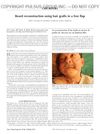 January 2011 in “Plastic Surgery”
 Hair grafts successfully restored a realistic beard and hid scars, satisfying the patient.
1 citations
,
January 2018 in “International Journal of Clinical and Developmental Anatomy” Dermoscopy improves accuracy in predicting treatment success for androgenetic alopecia with the Regenera® protocol.
 8 citations
,
September 2002 in “Genes to Cells”
8 citations
,
September 2002 in “Genes to Cells” Killing specific cells in hair follicles can lead to hair growth problems in mice.
18 citations
,
October 2015 in “Journal of the European Academy of Dermatology and Venereology” Topical eflornithine helps maintain hair reduction after IPL therapy in women with facial hirsutism.
 August 2025 in “Advanced Science”
 The corrections confirm the original findings on scarless hair follicle regeneration.
 2 citations
,
January 2012 in “Springer eBooks”
2 citations
,
January 2012 in “Springer eBooks” Hair restoration has greatly improved since 1992, moving from obvious grafts to unnoticeable hair transplants, thanks to better knowledge and dedication to excellence.
 January 2024 in “Journal of Cosmetic Dermatology”
 The 1565 nm non-ablative fractional laser is more effective and satisfying than 5% minoxidil for treating hair loss.
 April 2016 in “Proceedings of SPIE”
 UV-induced autofluorescence is effective for identifying different types of alopecia.