 56 citations
,
February 2010 in “PLOS ONE”
56 citations
,
February 2010 in “PLOS ONE” Blocking Wnt signaling in young mice causes thymus shrinkage and cell loss, but recovery is possible when the block is removed.
 17 citations
,
December 2013 in “PLoS ONE”
17 citations
,
December 2013 in “PLoS ONE” The postnatal thymus has cells like mesenchymal stem cells that can become different cell types and help maintain thymus structure.
Equine hoof progenitor cells can help develop therapies for hoof diseases like laminitis.
4 citations
,
February 2023 in “Stem Cell Research & Therapy” Mouse skin cells can become sperm-like cells in the lab.
 1 citations
,
March 2023 in “bioRxiv (Cold Spring Harbor Laboratory)”
1 citations
,
March 2023 in “bioRxiv (Cold Spring Harbor Laboratory)” Skin cell types develop when specific genes are turned on by removing certain chemical tags from DNA.
10 citations
,
August 2023 in “The EMBO Journal” Kdm6b is crucial for skin cell differentiation.
79 citations
,
June 1993 in “Molecular and Cellular Biology” The K5 promoter controls gene expression in skin cells, with specific DNA segments crucial for targeting and regulation.
133 citations
,
June 1993 in “Molecular and Cellular Biology” The human K5 promoter controls specific gene expression in skin cells, with key regulatory elements near the TATA box.
 November 2022 in “Journal of Investigative Dermatology”
 Scientists found a new type of skin cell that could help with skin repair and these cells work better with a certain protein.
13 citations
,
July 1994 in “PubMed” Keratins K6 and K16 are expressed more freely in regenerating mouse skin than K1 and K10.
12 citations
,
July 2019 in “Veterinary Dermatology” Nestin-expressing progenitor cells become outer root sheath keratinocytes.
14 citations
,
November 2022 in “Development” Controlling transposable elements is crucial for successful tissue regeneration.
 6 citations
,
April 2010 in “Cellular Reprogramming”
6 citations
,
April 2010 in “Cellular Reprogramming” Pig skin cells can turn into mesodermal cells but lose their ability to become neural cells.
 13 citations
,
February 2020 in “Cold Spring Harbor Perspectives in Biology”
13 citations
,
February 2020 in “Cold Spring Harbor Perspectives in Biology” New methods have helped find cells that create other cells in the body.
 November 2024 in “Experimental Dermatology”
 SKO-derived SKP-like cells may help with hair regeneration and skin restoration.
January 2012 in “Infoscience (Ecole Polytechnique Fédérale de Lausanne)” Human thymus has stem cells that can self-renew and maintain their identity.
July 2017 in “Cancer Research” Krt15+ cells in mice can resist radiation, regenerate tissue, and start tumors, suggesting new cancer treatment targets.
December 2025 in “The Journal of Cell Biology” Keratin 15 helps maintain skin cell growth and repair.
 254 citations
,
January 2012 in “Nature Reviews Molecular Cell Biology”
254 citations
,
January 2012 in “Nature Reviews Molecular Cell Biology” Stem cell offspring help control their parent stem cells, affecting tissue health, healing, and cancer.
10 citations
,
August 2020 in “Current protocols in stem cell biology” Scientists developed a way to create skin and hair cells from human stem cells, which could help treat burns and restore hair.
44 citations
,
September 2016 in “American Journal Of Pathology” Neural crest-derived progenitor cells in the cornea could help treat corneal issues without transplants.
 August 2015 in “MOJ proteomics & bioinformatics”
 ePUKs could be valuable for regenerative medicine due to their wound healing abilities.
26 citations
,
February 1998 in “DNA and Cell Biology” K6 gene expression can be controlled and manipulated in mice for studying skin disorders.
 6 citations
,
May 2021 in “Stem Cell Reviews and Reports”
6 citations
,
May 2021 in “Stem Cell Reviews and Reports” Newly found stem cells in horse hooves show promise for treating a hoof disease called laminitis.
4 citations
,
September 2024 in “Development” Researchers converted human embryonic stem cells into trophoblast stem cells using specific transcription factors.
August 2015 in “PubMed Central” Epithelial-derived Pop-Up Keratinocytes (ePUKs) may enhance wound healing in regenerative medicine.
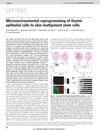 116 citations
,
August 2010 in “Nature”
116 citations
,
August 2010 in “Nature” Scientists turned rat thymus cells into stem cells that can help repair skin and hair.
36 citations
,
March 2011 in “Stem Cell Reviews and Reports”  January 2008 in “Yearbook of Dermatology and Dermatologic Surgery”
 One type of progenitor cell can maintain normal skin in mice.
 4 citations
,
January 2021 in “Journal of Clinical Medical Research”
4 citations
,
January 2021 in “Journal of Clinical Medical Research” c-Kit is important for heart regeneration and cancer development.