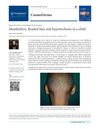
 January 2026 in “Cosmoderma”
 A 9-year-old girl has a rare hair disorder causing beaded, sparse hair.
 February 2020 in “Definitions”
 Mutations in the KRT16 gene can cause skin and nail disorders.
August 2012 in “Faculty Opinions – Post-Publication Peer Review of the Biomedical Literature” FGF18 controls hair cycle rest and growth phases.
 89 citations
,
September 2010 in “Annual Review of Genomics and Human Genetics”
89 citations
,
September 2010 in “Annual Review of Genomics and Human Genetics” The document concludes that understanding the genes and pathways involved in hair growth is crucial for developing treatments for hair diseases.
28 citations
,
December 1997 in “Journal of Biological Chemistry” A genetic mutation in the hHa1 gene creates a smaller, but still functional, hair protein without causing hair problems.
3 citations
,
October 1994 in “Journal of Dermatological Science” The new antibody, TYHF-1, specifically targets certain hair-related structures.
305 citations
,
December 2000 in “The EMBO Journal” Inhibiting Bmp signaling disrupts hair growth and differentiation.
 226 citations
,
January 2002 in “Biological and Pharmaceutical Bulletin”
226 citations
,
January 2002 in “Biological and Pharmaceutical Bulletin” A new method quickly extracts and identifies proteins from hair and other keratin sources.
 191 citations
,
November 1959 in “Annals of the New York Academy of Sciences”
191 citations
,
November 1959 in “Annals of the New York Academy of Sciences” Hair and wool have complex microscopic structures with microfibrils and varying cystine content.
 99 citations
,
January 2014 in “Nature communications”
99 citations
,
January 2014 in “Nature communications” Scientists created stem cells that can grow hair and skin.
77 citations
,
March 2000 in “Journal of Investigative Dermatology” The research identified six functional hair keratin genes and four pseudogenes, providing insights into hair formation and gene organization.
54 citations
,
October 2007 in “The FASEB Journal” Phospholipase C-δ1 is crucial for normal hair development.
39 citations
,
June 2012 in “Journal of Structural Biology” Disulfide bonds are crucial for hair structure during keratinization.
30 citations
,
October 2010 in “Biochemical and biophysical research communications” The Gsdma3 gene is essential for normal hair development in mice.
29 citations
,
April 2003 in “Experimental dermatology” Human hair follicles grown in vitro maintain normal keratin patterns and structure.
21 citations
,
May 2014 in “Toxicological Sciences” Toluene diisocyanate exposure can cause immune sensitization by interacting with proteins in hair follicles and sebaceous glands.
19 citations
,
July 1994 in “Journal of Dermatological Science” Human hair keratin genes are similar to mouse genes and are specifically expressed in hair follicles.
18 citations
,
January 2015 in “Experimental Dermatology” New mutations in KRT83 and KRT86 are linked to the hair disorder monilethrix.
 15 citations
,
October 2022 in “Allergy”
15 citations
,
October 2022 in “Allergy” Dupilumab treatment reduces Th2-related markers and helps hair growth in alopecia areata, showing Th2's role in the condition.
14 citations
,
September 2016 in “Journal of Photochemistry and Photobiology B Biology” UV exposure damages hair, increasing thiols and altering protein structure.
13 citations
,
March 2000 in “Veterinary Dermatology” Dogs have a skin condition like human pseudopelade, causing hair loss that doesn't improve with treatment.
6 citations
,
January 2011 in “European Journal of Dermatology” It's important to consider genetic hair disorders when diagnosing hair loss.
 5 citations
,
February 2009 in “International Journal of Cosmetic Science”
5 citations
,
February 2009 in “International Journal of Cosmetic Science” Coenzyme Q10 helps reduce aging in human hair.
5 citations
,
April 2019 in “Journal of Investigative Dermatology” Oral JAK inhibitors improved alopecia areata by modulating immune responses and boosting hair growth.
2 citations
,
November 2006 in “Pump Industry Analyst” Pilomatricomas don't follow the usual hair follicle cell differentiation process.
1 citations
,
April 2008 in “Pigment Cell & Melanoma Research” Foxn1 is essential for hair pigmentation by directing pigment transfer to hair cells.

Alopecia areata patients show increased inflammation and OX40 activation, suggesting a new treatment target.
May 2020 in “International journal of dermatology and venereology” Hair matrix cysts are rare skin nodules with unique features, often needing surgical removal.
 April 2017 in “Journal of Investigative Dermatology”
 The protein CTCF is essential for skin development, maintaining hair follicles, and preventing inflammation.
April 2012 in “J. Willard Marriott Library” Cannabinoids like THC and THCA get into hair through skin oils, not hair color.