 3 citations
,
May 2022 in “The journal of investigative dermatology/Journal of investigative dermatology”
3 citations
,
May 2022 in “The journal of investigative dermatology/Journal of investigative dermatology” Skin lesions in Carney Complex are caused by a gene change in some skin cells that leads to increased pigmentation and may lead to tumors.
4 citations
,
October 1993 in “Journal of the American Academy of Dermatology” Azelaic acid's effectiveness in treating certain skin conditions needs more research.
 34 citations
,
October 1982 in “Journal of applied polymer science”
34 citations
,
October 1982 in “Journal of applied polymer science” Moisture content significantly affects how human hair breaks.
FGF9 helps hair follicles grow in small-tailed Han sheep by affecting cell growth and certain signaling pathways.
 September 2022 in “JAAD case reports”
 The man has a genetic skin condition called pachyonychia congenita.
 August 2023 in “Research Square (Research Square)”
 Two microRNAs affect hair follicle development in sheep by targeting specific genes.
 1 citations
,
November 2022 in “DOAJ (DOAJ: Directory of Open Access Journals)”
1 citations
,
November 2022 in “DOAJ (DOAJ: Directory of Open Access Journals)” Male and female human hairs have different microscopic structures that can help in forensic analysis.
6 citations
,
May 2023 in “International journal of molecular sciences” Collagen-enhanced mesenchymal stem cells significantly improve skin wound healing.
April 2020 in “The FASEB journal” Poncirin is a promising inhibitor of Janus Kinase 3, potentially better than tofacitinib.
 2 citations
,
September 2021 in “Cutis”
2 citations
,
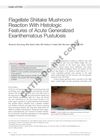
September 2021 in “Cutis” Eating shiitake mushrooms caused a man to develop a rash similar to a skin condition known as AGEP.
December 2012 in “Reactions weekly” 1 citations
,
September 2021 in “Rossijskij žurnal kožnyh i veneričeskih boleznej” Osteoma cutis is a rare, benign skin condition where bone forms in the skin.
May 2023 in “Pharmaceuticals” Three specific mutations in the LIPH gene can cause hair loss by damaging the protein's structure and function.

Psoriasis is a common, genetically influenced skin disease worsened by stress and lifestyle, but targeted treatments are promising.
 February 2021 in “Indonesian Journal of Perinatology”
 Most pregnancies with SLE resulted in intrauterine growth restriction (IUGR).
 February 2025 in “Indian Dermatology Online Journal”
 Pincer nails are rare in lupus patients and may be managed conservatively.
 3 citations
,
July 2021 in “Cutis”
3 citations
,
July 2021 in “Cutis” Panniculitis in dermatomyositis is rare, more common in women, and may persist despite treatment.
 January 2025 in “Majmaah Journal of Health Sciences”
 Nearly 70% of postmenopausal women in Saudi Arabia experience hair loss, often linked to early menopause, chronic diseases, family history, and stress.
10 citations
,
January 1995 in “Dermatology” Dermatologists should consider congenital syndromes like TRPS in young adults with early hair loss.
11 citations
,
October 2004 in “Journal of Experimental Biology” Billingham and Medawar's work laid the foundation for modern transplantation by showing how to prevent graft rejection.
January 2020 in “Stem Cells” May 2025 in “Journal of the European Academy of Dermatology and Venereology” February 2026 in “Figshare”  1 citations
,
June 2024 in “Cosmoderma”
1 citations
,
June 2024 in “Cosmoderma” Most patients with alopecia areata in Syria are young adult males, often with patchy scalp hair loss.
April 2024 in “Journal of the European Academy of Dermatology and Venereology”  January 2026 in “Acta Dermatovenerologica Alpina Pannonica et Adriatica”
 Accurate diagnosis is crucial for effectively treating severe alopecia and related symptoms.
January 2026 in “DR-NTU (Nanyang Technological University)” Human hair melanosomes can be used to create effective, eco-friendly sunscreen.
January 2026 in “EJC Skin Cancer” The serum effectively improves hair growth and is well-tolerated for post-cancer hair loss.

3D bioprinting shows great promise for improving wound healing and skin restoration.
 April 2026 in “Nanomaterials”
 Plant-derived vesicles from Ayurvedic plants may improve treatment delivery for hair growth and other conditions.