3 citations
,
May 2023 in “Pediatric Dermatology” A 9-year-old boy had a rare scalp condition usually seen in young men.
36 citations
,
July 1996 in “The journal of investigative dermatology/Journal of investigative dermatology” Mice with the 'lanceolate hair' mutation have abnormal hair and skin similar to human Netherton's syndrome.
January 2024 in “Veterinary Dermatology” A rare skin condition was found in a Labrador retriever outside North America.
August 1994 in “American Journal of Veterinary Research” Monoclonal antibody B72.3 selectively reacts with certain dog tissues, mainly in the gastrointestinal and respiratory tracts.
1 citations
,
August 2021 in “Journal of Investigative Dermatology” ASLAN004 was safe and well-tolerated, supporting further development for treating certain diseases.
The chapter concludes that certain skin diseases in bovines cause symmetrical, non-painful lesions and temporary hair loss due to stress.
 1 citations
,
January 2009 in “Elsevier eBooks”
1 citations
,
January 2009 in “Elsevier eBooks” Combining proper shaving, topical treatments, and laser therapy effectively reduces Pseudofolliculitis Barbae.
 February 2013 in “Journal of the American Academy of Dermatology”
 A woman's hair loss looked like a different condition due to her hairstyle, and treatment stopped further hair loss but didn't regrow hair.
1 citations
,
June 2011 in “Journal of Dermatological Case Reports” Shaving and applying erythromycin cream and clotrimazole powder effectively treated trichomycosis axillaris.
 October 2021 in “VITEK Bidang Kedokteran Hewan”
 The goat had enteritis and was treated with fluids, vitamins, antibiotics, and deworming medication.
October 2023 in “IP Indian Journal of Clinical and Experimental Dermatology” The luliconazole shampoo effectively reduces symptoms of seborrheic dermatitis and is well-tolerated.
June 2025 in “Formosa Journal of Sustainable Research” Mangkokan leaf extract can fight bacteria and may help prevent hair loss and treat infections.
 August 2023 in “Gastroenterology”
 A 78-year-old man with Cronkhite-Canada syndrome improved significantly after treatment and remains symptom-free.
January 2002 in “Agritrop (Cirad)” The hr gene is linked to hair loss in Valle del Belice sheep.
6 citations
,
March 2023 in “Materials” The GNP crosslinked scaffold with antibacterial coating is effective for rapid wound healing and infection prevention.
 3 citations
,
April 2022 in “Microorganisms”
3 citations
,
April 2022 in “Microorganisms” People with severe hair loss (Alopecia Areata) have different scalp bacteria than healthy people, which might help predict the condition's progress.
 19 citations
,
May 2007 in “Dermatologic therapy”
19 citations
,
May 2007 in “Dermatologic therapy” The document concludes that various treatments, including laser therapy, are effective for managing pseudofolliculitis barbae, especially in darker skin types.
1 citations
,
July 2022 in “Indian Journal of Dermatology” Bullous pyoderma gangrenosum can develop on cesarean scars and may require steroids for treatment.
16 citations
,
August 2017 in “Lupus” Chronic cutaneous lupus erythematosus should be considered when acne treatments don't work.
 January 2026 in “Frontiers in Pharmacology”
 Wedelolactone may help treat inflammation, infections, cancer, bone loss, and organ damage.
71 citations
,
June 1993 in “Journal of Investigative Dermatology”  2 citations
,
August 2018 in “Advances in Animal and Veterinary Sciences”
2 citations
,
August 2018 in “Advances in Animal and Veterinary Sciences” Camels in South Iraq were cured of skin infections with antibiotics and supplements.
 100 citations
,
March 2006 in “Journal of biological chemistry/The Journal of biological chemistry”
100 citations
,
March 2006 in “Journal of biological chemistry/The Journal of biological chemistry” Cystatin M/E strongly inhibits cathepsin V and cathepsin L, important for skin formation.
10 citations
,
April 2017 in “Journal of Investigative Dermatology” The gut microbiome affects the development of alopecia areata.
5 citations
,
April 2024 in “Heliyon” Wild and cultivated Saccharina latissima differ in chemical makeup and color due to environmental factors.
 January 2000 in “Time to knit”
 SFE is a better extraction method, and the HPTLC method is effective for analyzing wedelolactone in E. alba.
January 2022 in “Mammalian Genome” The wavy coat in NCT mice is caused by multiple genes, including a mutation in the Prss53 gene.
 October 2023 in “International Journal of Science and Research (IJSR)”
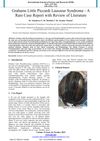
 Early diagnosis of GLPLS is crucial to prevent complications, but scarring alopecia is irreversible.
 September 2022 in “Tropical grasslands-Forrajes tropicales”
 Leucaena feed helps farmers grow larger cattle herds and is good for fattening, but its safety for breeding cows is unclear.
1 citations
,
October 2010 in “2010 3rd International Conference on Biomedical Engineering and Informatics” The LEF-1 gene in cashmere goats was successfully cloned and analyzed, showing potential for improving cashmere production.