November 2006 in “評価・診断に関するシンポジウム講演論文集” KSR1 is crucial for certain skin tumor formation and could be a cancer therapy target.
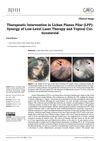 January 2024 in “Brazilian Journal of Hair Health”
 Combining low-level laser therapy with topical corticosteroids effectively improved Lichen Planopilaris symptoms.
April 2019 in “Journal of Investigative Dermatology” Blocking LFA-1 prevents hair loss in mice.
CCC1 is crucial for pH balance in plant cells, affecting growth and stress tolerance.
 January 1994 in “Nippon Ronen Igakkai Zasshi Japanese Journal of Geriatrics”
 Both VEPA and ML-Y1 treatments are not effective enough for elderly non-Hodgkin's lymphoma patients.
 1 citations
,
October 2023 in “Skin research and technology”
1 citations
,
October 2023 in “Skin research and technology” LC-OCT is an effective new method for diagnosing classic lichen planopilaris.
March 2017 in “Zenodo (CERN European Organization for Nuclear Research)” L. plantarum MTCC 1325 may help improve memory and cognitive functions in Alzheimer's.
15 citations
,
June 2023 in “Journal of Microbiology and Biotechnology” Loliolide from Scenedesmus deserticola may help with anti-aging.
July 2024 in “Journal of Investigative Dermatology” A KLK5 inhibitor effectively improved skin symptoms in a mouse model of Netherton Syndrome.
December 2015 in “OPAL (Open@LaTrobe) (La Trobe University)” QLT0267 stops hair follicle cell growth and movement.
3 citations
,
June 2021 in “Frontiers in genetics” The protein STAT3 slows down cell growth by blocking the FST gene, which affects hair development in sheep.
 July 2022 in “The journal of investigative dermatology/Journal of investigative dermatology”
 A patient with a PLEC mutation has epidermolysis bullosa, muscular dystrophy, and myasthenia gravis, which improved with steroid treatment.
Par3–mInsc and Gαi3 work together to ensure proper cell division orientation in skin development.
 1 citations
,
July 2025 in “Scientific Reports”
1 citations
,
July 2025 in “Scientific Reports” Diagonal earlobe crease and lipoprotein(a) together help diagnose coronary heart disease.
 39 citations
,
March 2008 in “Journal of biological chemistry/The Journal of biological chemistry”
39 citations
,
March 2008 in “Journal of biological chemistry/The Journal of biological chemistry” GLI2 increases follistatin production in human skin cells.
July 2024 in “Journal of Investigative Dermatology” PP405 may help hair growth by activating hair follicle stem cells.
February 2026 in “Small Ruminant Research” The IRF2BP2 gene affects sheep fleece quality by influencing fiber traits.
18 citations
,
July 2016 in “Genetica” BMP4 gene is crucial for hair follicle development in Liaoning cashmere goats.
 260 citations
,
July 2010 in “Cell”
260 citations
,
July 2010 in “Cell” Mutations in the SRD5A3 gene cause a new type of glycosylation disorder by blocking the production of a molecule necessary for protein glycosylation.
9 citations
,
June 2019 in “Cell cycle/Cell cycle (Georgetown, Tex. Online)” A specific RNA increases hair stem cell growth and skin healing by affecting a protein through interaction with a microRNA.
 102 citations
,
August 2008 in “Genes & Development”
102 citations
,
August 2008 in “Genes & Development” Laminin-511 is crucial for early hair growth and maintaining important hair development signals.
 January 2022 in “bioRxiv (Cold Spring Harbor Laboratory)”
 The gp130 receptor helps in tissue regeneration and disease progression, and manipulating it could improve healing and prevent disease.
 6 citations
,
May 1986 in “Cancer Chemotherapy and Pharmacology”
6 citations
,
May 1986 in “Cancer Chemotherapy and Pharmacology” The drug TGU was ineffective against small cell lung cancer and caused significant bone marrow suppression.
 35 citations
,
January 2013 in “The Journal of experimental medicine/The journal of experimental medicine”
35 citations
,
January 2013 in “The Journal of experimental medicine/The journal of experimental medicine” CD98hc's role in skin health decreases with age.
 2 citations
,
September 2022
2 citations
,
September 2022 The PER3 rs772027021 SNP may cause mild skin pigmentation changes in a new subtype of dyschromatosis universalis hereditaria.
July 2025 in “Frontiers in Medicine” Mutations in the LIPH gene cause woolly hair in a child.
5 citations
,
May 2024 in “Developmental Cell” Lower GATA3 levels in mice help hair regrow by changing certain immune cells.
IL-18 signaling helps mature Tregs move into the thymus.
1 citations
,
June 2025 in “Fermentation” Lactic acid bacteria fermentation boosts the health benefits of Radix Angelica gigas.
 6 citations
,
July 2021 in “Microbial biotechnology”
6 citations
,
July 2021 in “Microbial biotechnology” The combined treatment with engineered bacteria and yellow LED light improved wound healing in mice.