660 citations
,
December 2011 in “Cell” Different hair follicles in the skin are innervated by unique combinations of mechanosensory neurons, crucial for touch sensation.
January 2000 in “The Mouseion at the JAXlibrary (Jackson Laboratory)” The lanceolate hair-J mutation in mice helps understand human hair disorders like Netherton's syndrome.
 42 citations
,
January 2009 in “Colloids and Surfaces B: Biointerfaces”
42 citations
,
January 2009 in “Colloids and Surfaces B: Biointerfaces” A certain surfactant sticks to human hair, making it change from water-repelling to water-attracting, which could help in hair conditioning.
1 citations
,
January 2010 in “Biological and medical physics series” Human hair's structure and properties were studied using advanced microscopes and mechanical tests.
 87 citations
,
July 2009 in “The journal of investigative dermatology/Journal of investigative dermatology”
87 citations
,
July 2009 in “The journal of investigative dermatology/Journal of investigative dermatology” Human beard hair medulla contains a unique and complex mix of keratins not found in other human tissues.
January 2009 in “Chinese journal of Clinical Medicine” 81 citations
,
December 2007 in “Acta materialia” AFM helped show how hair changes under tension and the effects of damage and conditioner.
Researchers developed a new model for more realistic computer graphics of hair by considering how light scatters on hair fibers.
122 citations
,
January 2006 in “Molecular & Cellular Proteomics” Human hair contains many proteins, with some being highly abundant and modified.
42 citations
,
September 1985 in “British Journal of Dermatology” Trichothiodystrophy causes abnormal protein deposits and distortion in hair follicles.
125 citations
,
February 1971 in “Biochemistry” Specific cross-linkages help make hair proteins stable and strong.
 1 citations
,
December 2024 in “Methods in molecular biology”
1 citations
,
December 2024 in “Methods in molecular biology” Hair proteins are complex and provide valuable genetic and biological information.
4 citations
,
April 1989 in “The Journal of Dermatology” Trichohyalin granules help inner root sheath cells in hair follicles harden by integrating with keratin filaments.
1 citations
,
November 2023 in “Cosmetics” Surfactants damage hair, but sealing the cuticle can prevent this.
88 citations
,
July 1958 in “Nature” Citrulline was found in hair follicle proteins for the first time.
 1 citations
,
June 2023 in “Journal of applied crystallography”
1 citations
,
June 2023 in “Journal of applied crystallography” The technique showed that human hair has two main parts, with 68% being rigid and the rest flexible, and water swelling affects its structure.
10 citations
,
January 2010 in “International journal of trichology” Keratin-associated proteins are part of the developing hair fiber cuticle.
7 citations
,
April 1996 in “British Journal of Dermatology” Hair structural proteins are synthesized sequentially in specific cells, offering a new way to study hair proteins and defects.
Hair dysplasias involve various hair disorders causing fragility, breakage, and poor hair adhesion.
 21 citations
,
July 2010 in “International Journal of Cosmetic Science”
21 citations
,
July 2010 in “International Journal of Cosmetic Science” Older people's hair becomes less shiny because it gets more uneven and curved.
 4 citations
,
January 2017 in “Annals of Dermatology”
4 citations
,
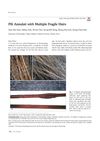
January 2017 in “Annals of Dermatology” Frequent hairdryer use may worsen hair fragility in people with Pili Annulati.
43 citations
,
July 2005 in “Journal of Chromatography B” A new method accurately measures hair lipids, revealing individual differences.
4 citations
,
December 1989 in “The Journal of Dermatology” Human hair proteins have similar cysteine and glycine levels to skin proteins.
51 citations
,
September 2012 in “Biomacromolecules” Disulfide bonds make keratin in hair stronger and tougher.
 January 2013 in “Sen'i Gakkaishi”
 Microfibrils are key for permanent waves, and hydrolyzed keratin improves wave formation and hair condition.
11 citations
,
January 1981 in “Cells Tissues Organs” Human hair cuticle has five cell layers with specific junctions and granules.
 October 2014 in “Springer eBooks”
 Rabbit hair fibers are similar to wool and have a hollow center like feathers.
40 citations
,
February 1994 in “Journal of Investigative Dermatology” 2 citations
,
August 2019 in “Electronics and Communications in Japan” The device mimics human hair follicles and detects tiny forces and moments with high sensitivity.