4 citations
,
December 2004 A new method accurately predicts the flight path of unguided projectiles.
5 citations
,
January 2012 in “Indian Journal of Dermatology Venereology and Leprology” Werner's syndrome causes early aging and increases cancer risk, requiring early diagnosis and symptom management.
October 2021 in “Journal of Investigative Dermatology” Blocking IL-12 can help treat alopecia areata by preventing hair follicle immune issues.
January 2026 in “China CDC Weekly” Large language models can accurately identify monkeypox from medical records.
3 citations
,
October 2021 in “The Application of Clinical Genetics” Certain gene changes in osteopontin are linked to higher risk of atopic dermatitis and asthma.
3 citations
,
August 2013 in “Journal of the American Academy of Dermatology” A new method quickly detects hair changes from EGFR inhibitors using a microscope.
October 2018 in “The American journal of gastroenterology” Pembrolizumab can cause serious liver issues, requiring close monitoring and early treatment.
April 2005 in “Journal of Investigative Dermatology” Vitamin D helps protect skin, PSORS1 gene's risk interval for psoriasis is expanded, hair follicles can be generated from mouse cells, and interferon-γ may cause pigmented skin lesions.
 3 citations
,
October 2023 in “Frontiers in physiology”
3 citations
,
October 2023 in “Frontiers in physiology” ceRNA networks offer potential treatments for skin aging and wound healing.
 January 2025 in “UiTM Institutional Repositories (Universiti Teknologi MARA)”
 Christia vespertilionis extract may help fight breast cancer cells.
October 2023 in “Open Repository of the University of Porto (University of Porto)” 1 citations
,
January 2010 in “Institutional Repository of Leibniz Universität Hannover (Leibniz Universität Hannover)” 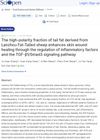 June 2026 in “Food Science and Human Wellness”
 Tail fat from Lanzhou Fat-Tailed sheep helps heal skin wounds by reducing inflammation and promoting tissue repair.
 6 citations
,
January 2020 in “Czech Journal of Animal Science”
6 citations
,
January 2020 in “Czech Journal of Animal Science” The FAT1 gene and its variations can help improve wool quality in Chinese Merino sheep through selective breeding.
9 citations
,
October 2025 in “MedComm” PROTACs offer new ways to treat hard-to-target diseases, with promising drugs for cancer in advanced trials.

Correcting EDA fibronectin organization and YAP translocation can improve wound healing in fibrotic conditions.
 44 citations
,
April 2006 in “Expert opinion on drug safety”
44 citations
,
April 2006 in “Expert opinion on drug safety” Gefitinib can cause skin problems, diarrhea, and nausea, but rarely causes severe lung disease or hair loss.
May 2022 in “Reactions Weekly” April 2023 in “Journal of The American Academy of Dermatology” Use a 3-mm spot size and specific protective eyewear for safer and more effective laser treatment of facial veins.
8 citations
,
September 2023 in “International Journal of Nanomedicine” A new lab-grown lung model helps study adenoviruses and test antiviral drugs.
 September 2022 in “XXXIX Congresso Brasileiro de Reumatologia”
 Tofacitinib may effectively treat skin symptoms in difficult cases of dermatomyositis.
9 citations
,
October 2017 in “Frontiers in plant science” The peach gene CTG134 helps control the interaction between auxin and ethylene, which could lead to new agricultural chemicals.
4 citations
,
May 2023 in “Cells” Baricitinib and its combination with lonafarnib improve fat cell formation in certain genetic disorders.
July 2024 in “Journal of Investigative Dermatology” ATR04-484 ointment shows promise for treating skin issues from cancer therapies.
9 citations
,
April 2024 in “Advanced Drug Delivery Reviews” March 1956 in “Institutional Repositories DataBase (IRDB)” July 2022 in “Zenodo (CERN European Organization for Nuclear Research)” 4 citations
,
July 2024 in “Skin Research and Technology”  1 citations
,
April 2017 in “Journal of Investigative Dermatology”
1 citations
,
April 2017 in “Journal of Investigative Dermatology” Using a teletriage system greatly increased access to skin care for uninsured Latino immigrants at a clinic.
 2 citations
,
August 2019 in “BMC Complementary and Alternative Medicine”
2 citations
,
August 2019 in “BMC Complementary and Alternative Medicine” Asiasari radix extract may be a potential treatment for melanoma because it selectively triggers cell death in melanoma cells by affecting p53 regulation.