July 2025 in “Journal of Investigative Dermatology” Discoid lupus erythematosus involves immune activation and fibrosis around hair follicles, with shared pathways across humans, dogs, and mice, suggesting potential treatments for both humans and animals.
 July 2025 in “Clinical Dermatology Review”
 Azathioprine can cause unexpected hair loss and severe bone marrow issues, so careful monitoring is needed.
16 citations
,
August 2023 in “JAAD Case Reports” JAK inhibitors, like ruxolitinib, may effectively treat frontal fibrosing alopecia.
10 citations
,
January 2021 in “Annals of dermatology/Annals of Dermatology” Nivolumab can cause hair loss as a rare side effect.
 May 2025 in “Journal of Inflammation Research”
 Natural killer and CD8+ T cells play a key role in hair loss in androgenetic alopecia.
 2 citations
,
July 2023 in “JAAD Case Reports”
2 citations
,
July 2023 in “JAAD Case Reports” A woman with a type of hair loss saw hair regrowth after two months of taking baricitinib.
38 citations
,
January 2017 in “PPAR Research” PPAR-γ helps control skin oil glands and inflammation, and its disruption can cause hair loss diseases.
9 citations
,
January 2014 in “World journal of clinical cases” Neomycin is a common cause of follicular contact dermatitis, which is treated by avoiding the allergen and using creams.
1 citations
,
August 2024 in “JAAD Case Reports” Tick bites can cause hair loss similar to alopecia areata, and baricitinib may help regrow hair.
January 2020 in “JAAD case reports” Hair loss condition FFA was seen before the appearance of skin depigmentation vitiligo in a patient.
January 2016 in “Indian dermatology online journal” The patient has frontal fibrosing alopecia (FFA).
January 2016 in “Indian dermatology online journal” Frontal fibrosing alopecia causes hair loss at the front hairline, and no effective treatment exists.
January 2026 in “Journal of Investigative Dermatology” Special cells can help regrow hair in alopecia areata.
5 citations
,
December 2023 in “Clinical Case Reports” Adalimumab effectively stabilized severe folliculitis decalvans, preventing further hair loss and inflammation.
December 2014 in “Actas dermo-sifiliográficas/Actas dermo-sifiliográficas” Hair removal with intense pulsed light can cause rare skin lesions that are hard to fully treat.

Accurate diagnosis and new therapies are crucial for effectively treating certain types of hair loss.
13 citations
,
July 2020 in “Anais brasileiros de dermatologia/Anais Brasileiros de Dermatologia” Trichoscopy can help diagnose and monitor the progression of dissecting cellulitis.
 2 citations
,
August 2022 in “Clinical Case Reports”
2 citations
,
August 2022 in “Clinical Case Reports” A 17-year-old girl had severe, on-and-off hair loss, likely due to COVID-19. She was treated with Vitamin D3, biotin, and other supplements, and saw some improvement within a month.
June 2025 in “American Journal of Dermatopathology” Granulomatous Alopecia Areata is rare and may be caused by hair antigens or follicle destruction.
17 citations
,
October 2024 in “Journal of the American Academy of Dermatology” Brepocitinib effectively reduces inflammation and improves symptoms in cicatricial alopecia with good safety.
 38 citations
,
January 2019 in “International Journal of Women's Dermatology”
38 citations
,
January 2019 in “International Journal of Women's Dermatology” The document concluded that more research is needed to find the best treatment for Frontal fibrosing alopecia.
2 citations
,
November 2023 in “Indian Dermatology Online Journal” A 4-year-old girl with a rare lupus condition was successfully treated with oral corticosteroids, leading to full recovery and hair regrowth.
1 citations
,
October 2024 in “JAAD Case Reports” Baricitinib effectively treated hair loss and inflammation in a patient with alopecia areata and lichen planopilaris.
July 2026 in “Journal of Dermatological Treatment” Excimer laser therapy may help improve scarring alopecia symptoms and hair appearance.
 March 2025 in “International Journal of Trichology”
 FAPD in children may not depend on androgens and should be treated with anti-inflammatory measures and minoxidil.
 January 2025 in “bioRxiv (Cold Spring Harbor Laboratory)”
 Potential therapeutic targets for scarring hair loss are identified.
 August 2024 in “Journal of Clinical Medicine”
 Pruritus is common in LPP and FFA, worsened by heat and stress, and relieved by cold, affecting quality of life.
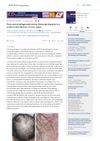 March 2023 in “Journal of Cosmetic Dermatology”
 A woman's progressive hair loss was correctly diagnosed as a rare condition called fibrosing alopecia in a pattern distribution after initially being mistaken for a more common type.
 December 2020 in “Galen Medical Journal”
 People with Alopecia Areata and Androgenic Alopecia have more mast cells in their scalp than healthy individuals, especially those with Alopecia Areata.
7 citations
,
May 2021 in “Clinical Case Reports” Alopecic and aseptic nodules of the scalp are rare, treatable, and often resolve with doxycycline or on their own.