 3 citations
,
January 2019 in “Journal of Dermatology”
3 citations
,
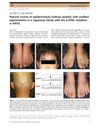
January 2019 in “Journal of Dermatology” The p.P25L mutation in the KRT5 gene causes a rare skin condition that worsens over time and may lead to hair loss starting in young adulthood.
4 citations
,
March 2024 in “Journal of Investigative Dermatology” SPRY1 deficiency in skin cells causes stem cells to move to the skin surface, leading to increased pigmentation.
20 citations
,
October 1995 in “Biochimica et Biophysica Acta (BBA) - Gene Structure and Expression” hHb1, hHb3, and hHb6 mRNAs start expressing at the same time in hair follicles.
April 2012 in “Cancer Research” Bone marrow-derived cells can lead to skin inflammation and tumors in mice.
 November 2023 in “Advanced Science”
 A specific hair protein variant increases the spread of breast cancer and is linked to worse survival rates.
47 citations
,
September 2004 in “Journal of Biological Chemistry” Hoxc13 regulates specific hair protein genes on mouse chromosome 16.
 9 citations
,
February 2005 in “The journal of investigative dermatology/Journal of investigative dermatology”
9 citations
,
February 2005 in “The journal of investigative dermatology/Journal of investigative dermatology” The document concludes that the human keratin gene cluster is complex, with a need for updated naming to reflect over 50 functional genes important for hair and skin biology.
2 citations
,
June 2013 in “Journal of Clinical Pathology” The LMNA mutation affects skin structure even in asymptomatic carriers.
March 2007 in “Journal of Cell Science” K10 may not prevent tumors as previously thought and might increase benign tumor risk.
 8 citations
,
January 2011 in “Experimental and Therapeutic Medicine”
8 citations
,
January 2011 in “Experimental and Therapeutic Medicine” Stromal cells in melanoma promote tumor growth and spread.
August 2025 in “BMC Research Notes” iPSC lines from different tissues share a common miRNA profile, supporting their pluripotent nature.
44 citations
,
December 2005 in “Journal of Investigative Dermatology” Certain genetic markers, especially the MICA gene, are linked to alopecia areata.
41 citations
,
December 1988 in “Journal of Investigative Dermatology” 10 citations
,
January 2012 in “Journal of Oncology” The surrounding tissue plays a crucial role in the growth and spread of skin cancer.
August 2005 in “The Journal of Cell Biology” Sgk3 kinase is essential for normal hair growth in mice.
8 citations
,
December 2003 in “Experimental Dermatology” Altering the keratin 17 gene in mice hair follicles caused temporary hair issues, but changes were minimal and short-lived.
 11 citations
,
September 2012 in “The journal of investigative dermatology/Journal of investigative dermatology”
11 citations
,
September 2012 in “The journal of investigative dermatology/Journal of investigative dermatology” A mutation in the KRT71 gene causes a hair disorder by disrupting hair follicle structure and texture.
8 citations
,
January 2017 in “Korean Journal of Physiology and Pharmacology” Pimecrolimus boosts melanin production and movement of skin pigment cells.
 3 citations
,
December 2020 in “Scientific reports”
3 citations
,
December 2020 in “Scientific reports” Mitochondrial problems in tooth cells lead to bad enamel and dentin development in mice.
6 citations
,
June 2016 in “The anatomical record” Dogs have varying numbers of touch-sensitive Merkel cells in different skin areas, with most in the oral mucosa and facial skin, unrelated to age, sex, breed, or color.
4 citations
,
October 2021 in “Journal of Clinical Medicine” Carriers of a specific gene mutation have subtle skin changes without visible symptoms.
324 citations
,
May 2002 in “Oncogene”  17 citations
,
November 2017 in “PLoS ONE”
17 citations
,
November 2017 in “PLoS ONE” Transplanted bone marrow cells actively move, form clusters, and grow after transplantation.
 June 2025 in “Animal Bioscience”
 miRNA-24 affects goat coat color by controlling proteins involved in pigment production.
March 2009 in “Chinese Journal of Dermatology” Melanocytes in the outer root sheath are likely stem cells that grow fast but stay immature.
2 citations
,
October 2023 in “PubMed” Scientists created a cell model to study and find treatments for a skin disease called RDEB.
387 citations
,
November 2003 in “Journal of Investigative Dermatology” The K15 promoter effectively targets stem cells in the hair follicle bulge.
25 citations
,
April 1985 in “Journal of Investigative Dermatology” 47 citations
,
September 2012 in “Human molecular genetics online/Human molecular genetics” Folliculin deficiency causes problems with cell division and positioning due to disrupted RhoA signaling and interaction with p0071.
 56 citations
,
February 2012 in “Cell Cycle”
56 citations
,
February 2012 in “Cell Cycle” MicroRNAs are crucial for controlling skin development and healing by regulating genes.