 January 1995 in “Equilibrium Research”
 Birds can regenerate inner ear hair cells from supporting cells, and mammals show potential for similar regeneration.
13 citations
,
April 1964 in “PubMed” Phosphatide distribution in mouse skin remains consistent in both normal and cancerous growths.
16 citations
,
February 2013 in “Molecular Medicine Reports” CD34+ cells from fat tissue help form hair follicles and blood vessels in skin.
 36 citations
,
March 2011 in “Nature Communications”
36 citations
,
March 2011 in “Nature Communications” Cells from a skin condition can create new hair follicles and similar growths in mice, and a specific treatment can reduce these effects.
 12 citations
,
January 2021 in “Cell Transplantation”
12 citations
,
January 2021 in “Cell Transplantation” Baby teeth stem cells can help grow hair in mice.
 1 citations
,
December 2022 in “The journal of investigative dermatology/Journal of investigative dermatology”
1 citations
,
December 2022 in “The journal of investigative dermatology/Journal of investigative dermatology” Choosing the right method to separate skin layers is key for good skin cell research.
 19 citations
,
July 1993 in “Journal of Applied Toxicology”
19 citations
,
July 1993 in “Journal of Applied Toxicology” Different oil products cause varying levels of skin irritation in mice, which could potentially lead to tumors.
 March 2025 in “International Journal of Molecular Sciences”
 The study created a mouse model to better understand hair follicle stem cells' role in hair growth and repair.
35 citations
,
December 2008 in “PubMed” Trichilemmoma, BCC, and SCC tumors have different stem cell marker expressions.
 65 citations
,
June 2003 in “EMBO journal”
65 citations
,
June 2003 in “EMBO journal” Noggin overexpression delays eyelid opening by affecting cell death and skin cell development.
 59 citations
,
September 2008 in “Experimental dermatology”
59 citations
,
September 2008 in “Experimental dermatology” Both mouse and rat models are effective for testing alopecia areata treatments.
 23 citations
,
September 2017 in “The journal of investigative dermatology/Journal of investigative dermatology”
23 citations
,
September 2017 in “The journal of investigative dermatology/Journal of investigative dermatology” NF-κB is crucial for different stages and types of hair growth in mice.
 21 citations
,
June 2016 in “Genesis”
21 citations
,
June 2016 in “Genesis” Researchers identified specific genes that are important for mouse skin cell development and healing.
 7 citations
,
March 2020 in “PloS one”
7 citations
,
March 2020 in “PloS one” α-parvin is necessary for skin and hair growth and for the correct orientation of skin cells.
1 citations
,
April 2023 in “International journal of molecular sciences” Certain skin proteins can form anchoring structures without the protein AMACO.
 October 2025 in “Records of Natural Products”
 Kaempferol promotes hair growth and could be a natural treatment for hair loss.
 April 2019 in “Journal of Investigative Dermatology”
 BRG1 is essential for skin cells to move and heal wounds properly.
 September 2017 in “Journal of Investigative Dermatology”
 The Siah1 and Siah2 genes are active in mouse skin development and hair growth, especially right after birth.
March 2011 in “Open Archive (Karolinska Institutet)” The mouse model showed defects in adult stem cell maintenance related to Hutchinson-Gilford progeria syndrome.
 13 citations
,
June 2018 in “Journal of histochemistry and cytochemistry/The journal of histochemistry and cytochemistry”
13 citations
,
June 2018 in “Journal of histochemistry and cytochemistry/The journal of histochemistry and cytochemistry” Laminin-511 may contribute to psoriasis by affecting skin cell growth and survival.
 829 citations
,
May 2007 in “Nature”
829 citations
,
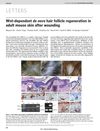
May 2007 in “Nature” Hair follicles can regrow in wounded adult mouse skin using a process like embryo development.
 236 citations
,
January 1951 in “Physiological zoology”
236 citations
,
January 1951 in “Physiological zoology” Hair growth and pigmentation in mice involve specific stages crucial for research.
 121 citations
,
March 1989 in “Journal of Investigative Dermatology”
121 citations
,
March 1989 in “Journal of Investigative Dermatology” Minoxidil can help grow hair in mice by making cells grow and improving hair quality. More research needed.
81 citations
,
September 2009 in “Birth defects research” Different body areas in mice produce different hair types due to interactions between skin layers.
 18 citations
,
January 2018 in “International journal of medical sciences”
18 citations
,
January 2018 in “International journal of medical sciences” Non-thermal plasma treatment makes mouse skin thicker and increases growth factors without harming the tissue.
10 citations
,
December 1990 in “Archives of Dermatological Research”  1 citations
,
December 2022 in “Parasitologists United Journal”
1 citations
,
December 2022 in “Parasitologists United Journal” House fly larvae substances improve wound healing and skin regeneration, especially in immunosuppressed mice.
 August 2023 in “bioRxiv (Cold Spring Harbor Laboratory)”
 Too much β-catenin activity can mess up the development of mammary glands and make them more like hair follicles.
9 citations
,
May 2023 in “Stem Cell Research & Therapy” Stem cell treatment from umbilical cords reduces symptoms of atopic dermatitis and may help hair growth.
 16 citations
,
April 1978 in “Genetics Research”
16 citations
,
April 1978 in “Genetics Research” Mice with the ab gene have abnormal sebaceous gland development, affecting sebum production.