 23 citations
,
January 2022 in “Biomaterials Science”
23 citations
,
January 2022 in “Biomaterials Science” Non-viral vectors show promise for safe and effective CRISPR/Cas9 gene editing in treating diseases.
 36 citations
,
August 2011 in “Journal of Controlled Release”
36 citations
,
August 2011 in “Journal of Controlled Release” Genetically-altered adult stem cells can help in wound healing and are becoming crucial in regenerative medicine and drug design.
 6 citations
,
June 2019 in “Biotechnology Letters”
6 citations
,
June 2019 in “Biotechnology Letters” Gene therapy shows promise for improving wound healing, but more research is needed for human use.
 2 citations
,
October 2015 in “Human Gene Therapy”
2 citations
,
October 2015 in “Human Gene Therapy” The congress highlighted new gene therapy techniques and cell transplantation methods for treating diseases.
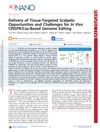 60 citations
,
July 2020 in “ACS Nano”
60 citations
,
July 2020 in “ACS Nano” Using CRISPR for gene editing in the body is promising but needs better delivery methods to be more efficient and specific.
 1 citations
,
October 1996 in “Journal of Cutaneous Medicine and Surgery”
1 citations
,
October 1996 in “Journal of Cutaneous Medicine and Surgery” Gene therapy shows promise for treating skin disorders and cancer, but faces technical challenges.
January 2025 in “Molecules” Non-viral delivery systems and stimuli-responsive nanoformulations can improve CRISPR-Cas9 gene therapy.
7 citations
,
July 2018 in “Stem cell research” Hair samples can be used to create stem cells easily and non-invasively.
5 citations
,
December 2022 in “Molecular Biology” Effective delivery of gene editors is crucial for safe and successful gene editing in healthcare and agriculture.
 September 2025 in “Advanced Pharmaceutical Bulletin”
 Genosomes are promising for safe and effective gene delivery in therapy.
 June 2022 in “Authorea (Authorea)”
 Efficient delivery systems are needed for the clinical use of CRISPR-Cas9 gene editing.
 21 citations
,
January 2022 in “Biomaterials Science”
21 citations
,
January 2022 in “Biomaterials Science” RNA delivery is best for in-body use, while RNP delivery is good for outside-body use. Both methods are expected to greatly impact future treatments.
15 citations
,
June 2021 in “Journal of Genetic Engineering and Biotechnology” Biomaterials can improve non-viral gene delivery by enhancing DNA uptake and reducing toxicity.
36 citations
,
August 2022 in “Molecular Therapy — Nucleic Acids” Gene therapy shows promise for healing chronic wounds but needs more research to overcome challenges.
 7 citations
,
August 2022 in “Journal of Nanobiotechnology”
7 citations
,
August 2022 in “Journal of Nanobiotechnology” Advancements in nanoformulations for CRISPR-Cas9 genome editing can respond to specific triggers for controlled gene editing, showing promise in treating incurable diseases, but challenges like precision and system design complexity still need to be addressed.
 October 2023 in “Scientific Reports”
 Gene therapy helped rats with a specific type of rickets grow hair without severe inflammation.
52 citations
,
September 2022 in “Viruses” SARS-CoV-2 proteins help the virus avoid the immune system, delaying response and increasing inflammation.
 40 citations
,
June 2013 in “Molecular Pharmaceutics”
40 citations
,
June 2013 in “Molecular Pharmaceutics” The gelatin/β-TCP scaffold with nanoparticles improves wound healing and skin regeneration.
 July 2025 in “Journal of medical & health sciences review.”
 Ultrasound-assisted gene therapy could revolutionize tissue regeneration by improving gene delivery.
 11 citations
,
May 2023 in “Journal of Cancer Research and Clinical Oncology”
11 citations
,
May 2023 in “Journal of Cancer Research and Clinical Oncology” CRISPR/Cas systems show promise for cancer treatment by targeting miRNAs, but delivery and specificity challenges remain.
 September 2023 in “HAL (Le Centre pour la Communication Scientifique Directe)”
 Peptide nanoparticles can effectively deliver CRISPR-Cas9 to target KRAS mutations in cancer.
16 citations
,
April 2000 in “Journal of Investigative Dermatology” The AVET system effectively delivers genes to human keratinocytes and may help treat skin diseases.
 3 citations
,
April 2022 in “Bioengineering”
3 citations
,
April 2022 in “Bioengineering” Ultrasound can help deliver genes to cells to stimulate tissue regeneration and enhance hair growth, but more research is needed to perfect the method.
 March 2026 in “Journal of Nanotheranostics”
 Nanotechnology improves CRISPR-Cas9 delivery for cancer treatment, but challenges remain.
42 citations
,
April 2021 in “Pharmaceuticals” Five FDA-approved drugs may help block COVID-19 virus entry.
17 citations
,
January 2023 in “Frontiers in Cell and Developmental Biology” iPSCs are promising for studying and treating COVID-19.
 260 citations
,
January 2019 in “Pharmaceutics”
260 citations
,
January 2019 in “Pharmaceutics” Niosomes are a promising, stable, and cost-effective drug delivery system with potential for improved targeting and safety.
 14 citations
,
May 2019 in “Human gene therapy”
14 citations
,
May 2019 in “Human gene therapy” MC-DNA vector-based gene therapy can temporarily treat CBS deficiency in mice.
 2 citations
,
November 2015 in “Journal of Investigative Dermatology”
2 citations
,
November 2015 in “Journal of Investigative Dermatology” RANKL improves the immune response against herpes simplex virus by enhancing T cell activation and could help develop better treatments or vaccines.
 35 citations
,
May 2019 in “Frontiers in genetics”
35 citations
,
May 2019 in “Frontiers in genetics” Non-coding RNAs play key roles in the hair growth cycle of Angora rabbits.