January 2025 in “Indian Journal of Dermatopathology and Diagnostic Dermatology” Nevus sebaceous is identified by unique skin changes, including thickened skin, fewer hair follicles, and many sebaceous glands.
 30 citations
,
September 2009 in “Seminars in Cutaneous Medicine and Surgery”
30 citations
,
September 2009 in “Seminars in Cutaneous Medicine and Surgery” Dermoscopy has greatly improved the diagnosis of skin lesions and our understanding of their morphology and biology.
 95 citations
,
January 2004 in “Archives of Dermatological Research”
95 citations
,
January 2004 in “Archives of Dermatological Research” Peripilar signs can help diagnose androgenetic alopecia and reveal its cause.
1 citations
,
March 2014 in “Journal of Innovative Optical Health Sciences” Hair structure worsens as tumors grow in mice.
 May 2026 in “Journal of Basic and Clinical Health Sciences”
 FAGA shows varied hair thickness, while TE has more empty follicles.
39 citations
,
January 2009 in “Journal of Ovarian Research” Observers often disagree on ultrasound results for polycystic ovaries, needing better training for consistency.
13 citations
,
January 1985 in “International Journal of Dermatology” The document found differences in lesion distribution and microscopic features among trichostasis spinulosa and similar skin conditions.
1 citations
,
August 2015 in “PubMed” Human hair's strength comes from a honeycomb-like structure and macrofibrils.
49 citations
,
September 2004 in “Journal of the European Academy of Dermatology and Venereology” Careful light microscopy is crucial for detecting mild cases of pili annulati, which weakens hair and varies widely in expression.
1 citations
,
January 2021 in “Springer Proceedings in Materials” Researchers developed a new method to clearly see and label hair proteins with minimal errors using advanced freezing and microscopy techniques.
6 citations
,
January 2019 in “Indian Journal of Dermatology, Venereology and Leprology” Low-cost dermoscopes can effectively diagnose early female pattern hair loss.
13 citations
,
March 2020 in “Spectrochimica Acta Part A Molecular and Biomolecular Spectroscopy” Alopecic hair has more irregular structures and chemical changes than normal hair, reducing its strength.
 1 citations
,
November 2023 in “Curēus”
1 citations
,
November 2023 in “Curēus” Early diagnosis and treatment of nail and skin conditions can improve health and appearance.
 74 citations
,
July 2008 in “Journal of Dermatological Case Reports”
74 citations
,
July 2008 in “Journal of Dermatological Case Reports” Trichoscopy is a quick and easy way to diagnose most genetic hair problems without invasive methods.
 September 2024 in “Indian Journal of Dermatology”
 Trichoscopy effectively diagnoses and assesses the severity of androgenetic alopecia.
 December 2024 in “Texila international journal of public health”
 Trichoscopy effectively diagnoses and monitors cicatricial alopecias, reducing the need for biopsies.
 2 citations
,
January 2017 in “Przegla̧d dermatologiczny”
2 citations
,
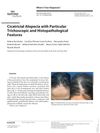
January 2017 in “Przegla̧d dermatologiczny” Two trichoscopic patterns found in hair loss: diffuse fibrotic and androgenetic alopecia, affecting treatment choice and regrowth chances.
 November 2018 in “Skin appendage disorders”
 The document concludes that a woman has both Frontal Fibrosing Alopecia and Lichen Simplex Chronicus, a previously unreported combination of conditions.
 December 2022 in “Skin Pharmacology and Physiology”
 Special scalp and hair examination techniques can identify hair problems.
 January 2018 in “Elsevier eBooks”
 Different nail disorders are treated by targeting their specific causes and using appropriate medications or protective measures.
 October 2021 in “International journal of research in dermatology”
 No link between scalp patterns and alopecia severity in children, but more severe cases often had nail abnormalities.
 3 citations
,
October 2021 in “Journal of Cosmetic Dermatology”
3 citations
,
October 2021 in “Journal of Cosmetic Dermatology” Trichoscopy helps tell apart Frontal Fibrosing Alopecia and Lichen planopilaris by showing different hair and scalp features.
2 citations
,
September 2019 in “Journal of the American Academy of Dermatology” USB videodermatoscopes are a practical and affordable alternative for diagnosing skin conditions.
 8 citations
,
May 2021 in “Journal of the European Academy of Dermatology and Venereology”
8 citations
,
May 2021 in “Journal of the European Academy of Dermatology and Venereology” A COVID-19 patient had unusual nail discoloration and nail separation possibly due to the virus's effects on small blood vessels.
2 citations
,
January 2023 in “Skin Appendage Disorders” More research is needed to confirm initial findings on hair loss patterns from chemotherapy.
 7 citations
,
March 2003 in “PubMed”
7 citations
,
March 2003 in “PubMed” The scalp has a natural speckled pattern of increased pigment around hair follicles, possibly linked to local hormone production.
August 2024 in “Research Journal of Health Sciences” Normal scalp and hair characteristics in Black Africans include white dots and a honeycomb pattern.
 19 citations
,
October 2014 in “Veterinary Dermatology”
19 citations
,
October 2014 in “Veterinary Dermatology” Dermoscopy is a good, noninvasive way to see normal cat skin structures and could be useful for check-ups.
2 citations
,
January 2022 in “Indian dermatology online journal” Dermoscopy may not show hookworms clearly, and comparing it with tissue studies could improve diagnosis accuracy for skin conditions caused by parasites.
53 citations
,
September 1999 in “Journal of Synchrotron Radiation” Keratinous tissues have multiple structural layers, including ordered keratin and lipid granules.