
PRP therapy effectively treats hair loss, wrinkles, scars, ulcers, and skin pigmentation disorders.
 July 2024 in “Periodontology 2000”
 Autologous platelet concentrates show promise in esthetic treatments but need more standardized research.
 October 2025 in “Asian Journal of Oral Health and Allied Sciences”
 Autologous growth factor concentrate therapy shows promise for treating early-stage hair loss safely and effectively.
 48 citations
,
February 2025 in “Nano-Micro Letters”
48 citations
,
February 2025 in “Nano-Micro Letters” Microneedles offer a promising, painless way to treat skin diseases but need improvements for better use.
 18 citations
,
November 2016 in “Journal of Oral and Maxillofacial Surgery”
18 citations
,
November 2016 in “Journal of Oral and Maxillofacial Surgery” Platelet-Rich Plasma (PRP) treatment can potentially increase hair density and quality in people with hair loss, but more research is needed to confirm its effectiveness.
 September 2025 in “Journal of Maxillofacial and Oral Surgery”
 Combining PRP with CGF is more effective for hair regrowth in androgenetic alopecia than PRP alone.
 1 citations
,
April 2018 in “Lasers in Surgery and Medicine”
1 citations
,
April 2018 in “Lasers in Surgery and Medicine” New treatments and technologies in laser medicine show promise for improving skin conditions, fat reduction, cancer treatment, wound healing, and hair restoration.
 September 2018 in “Facial Plastic Surgery Clinics of North America”
 Biologicals are increasingly used in medicine and cosmetics, especially for skin and hair treatments, but more research is needed.
 January 2019 in “Springer eBooks”
 PRP and LLLT can improve hair growth in AGA, but more research needed.
 June 2017 in “Journal of The American Academy of Dermatology”
 Women in Australia report different signs of facial aging compared to women in the US, UK, and Canada; men with Lichen planopilaris often have hormonal abnormalities and thyroid disease.
 June 2017 in “Journal of The American Academy of Dermatology”
 Most men with lichen planopilaris had it confirmed by biopsy and often had thyroid issues, sexual dysfunction, or prostate cancer, hinting at a link with hormonal problems.
 5 citations
,
January 2021 in “Journal of Cosmetic Dermatology”
5 citations
,
January 2021 in “Journal of Cosmetic Dermatology” Adding platelet-rich plasma improves hair density and thickness in androgenetic alopecia.
 1 citations
,
February 2021 in “Journal of Dermatological Treatment”
1 citations
,
February 2021 in “Journal of Dermatological Treatment” Artificial hair implants can quickly improve looks and life quality, but they have risks like infection and early fiber loss, so more research is needed to confirm their safety and effectiveness.
 January 2026 in “International Journal of Dermatology Venereology and Leprosy Sciences”
 Intradermal dutasteride effectively and safely improves hair growth in early-stage androgenetic alopecia.
 October 2024 in “International Journal of Research in Dermatology”
 Mintop serum effectively reduces hair fall and promotes new growth safely.
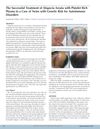 January 2018 in “Hair transplant forum international”
 PRP injections can effectively treat alopecia areata.
 January 2019 in “Acta dermatovenerologica Alpina, Pannonica et Adriatica (Tiskana izd.)”
 Non-ablative radio frequency can potentially increase hair count in men with androgenetic alopecia, but some may be bothered by the smell during treatment.
 6 citations
,
September 2019 in “Archives of Dermatological Research”
6 citations
,
September 2019 in “Archives of Dermatological Research” Found 32 genes linked to male baldness, affecting hair growth and stress-related pathways.
 1 citations
,
January 2022 in “The Egyptian Journal of Hospital Medicine ”
1 citations
,
January 2022 in “The Egyptian Journal of Hospital Medicine ” Cryotherapy and steroid injections are similarly effective and safe for treating alopecia areata.
 37 citations
,
May 2018 in “Journal of Cosmetic Dermatology”
37 citations
,
May 2018 in “Journal of Cosmetic Dermatology” PRP shows promise for hair loss treatment, but needs standardized preparation and composition.
 33 citations
,
February 2019 in “Journal of Tissue Engineering and Regenerative Medicine”
33 citations
,
February 2019 in “Journal of Tissue Engineering and Regenerative Medicine” Platelet-Rich Plasma (PRP) shows promise for treating various skin conditions, but more research is needed to standardize its use.
 23 citations
,
June 2018 in “Facial Plastic Surgery”
23 citations
,
June 2018 in “Facial Plastic Surgery” Platelet-Rich Plasma (PRP) is a low-risk treatment for Androgenic Alopecia (AGA) that generally improves hair count or density, but more research is needed for optimization.
 16 citations
,
March 2020 in “Facial Plastic Surgery Clinics of North America”
16 citations
,
March 2020 in “Facial Plastic Surgery Clinics of North America” Platelet-Rich Plasma (PRP), a substance from a patient's own blood, can stimulate hair regrowth in people with Androgenetic Alopecia (AGA) who haven't had success with other treatments, but more research is needed to optimize its use.
 13 citations
,
January 2016 in “Journal of cosmetology & trichology”
13 citations
,
January 2016 in “Journal of cosmetology & trichology” Alternative treatments show promise for hair growth beyond traditional methods.
 8 citations
,
March 2021 in “Medicina-lithuania”
8 citations
,
March 2021 in “Medicina-lithuania” PRP treatment may promote hair growth and improve hair density in women with AGA, but more research is needed.
 4 citations
,
February 2024 in “Dermatology and Therapy”
4 citations
,
February 2024 in “Dermatology and Therapy” The procedure effectively improves the appearance of stretch marks in women.
 4 citations
,
December 2019 in “Journal of Cosmetic Dermatology”
4 citations
,
December 2019 in “Journal of Cosmetic Dermatology” Thread monofilament and minoxidil together increase hair growth in female androgenetic alopecia.
 3 citations
,
July 2024 in “Cureus”
3 citations
,
July 2024 in “Cureus” Platelet-rich plasma (PRP) shows promise for treating melasma but needs more research for confirmation.
 3 citations
,
July 2021 in “Aesthetic Plastic Surgery”
3 citations
,
July 2021 in “Aesthetic Plastic Surgery” PHAT may improve hair growth better than PRP alone.
 1 citations
,
January 2022 in “Pharmaceutical Sciences Asia”
1 citations
,
January 2022 in “Pharmaceutical Sciences Asia” Microneedles offer a painless, effective way to deliver drugs through the skin.