39 citations
,
July 1997 in “American Journal of Medical Genetics” The gene for Clouston syndrome in a large Indian family is located in the 13q11-q12.1 region.
23 citations
,
July 2016 in “JAMA Ophthalmology” CDH3-related disease causes worsening eye and hair issues.
 May 2024 in “Frontiers in medicine”
 A genetic mutation in the LIPH gene causes tightly curled hair that stops growing in some Japanese individuals.
101 citations
,
June 2003 in “The EMBO Journal” Phospholipase Cδ1 is crucial for normal skin and hair development.
22 citations
,
December 2015 in “The journal of investigative dermatology/Journal of investigative dermatology” A mouse gene mutation increases the risk of skin cancer.
44 citations
,
February 2023 in “Cell” Fingerprints form uniquely before birth due to specific genetic pathways and local signals.
39 citations
,
September 2018 in “American Journal of Medical Genetics Part A” A new genetic mutation in the ODC1 gene causes developmental delay and other symptoms in a young girl.
 1 citations
,
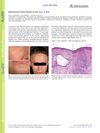
January 2019 in “Acta dermato-venereologica”
1 citations
,
January 2019 in “Acta dermato-venereologica” The woman's skin and hair symptoms were confirmed as frontal fibrosing alopecia, and while facial papules are common in such cases, there's no effective local treatment, but systemic treatments can help.
23 citations
,
February 1993 in “Journal of Investigative Dermatology”  October 2023 in “Psychiatry research. Case reports”
 A new HRAS gene variant may cause a range of symptoms including intellectual disability and psychiatric issues.
November 2018 in “Journal of dermatology & cosmetology” The document reports the first case of a rare skin condition in Colombia, the 19th case worldwide.
10 citations
,
November 2019 in “Journal of the European Academy of Dermatology and Venereology” The RAS pathway affects hair growth differently in CFCS and CS.
16 citations
,
July 2021 in “American Journal of Medical Genetics Part A” Mutations in the LSS gene cause hair loss and may affect brain development, with varying severity.
September 2003 in “Faculty Opinions – Post-Publication Peer Review of the Biomedical Literature” GLABRA2 gene controls root-hair growth by regulating phospholipid signaling.
1 citations
,
November 2003 in “SKINmed Dermatology for the Clinician” A 17-year-old with Netherton syndrome has dry, itchy skin, brittle hair, and high IgE levels, treated with antihistamines and emollients.
November 2012 in “Annales de Dermatologie et de Vénéréologie” Frontal fibrosing alopecia can occur in children, not just postmenopausal women.
 4 citations
,
October 2011 in “International Journal of Dermatology”
4 citations
,
October 2011 in “International Journal of Dermatology” Bardet-Biedl syndrome may include under-recognized skin problems related to its metabolic disturbances.
 11 citations
,
July 2012 in “International Journal of Trichology”
11 citations
,
July 2012 in “International Journal of Trichology” Caffeine may help hair growth in hereditary hair loss.
 September 2019 in “Journal of Investigative Dermatology”
 Severe Hidradenitis Suppurativa increases missed and unproductive workdays.
 September 2019 in “Journal of Investigative Dermatology”
 Abrocitinib at 100 mg and 200 mg daily may significantly improve moderate-to-severe atopic dermatitis in patients 12 years and older.
 September 2019 in “Journal of Investigative Dermatology”
 Different staff in a dermatology clinic understand mostly their own tasks, not the full clinic process.
 September 2019 in “Journal of Investigative Dermatology”
 Finasteride treatment lowers urine androgen and prostaglandin levels, making them potential markers for effectiveness.
April 1996 in “Journal of Dermatological Science” February 2026 in “Endokrynologia Polska” Early diagnosis and treatment are crucial for managing Berardinelli–Seip syndrome.
 September 2022 in “IP Indian journal of clinical and experimental dermatology”
 An 8-year-old girl has a rare genetic disorder causing complete, irreversible hair loss and skin bumps.
1 citations
,
April 2024 in “Animal Genetics” A genetic defect in an Appenzeller Mountain Dog caused skin issues, improved with ketoconazole, showing the importance of advanced genetic testing.
25 citations
,
January 1983 in “Archives of dermatology” The conclusion is that Darier-White disease was accurately described by White but he missed the key feature of dyskeratotic cells which Darier identified.
October 2024 in “Skin Research and Technology” Pili annulati causes zebra-striped hair but doesn't affect hair strength or quality of life.
August 2024 in “Indian Dermatology Online Journal” DCPA commonly affects males' lower legs, showing follicular pustules and white areas.
2 citations
,
October 2000 in “Journal of Investigative Dermatology” AUC and APL are distinct conditions needing careful clinical assessment.