September 2024 in “Revista Brasileira de Cirurgia Plástica” The modified forehead lift technique is effective and safe for alopecia patients, with good aesthetic results.
 September 2019 in “Actas dermo-sifiliográficas/Actas dermo-sifiliográficas”
 Isotretinoin at low doses effectively treats facial papules in frontal fibrosing alopecia.
 January 2018 in “Journal of Cleft Lip Palate and Craniofacial Anomalies”
 The FUE technique can effectively restore moustaches in patients with cleft lips and alopecia, with few complications.
 11 citations
,
May 2023 in “Journal of Cutaneous Medicine and Surgery”
11 citations
,
May 2023 in “Journal of Cutaneous Medicine and Surgery” Plasma Rich in Growth Factors may help reduce hair loss in Frontal Fibrosing Alopecia.
 26 citations
,
June 2018 in “Australasian Journal of Dermatology”
26 citations
,
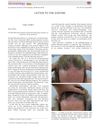
June 2018 in “Australasian Journal of Dermatology” Stopping sunscreen use on the forehead led to hair regrowth in a woman with frontal fibrosing alopecia.
 May 2015 in “Journal of the American Academy of Dermatology”
 Certain drugs and supplements may contribute to hair loss in the frontal hairline in older women.
 March 2023 in “Journal of clinical review & case reports”
 Frontal Fibrosing Alopecia mainly affects postmenopausal Mexican women, requiring early detection to prevent permanent hair loss.
 9 citations
,
August 2018 in “Journal der Deutschen Dermatologischen Gesellschaft”
9 citations
,
August 2018 in “Journal der Deutschen Dermatologischen Gesellschaft” Most patients with frontal fibrosing alopecia are middle-aged women, often have thyroid disease, and some treatments can help stabilize the condition.
2 citations
,
August 2025 in “JAAD reviews.” Frontal fibrosing alopecia significantly affects men, often causing hair loss in eyebrows, beard, and sideburns.
332 citations
,
June 1994 in “Archives of Dermatology” Postmenopausal frontal fibrosing alopecia may be a unique condition linked to postmenopausal changes.
Vertex accentuation is a common pattern in female hair loss.
22 citations
,
April 2012 in “Informa Healthcare eBooks” Frontal fibrosing alopecia is a type of hair loss that usually happens after menopause.
 September 2021 in “CRC Press eBooks”
 Fibrosing alopecia in a pattern distribution is a type of hair loss that may often be overlooked, especially in men.
 3 citations
,
September 2019 in “Skin appendage disorders”
3 citations
,
September 2019 in “Skin appendage disorders” Women with Frontal Fibrosing Alopecia have more wrinkles near their ears than similar aged women without the condition.
8 citations
,
January 2002 in “Piel” Postmenopausal women may experience frontal hairline and eyebrow loss due to cicatricial fibrosis.
 23 citations
,
November 2018 in “Journal of the European Academy of Dermatology and Venereology”
23 citations
,
November 2018 in “Journal of the European Academy of Dermatology and Venereology” The study concluded that severity of Frontal fibrosing alopecia is not linked to how long someone has it, can start before menopause, and eyebrow loss may be an early sign.
 2 citations
,
January 2020 in “Elsevier eBooks”
2 citations
,
January 2020 in “Elsevier eBooks” The document concludes that individualized Facial Feminization Surgery plans and comprehensive care are crucial for successful outcomes.
2 citations
,
January 2019 in “Skin appendage disorders” Early diagnosis and quick treatment improve life quality for FFA patients.
39 citations
,
April 2009 in “Journal of Plastic Reconstructive & Aesthetic Surgery” The surgery for severe congenital ptosis in children is safe and effective, with good long-term results.
August 2019 in “Journal of the American Academy of Dermatology” Frontal fibrosing alopecia may be caused by an autoimmune reaction and hormonal imbalance.
 January 2026 in “Frontiers in Medicine”
 FFA and FAPD might be related or stages of the same disease.
 July 2004 in “Dermatologic Surgery”
 A woman had temporary hair loss due to a stress-related condition after a facelift.
 November 2023 in “Indian Journal of Dermatology”
 The study found that Frontal Fibrosing Alopecia in North-East India mainly affects middle-aged women and is often associated with lichen planus pigmentosus.
 102 citations
,
April 2014 in “International Journal of Dermatology”
102 citations
,
April 2014 in “International Journal of Dermatology” The treatment helped reduce symptoms and stabilize the hairline in most patients with Frontal Fibrosing Alopecia, but hair regrowth was limited.
 1 citations
,
July 2023 in “Journal of the European Academy of Dermatology and Venereology”
1 citations
,
July 2023 in “Journal of the European Academy of Dermatology and Venereology” Portraits show women's hairlines have moved forward over time, suggesting changes in the occurrence of frontal hair loss.
 January 2021 in “Türkiye klinikleri dermatoloji dergisi”
 Eyebrow loss in frontal fibrosing alopecia is common and may be linked to other health issues.
 July 2025 in “Journal of Cosmetic and Laser Therapy”
 Hyaluronic acid fillers can cause hair loss if used near hair.
2 citations
,
June 2021 in “Sultan Qaboos University medical journal” Familial frontal fibrosing alopecia is rare, mostly affects women, and often occurs between sisters or mother-daughter pairs.
 53 citations
,
May 2010 in “Dermatologic Surgery”
53 citations
,
May 2010 in “Dermatologic Surgery” Hair transplantation may not work for Frontal Fibrosing Alopecia as transplanted hair was lost when the disease came back.
 126 citations
,
April 2006 in “International Journal of Dermatology”
126 citations
,
April 2006 in “International Journal of Dermatology” The conclusion is that FFA and LPP have similar scalp biopsy features, making them hard to distinguish histologically, and FFA may be a specific kind of scarring hair loss.