 June 2026 in “Studia Biologica”
 Felted wool in these sheep has more sweat and bacteria, altering its fatty acids and making it more prone to felting.

Ladakh hotsprings contain compounds with potential medicinal benefits for various health conditions.
 April 2024 in “Frontiers in pharmacology”
 Cynoglossum amabile has medicinal potential but poses safety concerns due to liver toxicity.
 June 2004 in “Bulletin of Pharmaceutical Sciences. Assiut University”
 The natural hair treatment with Cantharidin works best for hair loss.
 47 citations
,
September 2013 in “Aaps Pharmscitech”
47 citations
,
September 2013 in “Aaps Pharmscitech” Improved hair loss treatment using special particles and surfactants.
 June 2026 in “International Journal of Drug Delivery Technology”
 The new gel improves acne treatment and skin health with better delivery and fewer doses.
January 2004 in “Drug Development and Industrial Pharmacy” GI197111X is best dissolved in Capmul MCM for trials.
31 citations
,
February 1972 in “Experientia” The diphosphonate was the most effective at preventing calcification in rats.
21 citations
,
March 2021 in “Molecules” The new formulation greatly improved quercetin absorption in rats.
April 2025 in “Digital Commons - East Tennessee State University (East Tennessee State University)” Cromolyn sodium oleate gel is more effective and safer for treating atopic dermatitis than dexamethasone.
 32 citations
,
January 2017 in “PLoS ONE”
32 citations
,
January 2017 in “PLoS ONE” Adiponectin boosts lipid production in skin cells, potentially helping treat skin conditions with low sebum.
 7 citations
,
April 2009 in “Bioorganic & Medicinal Chemistry Letters”
7 citations
,
April 2009 in “Bioorganic & Medicinal Chemistry Letters” Diphenyl ethers can potentially reduce excess oil production when applied on the skin, helping treat conditions like acne.
July 2025 in “Journal of Investigative Dermatology” Solid Lipid Particle technology makes retinol more stable, effective, and gentle on the skin.
April 2016 in “International Journal of Drug Delivery” The ethosomal formulation improved finasteride delivery through the skin.
 November 2024 in “Research Square (Research Square)”
 Lipids may help treat hair loss by promoting hair growth through the HIF-1 pathway.
16 citations
,
November 2018 in “Medicinal Chemistry” The compound GD-23 may reduce anxiety like diazepam by targeting the TSPO receptor.
A new lipid-based formula using myristyl myristate can improve estradiol treatment for hair loss.
 8 citations
,
September 2021 in “EMBO Molecular Medicine”
8 citations
,
September 2021 in “EMBO Molecular Medicine” A new small peptide may help hair growth by activating a specific receptor and should be tested in humans.
43 citations
,
July 2017 in “International journal of pharmaceutics” Using β-cyclodextrin derivatives improves the solubility and bioavailability of steroidal drugs.
January 2015 in “Seoul National University Open Repository (Seoul National University)” Polyunsaturated fatty acids, especially arachidonic acid and eicosapentaenoic acid, can promote hair growth.
 5 citations
,
August 2014 in “Pharmaceutical Development and Technology”
5 citations
,
August 2014 in “Pharmaceutical Development and Technology” Propylene glycol and ethanol increase finasteride skin absorption, sodium lauryl sulfate doesn't.
 49 citations
,
October 2014 in “International Scholarly Research Notices”
49 citations
,
October 2014 in “International Scholarly Research Notices” Eclipta alba has many health benefits and contains compounds with potential for drug development.
 6 citations
,
April 2023 in “Frontiers in plant science”
6 citations
,
April 2023 in “Frontiers in plant science” Certain bacteria can boost lentil growth and improve soil used for farming.
 July 2025 in “International Journal of Allied Medical Sciences and Clinical Research”
 Eclipta prostrata is a medicinal herb with potential health benefits for various conditions and could be used in modern medicine.
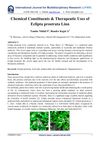 January 2024 in “International Journal For Multidisciplinary Research”
 Eclipta prostrata Linn has many health benefits and is used in traditional medicine.
False daisy is a medicinal herb with many health benefits, including hair growth promotion.

Icosapent ethyl may help treat long-lasting symptoms after COVID-19.
61 citations
,
March 2006 in “Colloids and surfaces. B, Biointerfaces” Lecithin microemulsion safely delivers tetracaine hydrochloride through the skin.
4 citations
,
November 2024 in “Scientific Reports” 16-MHA can restore damaged hair's protective barrier and moisture balance.
 January 2025 in “International Journal of Pharmaceutical Research and Applications”
 Hibiscus mucilage is an effective gelling agent for diclofenac diethylamine gel.