1 citations
,
November 2021 in “Jurnal Tadris IPA Indonesia” PRP can improve skin beauty naturally but doesn't last as long as plastic surgery.
13 citations
,
September 2012 in “Cell & tissue research/Cell and tissue research” pCLCA2 protein may help maintain skin structure and function.
7 citations
,
June 2009 in “Journal of the European Academy of Dermatology and Venereology” Basement membrane changes in lichen planopilaris cause scarring and permanent hair loss.
4 citations
,
October 2019 in “Acta Médica Costarricense” More research is needed to standardize and prove the effectiveness of platelet-rich plasma treatments.
 January 2017 in “Hair transplant forum international”
 Platelet-rich plasma (PRP) treatments are not effective.
 2 citations
,
June 2015 in “Vestnik dermatologii i venerologii”
2 citations
,
June 2015 in “Vestnik dermatologii i venerologii” PRP shows promise for treating certain types of hair loss.
101 citations
,
June 2003 in “The EMBO Journal” Phospholipase Cδ1 is crucial for normal skin and hair development.
 October 2023 in “Facial Plastic Surgery”
 The PHAT technique effectively rejuvenates lips and face.
 30 citations
,
January 2020 in “Journal of The American Academy of Dermatology”
30 citations
,
January 2020 in “Journal of The American Academy of Dermatology” Fibrosing alopecia in a pattern distribution is a hair loss condition often confused with other types, requiring early treatment but usually not resulting in significant hair regrowth.
 November 2018 in “Biomedical Journal of Scientific and Technical Research”
 Long-Acting Platelet Rich Plasma therapy can effectively reduce hair shedding, thicken hair, and promote new growth in women with pattern hair loss.
 37 citations
,
August 2014 in “Journal of experimental botany”
37 citations
,
August 2014 in “Journal of experimental botany” A gene in Arabidopsis thaliana, AtPRPL1, affects root hair length but not cell wall composition.
6 citations
,
September 2019 in “Indian Journal of Dermatology” 1 citations
,
October 2023 in “PROTOPLASMA”  2 citations
,
March 2017 in “Current regenerative medicine”
2 citations
,
March 2017 in “Current regenerative medicine” Platelet-rich plasma helps tissue healing but lacks standard use methods.
April 2023 in “Australasian Journal of Dermatology” Both methods of platelet-rich plasma showed positive effects on hair loss.
 6 citations
,
December 2022 in “Colloids and Surfaces B: Biointerfaces”
6 citations
,
December 2022 in “Colloids and Surfaces B: Biointerfaces” The new wound dressing promotes cell growth and healing, absorbs wound fluids well, and is biocompatible.
 August 2024 in “Quality in Sport”
 PRP helps with skin, hair, and wound treatments but needs more research for standard use.
31 citations
,
September 2014 in “Spinal Cord” September 2022 in “Dermatologic Therapy” 35 citations
,
November 2019 in “Journal of the American Academy of Dermatology” A new variant of lichen planopilaris causing diffuse hair thinning was identified.
 July 2003 in “Hair transplant forum international”
 The document's conclusion cannot be provided because the document is not available for parsing.
 April 2021 in “The journal of investigative dermatology/Journal of investigative dermatology”
 6.1% of patients seeking PRP for hair loss had undiagnosed cicatricial alopecia, which PRP cannot treat.
1 citations
,
June 2024 in “Plastic & Reconstructive Surgery Global Open” A super thin DIEP flap can effectively reconstruct scalp defects with good skin coverage and contour.
1 citations
,
July 2024 in “Journal of Investigative Dermatology” Plaquenil can cause a severe skin reaction called AGEP, requiring prompt diagnosis and treatment.
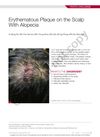
The woman has a scalp condition causing hair loss.
47 citations
,
September 2012 in “Human molecular genetics online/Human molecular genetics” Folliculin deficiency causes problems with cell division and positioning due to disrupted RhoA signaling and interaction with p0071.
1 citations
,
April 2021 in “Journal of the American Academy of Dermatology” Inconsistent platelet counts in PRP are due to varying blood volumes, preparation methods, and analyzer types.
 November 2024 in “Cureus”
 Scalp edema may be a new variant of conditions reacting to scarring alopecia like LPP.
April 2017 in “Journal of dermatological science” Removing PLCg1 from skin cells caused thicker oil glands and less hair in mice.

Early diagnosis and treatment of Lichen Planopilaris are crucial to prevent permanent hair loss.