 April 2017 in “Journal of Investigative Dermatology”
 The protein CTCF is essential for skin development, maintaining hair follicles, and preventing inflammation.
September 2016 in “Journal of Dermatological Science” Hair follicles produce IL-7, which is essential for certain skin lymphoma cells to survive.
September 2016 in “Ege tıp dergisi/Ege tıp dergisi :” An 11-year-old obese girl was diagnosed with lipedematous scalp, a condition with swollen scalp tissue usually found in adult women.
 April 2016 in “Journal of The American Academy of Dermatology”
 The study found that Temporal Triangular Alopecia often starts in early childhood, while Folliculitis Decalvans is characterized by tufted hairs and redness around hair follicles.
 November 2015 in “International journal of science and research”
 Adult acne is mostly inflammatory, affects women more, and often scars, needing good treatment to prevent damage.
January 2015 in “Rawal Medical Journal” Telogen effluvium is the main cause of hair loss in women in Karak, followed by androgenetic alopecia.
Different connective tissue disorders have unique symptoms and treatments, with varying outcomes and often require ongoing care from a specialist.
September 2014 in “Journal of the American Academy of Dermatology” The girl likely has Loose anagen hair syndrome, which may improve on its own or with minoxidil.
 August 2013 in “Gastroenterology”
 A 60-year-old man with Cronkhite-Canada syndrome improved with treatment, but the condition has a high mortality rate and a risk of colorectal cancer.
March 2013 in “Faculty Opinions – Post-Publication Peer Review of the Biomedical Literature” Prostate cancer screening doesn't significantly reduce death rates and has risks like overdiagnosis and side effects.
January 2013 in “Digital Repository (National Repository of Grey Literature)” Hair loss negatively affects self-esteem and identity.
January 2012 in “The Journal of Practical Medicine” Chinese Han individuals have fewer hair follicles and hairs than Caucasians and Africans.
 January 2011 in “Journal of The American Academy of Dermatology”
 Treating generalized granuloma annulare is difficult, with PUVA being the most effective option, but relapses are common.
Discoid Lupus Erythematosus is more common in women aged 31-40, often worsened by sunlight, and confirmed by specific lab tests.
January 2008 in “대한피부과학회지” Androgenetic alopecia is more common in men, often linked to genetics and hormones.
January 2008 in “대한피부과학회지” Androgenetic alopecia is more common in men, linked to genetics and androgen levels, but routine pelvic ultrasound isn't recommended.
 July 2007 in “Faculty Opinions – Post-Publication Peer Review of the Biomedical Literature”
 The BASP classification is a detailed system for categorizing hair loss in both men and women, but it may be complex for beginners and not fully suitable for grading female hair loss.
January 2007 in “Revista del Centro Dermatológico Pascua” Androgenetic alopecia causes hair thinning in women, affecting their quality of life.

A patient experienced intense hair loss due to telogen effluvium after scalp contact dermatitis, but hair regrew completely within two months without further treatment.
May 2005 in “Molecular Carcinogenesis” mrp/plf-mRNA can indicate tumor-promoting effects in skin.
March 1995 in “The Journal of Dermatology” Immature hair cells can grow and change into different types of hair cells over time.
 July 1989 in “British Journal of Dermatology”
 Women's acne improvement with antibiotics is not linked to signs of high male hormones.
April 2022 in “Microbiology and Immunology” A specific DNA pattern in Malassezia restricta may be linked to hair loss in men.
 January 2022 in “Social Science Research Network”
 The Ar/miR-221/IGF-1 pathway is involved in male pattern baldness, with miR-221 potentially being a new target for treatment.
December 2021 in “International Journal of Medicine in Developing Countries” Topical finasteride's effectiveness for hair loss needs standardized evaluation methods.
 May 2019 in “Journal of the Dermatology Nurses’ Association”
 Folliculitis decalvans mainly affects middle-aged African American men and is treated with antibiotics.
 September 2017 in “Journal of Investigative Dermatology”
 Injections of special skin cells showed potential in treating hair loss, with some participants experiencing increased hair density.

Androgenetic alopecia, or hair loss, is caused by genetic factors and hormones, with different mechanisms in men and women, and can be linked to insulin resistance and polycystic ovary syndrome.
 20 citations
,
September 2018 in “Journal of cutaneous pathology”
20 citations
,
September 2018 in “Journal of cutaneous pathology” Different skin diseases show unique patterns of skin cell separation, cell death, and granular layer changes.
 19 citations
,
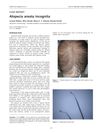
January 2011 in “Clinics”
19 citations
,
January 2011 in “Clinics” A young woman with a rare hair loss condition improved with steroid and biotin treatment.