 7 citations
,
August 2017 in “PloS one”
7 citations
,
August 2017 in “PloS one” Key genes linked to hair growth and cancer were identified in hairless mice.
6 citations
,
January 2022 in “Gene” Scientists found 53 keratin genes in yaks that are important for hair growth and share similarities with those in other animals.
6 citations
,
June 2016 in “Journal of cellular biochemistry” The Hr protein binds to DNA, interacts with p53, and affects cell cycle genes.
 4 citations
,
May 2018 in “International Journal of Molecular Sciences”
4 citations
,
May 2018 in “International Journal of Molecular Sciences” The research showed how melanocytes develop, move, and respond to UV light, and their stem cells' role in hair color and skin cancer risk.
 4 citations
,
March 2017 in “Development”
4 citations
,
March 2017 in “Development” Estrogen is important for keeping adult mouse nipple skin healthy by controlling certain cell signals.
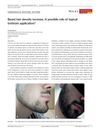 4 citations
,
November 2016 in “Dermatologic Therapy”
4 citations
,
November 2016 in “Dermatologic Therapy” Topical tretinoin may increase beard hair density.
 3 citations
,
May 2017 in “British journal of dermatology/British journal of dermatology, Supplement”
3 citations
,
May 2017 in “British journal of dermatology/British journal of dermatology, Supplement” Certain cells around hair follicles help improve skin regeneration for potential use in skin grafts.
2 citations
,
March 2020 in “Developmental cell” Stress can cause hair to turn gray by depleting pigment-producing cells through the release of a stress hormone.
 2 citations
,
March 2014 in “Turkderm”
2 citations
,
March 2014 in “Turkderm” Mesotherapy and platelet-rich plasma treatments may help with hair loss, but their safety and effectiveness are still uncertain.
2 citations
,
May 1985 in “Environmental Health Perspectives” Chlorinated compounds like TCDD can cause skin issues and chloracne by affecting cell behavior.
 1 citations
,
August 2024 in “Transgenic Research”
1 citations
,
August 2024 in “Transgenic Research” Activated β-catenin affects hair growth and skin thickness, and changes are reversible.
1 citations
,
March 2020 in “Meždunarodnyj medicinskij žurnal” PRP could be a promising treatment for hair loss but needs more research.
July 2026 in “Journal of Investigative Dermatology” Tanshinone Capsule may help regrow hair by boosting specific cell signals.
June 2026 in “Advanced Healthcare Materials” Engineered vesicles with EGF mRNA improve skin wound healing and reduce scarring.
June 2026 in “Journal of Cosmetic Dermatology” The ingredient blend may boost hair growth by enhancing elastin and signaling pathways.
May 2026 in “Ibero-American Journal of Health Science Research” Regenerative therapies like PRP and stem cells are promising for skin rejuvenation and repair.
 January 2026 in “Scientific Reports”
 Sesamin may help treat hair loss by affecting specific cell pathways.
April 2025 in “ALEXMED ePosters” Combining nanofat with FUE improves scar appearance and function better than FUE alone.
 December 2024 in “Здобутки клінічної і експериментальної медицини”
 Advancements in skin regeneration focus on stem cells, nanotechnology, and bioengineered skin to improve healing and reduce scarring.
November 2024 in “Journal of Investigative Dermatology” Serotonin helps wounds heal faster.
September 2023 in “World Rabbit Science” The FRZB gene slows hair growth in rabbits.
 May 2023 in “bioRxiv (Cold Spring Harbor Laboratory)”
 Cannabidivarin (CBDV) helps new brain cells grow and develop in a specific brain area through a certain receptor.
 March 2023 in “Biomedicine & Pharmacotherapy”
 GPR40 agonists help hair growth through the protein ANGPTL4.
 October 2022 in “Journal of Pharmaceutical Negative Results”
 Photobiomodulation therapy shows promise in treating various health conditions by using specific light wavelengths.
January 2022 in “Figshare” lncRNA MTC helps goat skin cells grow and may aid hair growth by controlling proteins linked to cell growth.

Human hair keratins can be turned into useful 3D biomedical scaffolds through a freeze-thaw process.
 April 2021 in “Journal of Investigative Dermatology”
 Bacteria can help skin regenerate through a process called IL-1β signaling.
 March 2021 in “bioRxiv (Cold Spring Harbor Laboratory)”
 A specific immune response helps control mite populations on the skin, maintaining healthy hair follicles.
 August 2019 in “Journal of Investigative Dermatology”
 The study found that tight junctions reach the top layer of the skin's stratum granulosum, not just the second top layer as previously thought.
April 2019 in “The journal of investigative dermatology/Journal of investigative dermatology” Spiny mice regenerate skin better than laboratory mice due to larger hair bulges, more stem cells, and different collagen ratios.