1 citations
,
October 2025 in “International Journal of Molecular Sciences” Natural compounds may help treat advanced papillary thyroid cancer by targeting specific molecular pathways.
 December 2005 in “Endocrine-related cancer”
 A woman's adrenal tumor disappeared after treatment with cyproterone acetate.
2 citations
,
January 2014 in “Journal of Cytology & Histology” Rapamycin and anti-EGFR antibody reduce LAM/TSC cell migration and blood vessel growth in the uterus.
 42 citations
,
February 1998 in “The Journal of Steroid Biochemistry and Molecular Biology”
42 citations
,
February 1998 in “The Journal of Steroid Biochemistry and Molecular Biology” PNU 157706 is a more effective treatment than finasteride for conditions caused by DHT, like enlarged prostate and hair loss.
5 citations
,
July 1996 in “Journal of Cutaneous Medicine and Surgery” TTD patients don't have a higher skin cancer risk because their main issue is with transcription, not DNA repair.
 145 citations
,
May 2008 in “Cancer Science”
145 citations
,
May 2008 in “Cancer Science” Cancer cells often have more copies of TERT and TERC genes, which helps them grow and could affect patient outcomes.
 March 2024 in “Tissue engineering. Part A”
 Negative pressure therapy increases hair growth in mice.
 54 citations
,
October 2023 in “Oncogene”
54 citations
,
October 2023 in “Oncogene” p63 is essential for controlling epithelial stem cells and tissue health.
91 citations
,
July 2004 in “Journal of Biological Chemistry” Overexpressing SSAT enzyme reduces prostate tumor growth in mice.
32 citations
,
March 2018 in “Neoplasia” Nephronectin is linked to worse breast cancer outcomes and helps cancer spread.
3 citations
,
December 2003 in “Archives of Pathology & Laboratory Medicine” The nodule was a benign cutaneous lymphadenoma, not cancer, and was successfully removed.
October 2014 in “Cancer research” Blocking mTORC1 reduces skin tumor growth in mice.
 October 2018 in “Annals of oncology”
 Topical calcitriol (BPM31543) is safe for preventing hair loss from chemotherapy and shows some effectiveness.
24 citations
,
December 2013 in “Archives of Dermatological Research”  August 2023 in “Research Square (Research Square)”
 Personalized thiopurine dosing based on NUDT15 genotyping can improve long-term outcomes for ulcerative colitis and Crohn's disease patients.
 17 citations
,
October 2006 in “Molecular and Cellular Endocrinology”
17 citations
,
October 2006 in “Molecular and Cellular Endocrinology” The L457(3.43)R mutation in the human lutropin receptor causes increased activity and hormone insensitivity, leading to precocious puberty.
188 citations
,
June 1998 in “Molecular cell” Researchers created a mouse with the same mutation as humans with trichothiodystrophy, showing similar symptoms and confirming the condition is due to defects in DNA repair and gene activity.
September 2023 in “Journal of the American Academy of Dermatology” BAP1 mutations are rare in pediatric melanocytic tumors and may develop later in life.
 June 2026 in “Current Oncology Reports”
 Sacituzumab Tirumotecan shows promise in treating gynecologic cancers with manageable side effects.
 1 citations
,
July 2009 in “Journal of dermatology”
1 citations
,
July 2009 in “Journal of dermatology” A 29-year-old man had a jaw plaque diagnosed as follicular mucinosis, linked to nestin-positive hair follicle stem cells.
 5 citations
,
May 2020 in “Life science alliance”
5 citations
,
May 2020 in “Life science alliance” Removing integrin α3β1 from hair stem cells lowers skin tumor growth by affecting CCN2 protein levels.
 4 citations
,
March 2018 in “Journal of labelled compounds & radiopharmaceuticals”
4 citations
,
March 2018 in “Journal of labelled compounds & radiopharmaceuticals” A new compound was effective for imaging prostate cancer in rats.
5 citations
,
August 2000 in “Archives of Pathology & Laboratory Medicine” The nodule on the woman's back was a benign hair follicle tumor, not cancer, but needed removal.
1 citations
,
December 2020 in “International journal of molecular sciences” External factors can cause skin cancer cells that usually don't spread to grow and form tumors in mice.
1 citations
,
December 2016 in “Revista română de medicină de laborator” The NIPAL4 mutation c.527C>A is common in Romanian patients with autosomal recessive congenital ichthyosis.
143 citations
,
May 2002 in “PubMed” LGD1069 effectively prevents breast tumors in mice without toxicity.
 April 2023 in “Journal of Investigative Dermatology”
 An automated system can predict death risk in thin melanoma by analyzing immune cells.
11 citations
,
February 2018 in “Oncotarget” Lower SMAD2/3 activation predicts more severe skin cancer.
February 2024 in “Frontiers in Cell and Developmental Biology” Eribulin-based chemotherapy is more effective and has fewer side effects for advanced triple-negative breast cancer.
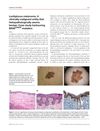 1 citations
,
March 2015 in “Journal of the European Academy of Dermatology and Venereology”
1 citations
,
March 2015 in “Journal of the European Academy of Dermatology and Venereology” A clinically suspected melanoma appeared benign under the microscope but was confirmed by specific tests and a rare mutation.