March 2005 in “Journal of the American Academy of Dermatology” Recognizing minor skin lesions can help identify serious cancer syndromes.
 59 citations
,
March 2008 in “The journal of investigative dermatology/Journal of investigative dermatology”
59 citations
,
March 2008 in “The journal of investigative dermatology/Journal of investigative dermatology” Smad-4 and Smad-7 are key in hair follicle development, with other Smads being less important.
 36 citations
,
November 2019 in “Molecular biology and evolution”
36 citations
,
November 2019 in “Molecular biology and evolution” Cysteine-rich keratins evolved independently in mammals, reptiles, and birds for hard skin structures like hair, claws, and feathers.
46 citations
,
August 1977 in “Journal of Morphology” The big-clawed shrew's sinus hair follicles are highly specialized for sensing vibrations.
8 citations
,
January 2013 in “genesis” Zfp157 is active in many mouse tissues during development and in specific adult cells.
10 citations
,
June 2016 in “Cell Transplantation” Sebaceous glands can help harvest hair follicle stem cells to regenerate skin and hair.
2 citations
,
November 2006 in “Pump Industry Analyst” Pilomatricomas don't follow the usual hair follicle cell differentiation process.
June 2026 in “The Journal of Sexual Medicine” Rare seminoma found in a 33-year-old woman with atypical genitalia and no Y chromosome.
 88 citations
,
July 2008 in “Development”
88 citations
,
July 2008 in “Development” BMP2 and BMP7 have opposite roles in feather formation.
 January 1995 in “Skin Cancer”
 The outer root sheath in hair follicles changes during growth, with different keratinization processes in its layers.
 April 2018 in “Journal of Investigative Dermatology”
 Hair follicle stem cells can change their role to ensure proper hair development.
3 citations
,
December 2013 in “Journal of Cell Science” Keratin 79 cells help form and regenerate hair canals.
18 citations
,
February 2001 in “Der Hautarzt” A woman with myotonic dystrophy had multiple skin tumors on her scalp, suggesting a genetic link.
 11 citations
,
June 2005 in “Stem Cells and Development”
11 citations
,
June 2005 in “Stem Cells and Development” Intestinal stem cells can help repair skin damage from radiation.
 March 2026 in “bioRxiv (Cold Spring Harbor Laboratory)”
 Spiny mice have a unique skin structure that helps them heal and regenerate quickly.
 137 citations
,
April 2015 in “Nature Reviews Molecular Cell Biology”
137 citations
,
April 2015 in “Nature Reviews Molecular Cell Biology” Different types of stem cells with unique roles exist in blood, skin, and intestines, and this variety is important for tissue repair.
164 citations
,
February 2010 in “Journal of Cell Science” Human dermal stem cells can become functional skin pigment cells.
 66 citations
,
December 2014 in “Nature Communications”
66 citations
,
December 2014 in “Nature Communications” Fibroblasts can be turned into melanocytes for potential skin treatments.
 1 citations
,
November 2023 in “Biomaterials advances”
1 citations
,
November 2023 in “Biomaterials advances” Sponges made of soy protein and β-chitin with human cells from hair or fat can speed up healing of chronic wounds.
26 citations
,
April 2011 in “British Journal of Dermatology” New mutations in the DSG4 gene cause a rare hair condition.
 68 citations
,
December 2011 in “Journal of Investigative Dermatology”
68 citations
,
December 2011 in “Journal of Investigative Dermatology” Sox2-positive dermal papilla cells have unique characteristics and contribute more to skin and hair follicle formation than Sox2-negative cells.
Keratinocytes grew and migrated into hair follicle areas but disappeared after 15-20 days.
19 citations
,
February 2013 in “Archives of Dermatological Research”  15 citations
,
December 2014 in “PLoS ONE”
15 citations
,
December 2014 in “PLoS ONE” A mutation in the iRhom2 gene causes hairless mice due to abnormal hair follicle development.
The PI's development is closely linked to skin and hair pigmentation in macaques.
 788 citations
,
February 2007 in “Nature”
788 citations
,
February 2007 in “Nature” The document concludes that skin stem cells are important for hair growth and wound healing, and could be used in regenerative medicine.
 26 citations
,
January 2014 in “Cell Structure and Function”
26 citations
,
January 2014 in “Cell Structure and Function” Human sweat glands contain stem cells capable of self-renewal and forming different cell types.
 418 citations
,
September 2012 in “Nature”
418 citations
,
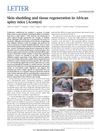
September 2012 in “Nature” African spiny mice can regenerate skin, hair, and cartilage, but not muscle, and their unique abilities could be useful for regenerative medicine.
December 2009 in “Cancer Research” Over-expression of Sp2 can lead to cancer by preventing proper stem cell differentiation.
 June 2021 in “bioRxiv (Cold Spring Harbor Laboratory)”
 KIF18B is important for correctly positioning cell division machinery in skin cells, affecting hair follicle development.