19 citations
,
January 2015 in “International Journal of Cosmetic Science” The improved nanoparticles can effectively target hair follicles for drug delivery.
 January 2025 in “Biomedical Engineering Letters”
 MXD@CP could be a promising new topical treatment for hair loss.
 April 2017 in “Journal of Investigative Dermatology”
 Certain mutations in the KLHL24 gene cause a skin disorder by breaking down an important skin protein.
4 citations
,
November 2019 in “Dermatology - Open Journal” Lichen planus pigmentosus is hard to treat and may be more common in North Africa than previously thought.
July 2006 in “Inpharma Weekly” 28 citations
,
September 2020 in “International Journal of Molecular Sciences” Leucocyte-rich platelet-rich plasma boosts cell activity and helps wound healing.
 March 2024 in “Journal of cosmetic dermatology”
 Platelet-rich plasma (PRP) is an effective treatment for lichen planopilaris.
 33 citations
,
September 2016 in “Lasers in Surgery and Medicine”
33 citations
,
September 2016 in “Lasers in Surgery and Medicine” Fractional resurfacing is safe and effective for certain skin conditions in Asian patients, but care must be taken to avoid skin pigmentation issues.
 January 2025 in “Dermatology Research and Practice”
 The treatment effectively repairs and strengthens damaged hair by restoring natural lipids.
 June 2015 in “Biomedical and biopharmaceutical research”
 The congress showed advancements in skin hydration, barrier function, and safe, effective new cosmetic formulations.
April 2026 in “Case Reports in Dermatology” Tofacitinib effectively treated a woman's complex autoimmune and autoinflammatory disorders.
 January 2007 in “Proceedings of the Korean Fiber Society Conference”
 New resin B makes artificial hair fibers hold curls longer than traditional resin A.
 2 citations
,
January 1980 in “Archives of Dermatology”
2 citations
,
January 1980 in “Archives of Dermatology” The author suggests changing "telogen effluvium" to "telogen defluxion" for hair loss terminology.
49 citations
,
July 2007 in “Ophthalmic Plastic and Reconstructive Surgery” Surgical excision is an effective treatment for persistent nodules from poly-L-lactic acid injections.
2 citations
,
February 2024 in “Burns” 14 citations
,
July 2021 in “Bioinformatics” rPanglaoDB helps study rare cell types by merging RNA data, showing fibrocytes aid in healing.
 June 2026 in “Acta Pharmacologica Sinica”
 Improving PROTAC delivery systems can enhance their effectiveness and speed up their use in medicine.
 4 citations
,
September 2013 in “Journal of Plastic Surgery and Hand Surgery”
4 citations
,
September 2013 in “Journal of Plastic Surgery and Hand Surgery” A girl with a rare syndrome had successful hair loss treatment with no relapse after 4 years.
January 2014 in “Theriogenology” Neurosteroids help control stress hormone levels in pregnant sheep.
 September 2022 in “Piretc”
 The document's conclusion cannot be provided because the document is not accessible or understandable.
 4 citations
,
December 1999
4 citations
,
December 1999 The book showed that combining expertise from various specialties improves facial cosmetic surgery outcomes.
 2 citations
,
January 2001 in “Dermatologic Surgery”
2 citations
,
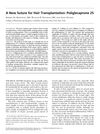
January 2001 in “Dermatologic Surgery” Poliglecaprone 25 is better than steel staples for hair transplant surgery, causing less discomfort and finer scars.
 August 2019 in “Journal of Investigative Dermatology”
 The study found that tight junctions reach the top layer of the skin's stratum granulosum, not just the second top layer as previously thought.
2 citations
,
March 2016 in “Düşünen Adam” Switching from escitalopram to duloxetine improved hair loss.
2 citations
,
May 2011 in “Journal of Clinical Oncology” Further testing of paclitaxel poliglumex for this cancer treatment is not justified.

BLTP1 and KIF27 gene mutations can help breed better wool sheep.
6 citations
,
March 2010 in “Journal of plastic, reconstructive & aesthetic surgery” Laser treatment can fix skin color issues after syndactyly surgery.
3 citations
,
October 2024 in “International Journal of Molecular Sciences” Xenopus laevis tadpoles can regenerate complex tail structures, offering insights for regenerative medicine.

The treatment improved facial structure and corrected bite issues in patients.
57 citations
,
July 1983 in “Journal of Investigative Dermatology”