30 citations
,
January 1999 in “Journal of Cutaneous Pathology” Spiny keratoderma may be ectopic hair formation on palms and soles.
January 1997 in “Purdue e-Pubs (Purdue University)” Whole hair strands can reliably measure gamma ray exposure using ESR techniques, but samples should be analyzed quickly or stored in liquid nitrogen.
February 2018 in “bioRxiv (Cold Spring Harbor Laboratory)” Rodent spiny hair traits are due to genetic factors other than the Edar gene.
 10 citations
,
September 2020 in “Archives of Dermatological Research”
10 citations
,
September 2020 in “Archives of Dermatological Research” Both methods improve hair density and thickness; double-spin may be more effective.
 November 2022 in “International journal of biology, pharmacy and allied sciences”
 The new herbal shampoo is effective, safe, and more affordable than other products.
April 2018 in “Journal of Investigative Dermatology” African spiny mice can regenerate skin and hair after wounds due to specific tissue mechanics.
1 citations
,
October 2021 in “QJM: An International Journal of Medicine” Double-spin PRP is more effective for treating female hair loss than single-spin PRP.
 September 2016 in “Journal of dermatological science”
 Transplanted whisker follicles caused hair growth on the spine of mice.
 1 citations
,
June 2023 in “Journal of applied crystallography”
1 citations
,
June 2023 in “Journal of applied crystallography” The technique showed that human hair has two main parts, with 68% being rigid and the rest flexible, and water swelling affects its structure.
 22 citations
,
May 2021 in “Nature Communications”
22 citations
,
May 2021 in “Nature Communications” Tissue stiffness affects hair follicle regeneration, and Twist1 is a key regulator.
June 2021 in “Faculty Opinions – Post-Publication Peer Review of the Biomedical Literature”  37 citations
,
February 2019 in “Experimental Dermatology”
37 citations
,
February 2019 in “Experimental Dermatology” Spiny mice are better at regenerating hair after injury than laboratory mice and could help us understand how to improve human skin repair.
 March 2026 in “bioRxiv (Cold Spring Harbor Laboratory)”
 Spiny mice have a unique skin structure that helps them heal and regenerate quickly.
44 citations
,
November 2012 in “International journal of nanomedicine” A new method improves silicone oil coating on hair, enhancing moisture and lubrication.
Spiny keratoderma is a rare skin condition with small spines on palms and soles, possibly linked to abnormal hair formation.
 June 2022 in “International Journal of Advanced Research in Science, Communication and Technology”
 The polyherbal hair oil helps hair growth, darkens white hair, fights dandruff, and makes hair shiny.
 418 citations
,
September 2012 in “Nature”
418 citations
,
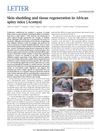
September 2012 in “Nature” African spiny mice can regenerate skin, hair, and cartilage, but not muscle, and their unique abilities could be useful for regenerative medicine.
April 2019 in “The journal of investigative dermatology/Journal of investigative dermatology” Spiny mice regenerate skin better than laboratory mice due to larger hair bulges, more stem cells, and different collagen ratios.
 June 2022 in “bioRxiv (Cold Spring Harbor Laboratory)”
 A specific molecular switch, driven by MAPK/ERK signaling, helps spiny mice heal wounds by regenerating skin instead of forming scars.
 July 2025 in “Frontiers in Medicine”
 Single-spin and double-spin PRP methods are equally effective for treating hair loss.
 December 2023 in “Journal of molecular structure”
 Hair treatments and dehydration affect hair's lipid and protein behavior, influencing its flexibility and appearance.
 4 citations
,
January 2018 in “Cosmetics”
4 citations
,
January 2018 in “Cosmetics” Spin traps like PBN could protect skin from pollution and sunlight in cosmetics but need more research for safe use.
July 2025 in “OPAL (Open@LaTrobe) (La Trobe University)” Single-spin PRP may be more effective for hair loss, but more research is needed.
July 2025 in “OPAL (Open@LaTrobe) (La Trobe University)” Single-spin PRP may be more effective for treating hair loss.
September 2018 in “CRC Press eBooks” Hair and nail disorders can cause changes in scalp pigmentation, especially with sun exposure and alopecia.
39 citations
,
June 2018 in “Burns” The spiny mouse can fully regenerate skin after burns, unlike the lab mouse.
 1 citations
,
August 2023 in “Genome research”
1 citations
,
August 2023 in “Genome research” The spiny mouse regenerates ear tissue asymmetrically, with gene expression differences possibly explaining its unique healing abilities.
December 2020 in “American Journal of Transplantation” Early recognition and treatment of VATS in transplant patients improve outcomes.
 August 1994 in “Journal of dermatological science”
 Active oxygen scavengers can reverse the suppression of hair cell growth caused by androgens.
 January 2026 in “Lumbung Farmasi Jurnal Ilmu Kefarmasian”
 The topical formula with sidr leaves and roasted candlenut extracts significantly boosts hair growth for alopecia.