 40 citations
,
August 2010 in “Archives of dermatology”
40 citations
,
August 2010 in “Archives of dermatology” A 5-year-old boy's skin condition improved with systemic valganciclovir after a cardiac transplant and immunosuppressive therapy.
40 citations
,
February 1946 in “Canadian Journal of Research/Canadian journal of research” Hereditary factors cause hair loss in mice by affecting skin and hair follicle structure.
 38 citations
,
August 2005 in “Veterinary dermatology”
38 citations
,
August 2005 in “Veterinary dermatology” A disease causing skin issues in young adult German short-haired pointers is hereditary, with most affected dogs not responding to treatment.
36 citations
,
January 2000 in “British journal of dermatology/British journal of dermatology, Supplement” A mother and daughter had severe skin, hair, and eye issues linked to IFAP.
36 citations
,
July 1996 in “The journal of investigative dermatology/Journal of investigative dermatology” Mice with the 'lanceolate hair' mutation have abnormal hair and skin similar to human Netherton's syndrome.
35 citations
,
January 2011 in “Journal of Biological Chemistry” sPLA2-X is crucial for normal hair growth and follicle health.
28 citations
,
January 2017 in “Obstetrician & gynaecologist/The obstetrician & gynaecologist” The document concludes that managing PCOS effectively requires considering ethnic differences, obesity's impact, and ethical concerns in treatment approaches.
 28 citations
,
February 2010 in “British journal of dermatology/British journal of dermatology, Supplement”
28 citations
,
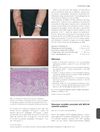
February 2010 in “British journal of dermatology/British journal of dermatology, Supplement” WNT10A mutations cause varied symptoms in patients with odonto-onycho-dermal dysplasia.
28 citations
,
June 1995 in “The Journal of Dermatology” The flaky skin mouse mutation is a natural model for studying human psoriasis.
 27 citations
,
July 2017 in “Scientific Reports”
27 citations
,
July 2017 in “Scientific Reports” N-WASP is essential for healthy skin and preventing inflammation.
22 citations
,
December 2015 in “The journal of investigative dermatology/Journal of investigative dermatology” A mouse gene mutation increases the risk of skin cancer.
 20 citations
,
October 2016 in “Veterinary dermatology”
20 citations
,
October 2016 in “Veterinary dermatology” Dogs with generalized discoid lupus erythematosus have similar symptoms to humans and need continuous treatment.
 20 citations
,
July 2006 in “Veterinary dermatology”
20 citations
,
July 2006 in “Veterinary dermatology” Melatonin helped some Pomeranian dogs regrow hair, but it wasn't linked to estrogen receptors.
18 citations
,
March 1992 in “Archives of Dermatology” The man's scarring alopecia and skin issues did not improve with treatments.
17 citations
,
October 2001 in “Veterinary dermatology” The skin issues in the two dogs might be caused by infection or self-injury, not genetics.
16 citations
,
June 2015 in “The journal of investigative dermatology/Journal of investigative dermatology” The enzyme DHHC13 is essential for healthy hair and skin, and its deficiency leads to hair loss and skin problems.
16 citations
,
August 2000 in “British Journal of Dermatology” Removing the liver tumor improved the patient's skin condition and hair growth.
15 citations
,
November 2024 in “Journal of Advanced Research” miR-3606-3p reduces skin fibrosis by blocking key signaling pathways.
12 citations
,
May 2021 in “The journal of investigative dermatology/Journal of investigative dermatology” Laminin 332 is essential for normal skin cell behavior and structure.
12 citations
,
January 2013 in “Indian dermatology online journal” Dermatopathia pigmentosa reticularis causes skin discoloration, hair loss, and nail problems.
12 citations
,
February 1986 in “PubMed” Injecting newborn mice with a niacin blocker caused skin, gut, and brain damage similar to human pellagra.
 11 citations
,
June 2012 in “Acta histochemica”
11 citations
,
June 2012 in “Acta histochemica” Mice with a Gsdma3 gene mutation have thicker skin and longer hair follicle openings due to increased β-catenin levels.
 9 citations
,
August 2017 in “Photochemistry and Photobiology”
9 citations
,
August 2017 in “Photochemistry and Photobiology” Red light at 627 nm can safely trigger IL-4 release in skin cells, potentially helping treat inflammatory skin conditions.
9 citations
,
June 2012 in “Joint Conference on Lexical and Computational Semantics” The gel effectively thickens eyelashes and eyebrows without side effects.
9 citations
,
September 2009 in “PubMed” Antigen presenting cells around hair follicles are crucial in SLE-related hair loss.
 9 citations
,
February 1981 in “Australian journal of biological sciences”
9 citations
,
February 1981 in “Australian journal of biological sciences” Lambs fed a liquid diet showed abnormal wool and skin, which improved with more B-vitamins, suggesting a link to B-vitamin deficiency.
 8 citations
,
July 2014 in “Hair transplant forum international”
8 citations
,
July 2014 in “Hair transplant forum international” Bio-enhanced hair restoration, using methods like growth factors, stem cells, and ATP, results in better hair growth and density than traditional hair transplants.
7 citations
,
May 2012 in “Journal of veterinary diagnostic investigation” Some young Angus cattle had skin problems due to not enough vitamin A, which got better after they were given more vitamin A.
7 citations
,
January 2002 in “PubMed” Prolonged UVB exposure causes significant skin changes and damage in rats.
 7 citations
,
November 1987 in “Pharmacotherapy: The Journal of Human Pharmacology and Drug Therapy”
7 citations
,
November 1987 in “Pharmacotherapy: The Journal of Human Pharmacology and Drug Therapy” Minoxidil can help thicken hair in some people with male pattern baldness, especially if used early and continuously.