
Baricitinib may reactivate trichilemmal cysts in people with a history of these cysts.
 November 2023 in “The journal of investigative dermatology/Journal of investigative dermatology”
 Cancer treatment drugs can cause permanent hair loss by damaging hair follicle stem cells, but a specific inhibitor might reverse this effect.
1 citations
,
January 2023 in “Dermatologic Therapy” Macrofocused ultrasound is a safe and effective treatment for reducing enlarged facial pores.
January 2005 in “Di-san junyi daxue xuebao” VEGF can boost hair growth in mice with scleroderma.
1 citations
,
September 2018 in “Apollo (University of Cambridge)” Phosphate starvation reduces calcium signaling in plant roots.
 October 2025 in “bioRxiv (Cold Spring Harbor Laboratory)”
 Aging reduces hair cell size and function in mice, contributing to hearing loss.
 March 2023 in “Journal of Applied Biomedicine”
 Oleanolic acid improved hair growth in mice by affecting hair growth pathways and reducing inflammation.
 April 2017 in “Journal of Investigative Dermatology”
 Eating a lot of fat increases PKCβ and inflammation in skin fat cells, which affects skin and hair health.
 April 2017 in “Journal of Investigative Dermatology”
 Targeted siRNA therapy may be a promising treatment for KID syndrome by reducing mutant gene expression and improving cell communication.
34 citations
,
June 2020 in “British journal of dermatology/British journal of dermatology, Supplement” Frontal fibrosing alopecia is linked to increased immune system activity and reduced stem cells, suggesting early treatment targeting this pathway might prevent hair follicle damage.
5 citations
,
August 2021 in “Experimental dermatology” Overexpressing Merkel cell virus proteins in human hair follicles can create clusters of cells that resemble Merkel cell cancer.
 July 2023 in “British journal of dermatology/British journal of dermatology, Supplement”
 HPV8 E6 gene causes growth of certain skin stem cells.
STAT5 and Sox18 are crucial for hair growth and wound healing.
 4 citations
,
November 2019 in “Biomedical Journal of Scientific and Technical Research”
4 citations
,
November 2019 in “Biomedical Journal of Scientific and Technical Research” The document concludes that the acoustic coupler SF-001 is good for skin ultrasound, especially on rough body parts, because it's stable and shows blood vessels well.
2 citations
,
August 2019 in “Electronics and Communications in Japan” The device mimics human hair follicles and detects tiny forces and moments with high sensitivity.
1 citations
,
January 2001 in “PubMed” Mechanoreceptors convert physical touch into electrical signals through specialized nerve structures.
1 citations
,
June 2019 in “IEEJ Transactions on Sensors and Micromachines” A new device mimics hair follicle functions and detects tiny forces with high sensitivity.
 170 citations
,
July 2012 in “Journal of Investigative Dermatology”
170 citations
,
July 2012 in “Journal of Investigative Dermatology” Wnt ligands are crucial for hair growth and repair.
 159 citations
,
October 2015 in “Science Advances”
159 citations
,
October 2015 in “Science Advances” Blocking JAK-STAT signaling can lead to hair growth.
 49 citations
,
October 2009 in “Cancer research”
49 citations
,
October 2009 in “Cancer research” Disrupting Stat3 in hair follicle stem cells greatly reduces skin tumor formation.
 22 citations
,
March 2021 in “Journal of Cutaneous Medicine and Surgery”
22 citations
,
March 2021 in “Journal of Cutaneous Medicine and Surgery” Ultrasound is a useful, non-invasive tool in dermatology for diagnosing skin conditions and guiding treatments, but it has some limitations.
 15 citations
,
July 1991 in “International Journal of Dermatology”
15 citations
,
July 1991 in “International Journal of Dermatology” Laser Doppler velocimetry is a valuable noninvasive tool for skin blood flow research in dermatology.
 1 citations
,
January 2023 in “Portuguese Journal of Dermatology and Venereology”
1 citations
,
January 2023 in “Portuguese Journal of Dermatology and Venereology” JAK inhibitors effectively treat skin conditions and topical forms are safer.
 January 2025 in “Acta Dermatovenerologica Alpina Pannonica et Adriatica”
 Baricitinib is effective and safe for treating severe alopecia areata.
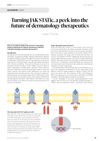 August 2024 in “New Zealand Medical Student Journal”
 JAK inhibitors show promise for treating skin diseases effectively and safely.
 January 2023 in “National Journal of Physiology, Pharmacy and Pharmacology”
 Tofacitinib effectively reduced hair loss in alopecia areata patients without adverse effects.
 December 2022 in “Revista Medicina Cutánea Ibero-Latino-Americana”
 JAK inhibitors help treat alopecia areata but have high recurrence after stopping.
 August 2022 in “Nature Biotechnology”
 Drug approvals slowed in 2Q22, but notable drugs like Amvuttra, Camzyos, and Olumiant were approved.
 6 citations
,
January 2015 in “Biochemical Society Transactions”
6 citations
,
January 2015 in “Biochemical Society Transactions” The Ysc84/SH3yl1 protein family is important for cell movement and the process of taking in materials by interacting with actin and cell membranes.
 June 2026 in “arXiv (Cornell University)”
 Hair beds in fluid show nonlinear response due to viscosity, inertia, and elasticity.