Trichopigmentation is a non-invasive, reversible treatment for hair loss that offers natural-looking results for both men and women.
30 citations
,
May 2020 in “Forensic Science International Genetics” The method improved hair analysis for better forensic identification.
July 2019 in “Indian dermatology online journal” Alopecia areata can show unusual red-dotted vessels and dithranol treatment may mask typical patterns.
 2 citations
,
June 2023 in “Skin Research and Technology”
2 citations
,
June 2023 in “Skin Research and Technology” Yellow dots and short vellus hairs are the most common signs of Alopecia Areata (AA), and trichoscopy can help diagnose AA and track treatment progress.
 96 citations
,
September 2017 in “Analytica Chimica Acta”
96 citations
,
September 2017 in “Analytica Chimica Acta” Hair elemental analysis could be useful for health and exposure assessment but requires more standardization and research.
 3 citations
,
April 2012 in “Bioinformation”
3 citations
,
April 2012 in “Bioinformation” Two specific SNPs in the TRPS1 gene cause excessive hair growth by altering the protein's structure.
 November 2017 in “British Journal of Dermatology”
 The electronic version of the Dermatology Life Quality Index is as effective as the paper version, with most patients preferring it.
 May 2026 in “Aesthetic Cosmetology and Medicine”
 Effective scalp problem treatment needs a comprehensive approach.
 5 citations
,
January 2018
5 citations
,
January 2018 The conclusion is that a new test was created to find substances that affect specific ion channels, and it works well for drug discovery.
The digital system for measuring melasma shows promise but needs more development for better accuracy and automation.
January 2013 in “CINECA IRIS Institutial research information system (University of Pisa)”  November 2025 in “Archives of Dermatological Research”
 Using a higher concentration of triamcinolone acetonide leads to faster hair regrowth in scalp patchy alopecia areata.
 November 2021 in “International Journal of Research in Dermatology”
 Low iron levels are linked to certain types of hair loss.
99 citations
,
July 2005 in “Ultramicroscopy” The research improved understanding of hair and skin properties across different ethnicities and conditions.
 2 citations
,
June 2020 in “Skin Research and Technology”
2 citations
,
June 2020 in “Skin Research and Technology” MRI reveals thinner scalps and smaller hair follicles in people with androgenetic alopecia.
 3 citations
,
April 2016 in “International Journal of Dermatology”
3 citations
,
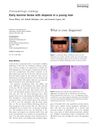
April 2016 in “International Journal of Dermatology” A young man was diagnosed with trichoepitheliomas, causing thick skin and hair loss.
 March 2022 in “Benha Journal of Applied Sciences”
 ULBP3 levels are higher in Tinea capitis patients and may help predict the disease's severity.
 1 citations
,
July 2017 in “International Journal of Advanced Research”
1 citations
,
July 2017 in “International Journal of Advanced Research” Tridax procumbens L. has compounds that can fight fungi.
 October 2018 in “InTech eBooks”
 Better tools are needed to assess alopecia effectively.
4 citations
,
April 2018 in “Journal of vacuum science and technology. B, Nanotechnology & microelectronics” The conclusion is that a new method can identify cosmetic residues on hair and match them to their products.
January 2007 in “Belarusian State Pedagogical University repository (Belarusian State Pedagogical University)” Certain hairstyles in an urban South African township are linked to specific scalp disorders.
April 2023 in “Journal of Investigative Dermatology” Trichohyalin in hair can trigger immune attacks in alopecia areata.
2 citations
,
July 2025 in “Analytical Chemistry” The method effectively images and correlates elements and metabolites in tissue samples at a micron scale.
January 2024 in “ResearchWorks at the University of Washington (University of Washington)” LA-ICP-MS effectively measures zinc, lead, and mercury in hair.
 November 2023 in “Skin appendage disorders”
 The article discusses ways to diagnose and treat hair loss in young people.
June 2026 in “Journal of Clinical Practice and Medical Case Report.” Trichotillomania can mimic alopecia areata, requiring careful diagnosis and consideration of psychosocial factors in treatment.
 67 citations
,
April 2018 in “JAMA Dermatology”
67 citations
,
April 2018 in “JAMA Dermatology” Hair loss from hormone therapy in breast cancer patients can be improved with minoxidil treatment.
 12 citations
,
June 2020 in “Journal of The American Academy of Dermatology”
12 citations
,
June 2020 in “Journal of The American Academy of Dermatology” Platelet-rich plasma is tolerable for lichen planopilaris and doesn't worsen the condition, but its effectiveness is unclear.
 January 2026 in “International Journal of Science and Research (IJSR)”
 AI is now essential in Indian aesthetic medicine.
 December 2025 in “Aesthetic Cosmetology and Medicine”
 Injectable platelet-rich fibrin therapy improved hair and scalp conditions in women with excessive hair loss.