 28 citations
,
November 2018 in “Journal of Cellular and Molecular Medicine”
28 citations
,
November 2018 in “Journal of Cellular and Molecular Medicine” CXXC5 is a protein that controls cell growth and healing processes, and changes in its activity can lead to diseases like cancer and hair loss.
 5 citations
,
January 2010 in “The anatomical record”
5 citations
,
January 2010 in “The anatomical record” Most dogs have hair whorls on their chest and limbs, with shelter dogs and short-haired dogs having more chest whorls.
133 citations
,
August 1969 in “Science” Melatonin causes weasels to grow white fur and become reproductively inactive.
November 2025 in “Journal of Investigative Dermatology” A new genetic mutation causing Xeroderma Pigmentosum was found in an 8-year-old girl, affecting her DNA repair.
 March 2026 in “Mendeley Data”
 rwSALT accurately measures hair regrowth in alopecia areata using scalp photos.
January 2023 in “Indian Dermatology Online Journal” Uncombable hair syndrome is linked to Zellweger syndrome.
8 citations
,
August 2019 in “ACR Open Rheumatology” Defective repair processes may cause immune activation and inflammation in psoriatic disease.
2 citations
,
June 2013 in “Journal of Clinical Pathology” The LMNA mutation affects skin structure even in asymptomatic carriers.
15 citations
,
June 2019 in “Biochemical Journal” A new genetic disorder caused by an ODC1 mutation can be treated with DFMO.
June 2023 in “Zenodo (CERN European Organization for Nuclear Research)” 25 citations
,
April 1985 in “Journal of Investigative Dermatology”  20 citations
,
August 2014 in “PloS one”
20 citations
,
August 2014 in “PloS one” MED1 affects skin wound healing differently in young and old mice.
 40 citations
,
February 1990 in “Journal of The American Academy of Dermatology”
40 citations
,
February 1990 in “Journal of The American Academy of Dermatology” A 17-year-old developed woolly hair nevus in adolescence, which is unusual, and over time the hair darkened and straightened slightly, but microscopic changes persisted.
 1 citations
,
January 2013 in “The Journal of Dermatology”
1 citations
,
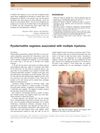
January 2013 in “The Journal of Dermatology” A skin condition called pyodermatitis vegetans was found in a patient with multiple myeloma for the first time.
September 2024 in “Clinical Case Reports” Early recognition and multidisciplinary management of Whitaker syndrome can improve patient outcomes.
19 citations
,
July 2019 in “Journal of Endocrinology” GTx-024 and Danazol affect the uterus like DHT, while GTx-007 has little impact.
 January 1994 in “Nippon Ronen Igakkai Zasshi Japanese Journal of Geriatrics”
 Both VEPA and ML-Y1 treatments are not effective enough for elderly non-Hodgkin's lymphoma patients.
 31 citations
,
April 2018 in “Royal Society open science”
31 citations
,
April 2018 in “Royal Society open science” Sarcoptes scabiei infection causes significant health and behavior changes in wombats.
March 2024 in “Preprints.org” Activated protein C helps protect mice from radiation damage.
June 2020 in “Comparative medicine” NSG mice had the most mites, and genetic factors affect immune response and susceptibility.
28 citations
,
September 2014 in “Journal of Veterinary Internal Medicine” VDC-1101 shows potential as a treatment for canine cutaneous T-cell lymphoma.
The naked mutation in mice causes hair loss and helps identify keratin genes.
 4 citations
,
December 2021 in “The journal of investigative dermatology/Journal of investigative dermatology”
4 citations
,
December 2021 in “The journal of investigative dermatology/Journal of investigative dermatology” Overactive Wnt signaling in mouse skin stem cells causes acne-like cysts and shrinking oil glands, which some treatments can partially fix.

The new sensor can detect a toxic chemical in water with high sensitivity and accuracy.
11 citations
,
December 2013 in “Clinical and experimental dermatology” A child with skin and heart issues had rare genetic mutations affecting skin and heart cell cohesion.
 March 2025 in “Advanced Science”
 Bioengineered hair germs using special hydrogels can help regenerate hair follicles and treat hair loss.
January 2004 in “Giornale di Metafisica: revista bimestrale di filosofia” Increased Wnt signaling causes hair graying by depleting melanocyte stem cells in aged mice.
July 2025 in “Frontiers in Medicine” Mutations in the LIPH gene cause woolly hair in a child.
293 citations
,
September 2004 in “Development” WNT signaling is crucial for starting mammary gland development.
 March 2026 in “International Journal of Science Strategic Management and Technology”
 WomenCare helps predict PCOD risk in women to encourage early medical consultation.