 1 citations
,
February 2022 in “bioRxiv (Cold Spring Harbor Laboratory)”
1 citations
,
February 2022 in “bioRxiv (Cold Spring Harbor Laboratory)” A peptide from hair follicle stem cells promotes hair growth by activating specific skin cells.
3 citations
,
November 2021 in “Journal of Clinical Laboratory Analysis” hsa_circ_0001079 may help diagnose and treat hair loss.
January 2024 in “Wiadomości Lekarskie” DEC cells show promise as a safe and effective treatment for Duchenne muscular dystrophy.
 10 citations
,
July 2022 in “Journal of Medicinal Chemistry”
10 citations
,
July 2022 in “Journal of Medicinal Chemistry” Adding a second method to PROTACs could improve cancer treatment.
 25 citations
,
June 2018 in “Journal of The American Academy of Dermatology”
25 citations
,
June 2018 in “Journal of The American Academy of Dermatology” Genes linked to fibrosis are more active in people with central centrifugal cicatricial alopecia.
Deleting the MAD2L1 gene in mice led to rapid tumor growth despite chromosomal instability.
1 citations
,
July 2025 in “Advanced Materials” The zinc-coordinated nanogel therapy speeds up wound healing after pancreas surgery by balancing metabolism and fighting bacteria.
3 citations
,
March 2024 in “Journal of Biomedical Materials Research Part A” The nanogel helps wounds heal without scars.
9 citations
,
March 2022 in “Military Medical Research” Small molecules can help turn skin cells into sweat gland-like cells for potential skin repair.
April 2019 in “Journal of Investigative Dermatology” The humanized AA mouse model is better for testing new alopecia areata treatments.
1 citations
,
July 2024 in “Journal of Investigative Dermatology” Immune cells boost stem cell activity in hairy moles, causing more hair growth.
Ganoderma lucidum extract and microneedle therapy promote hair growth in mice.
 64 citations
,
January 2015 in “BioMed Research International”
64 citations
,
January 2015 in “BioMed Research International” Certain growth factors can promote hair growth in mice by activating hair growth-related proteins.
October 2025 in “Clinical and Experimental Pediatrics” A novel CLDN1 mutation in a 2-month-old with NISCH showed improvement with symptom management.
 July 2026 in “Zenodo (CERN European Organization for Nuclear Research)”
 Biochanin A from soy is a promising and safe candidate for treating hair loss.
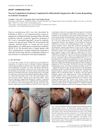 14 citations
,
January 2015 in “Acta dermato-venereologica”
14 citations
,
January 2015 in “Acta dermato-venereologica” Acitretin significantly reduced inflammatory attacks in a woman with Naevus Comedonicus Syndrome but caused side effects.
28 citations
,
June 2020 in “ACS Biomaterials Science & Engineering” The new ECM patch greatly improves wound healing and tissue regeneration.
3 citations
,
July 2022 in “Brain and Behavior” The HtrA1L364P mutation causes brain dysfunction and blood vessel damage.
2 citations
,
May 2015 in “International Journal of Scientific Reports” Neonatal mesenchymal stem cell therapy shows promise for treating hair loss but needs more research.
January 2026 in “ACS Applied Bio Materials” A new treatment using nanoliposomes can improve hair regrowth in androgenetic alopecia.
January 2026 in “Biomacromolecules” A new method using nanolipogels with fucosterol can help regrow hair by targeting follicles, reducing inflammation, and improving blood flow.
 January 2024 in “International Journal of Molecular Sciences”
 Blocking the protein CXCL12 with a specific antibody can increase hair growth in common hair loss conditions.
 104 citations
,
October 2016 in “PLoS ONE”
104 citations
,
October 2016 in “PLoS ONE” CRISPR/Cas9 gene editing in cashmere goats increases hair follicles and fiber length, boosting cashmere yield.
June 2025 in “Molecular Genetics & Genomic Medicine” Severe genetic variants in children with a specific adrenal condition match predicted symptoms well, but milder variants do not.
 April 2026 in “Journal of Nanobiotechnology”
 A new microneedle system effectively treats hair loss by delivering drugs directly to hair follicles.
September 2025 in “OPAL (Open@LaTrobe) (La Trobe University)” AR-27 E-Chol siRNA can effectively promote hair regrowth for androgenetic alopecia.
June 2026 in “Strathprints: The University of Strathclyde institutional repository (University of Strathclyde)” Topical IKKα inhibitors may help prevent CCS tumours.
66 citations
,
June 2004 in “Development” FGF signaling is crucial for starting feather development in chicken embryos.
 2 citations
,
June 2012 in “PubMed”
2 citations
,
June 2012 in “PubMed” The document concludes that central centrifugal cicatricial alopecia (CCCA) should be considered in African American men with vertex hair loss and scalp symptoms, and that prompt diagnosis and treatment can slow disease progression.