A new mutation in the CYP11B1 gene was found in a woman with mild hyperandrogenemia, a rare cause of non-classic congenital adrenal hyperplasia.
January 1983 in “Elsevier eBooks” Masculinization in affected individuals occurs gradually after puberty due to hormone changes.
April 2019 in “Journal of the Endocrine Society” A 31-year-old woman was diagnosed with Complete Androgen Insensitivity Syndrome much later than usual, leading to a call for earlier detection and treatment guidelines.
 September 2025 in “Cureus”
 Early recognition and multidisciplinary management are crucial for improving outcomes in Parry-Romberg syndrome.
 April 2024 in “Research Square (Research Square)”
 A 27-year-old with APS-1 showed improvement in symptoms after treatment.
 June 2026 in “Archives of Dermatological Research”
 The rs4541843 variant is linked to higher risk and severity of alopecia areata.
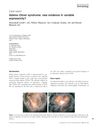 December 2013 in “International Journal of Dermatology”
 The clinical signs of Adams-Oliver syndrome can vary greatly, even among family members.
January 2024 in “Ankara City Hospital Medical Journal” Rhupus is a complex syndrome that combines rheumatoid arthritis and lupus, making diagnosis challenging.
 June 2022 in “Indian journal of clinical and experimental opthalmology”
 The report shows a young man with Hutchinson-Gilford Progeria Syndrome had typical and additional eye problems related to the disease.
8 citations
,
October 2014 in “The Journal of Dermatology” Patients with alopecia areata should be checked for muscle spasms, diarrhea, and ANA to avoid missing Satoyoshi syndrome.
 42 citations
,
April 2013 in “Steroids”
42 citations
,
April 2013 in “Steroids” Non-classic congenital adrenal hyperplasia is a common disorder causing symptoms like acne and infertility, and it's managed based on symptoms, not just test results. Treatment can improve fertility and reduce miscarriage risk.
 18 citations
,
December 2006 in “Clinical dysmorphology”
18 citations
,
December 2006 in “Clinical dysmorphology” A 2-year-old boy with a rare brain malformation may have Gomez–López-Hernández syndrome.
 15 citations
,
January 2010 in “Reproduction, Fertility and Development”
15 citations
,
January 2010 in “Reproduction, Fertility and Development” A certain gene variant may increase the risk of polycystic ovary syndrome in Chinese women.
April 2019 in “Journal of the Endocrine Society” A 12-year-old boy with PAIS successfully developed male characteristics using high-dose testosterone and anastrozole.
January 2017 in “Elsevier eBooks” Congenital Adrenal Hyperplasia is mainly caused by enzyme deficiencies, leading to varying symptoms like hormone imbalances and physical changes.
20 citations
,
January 2002 in “Laboratory Animals” Mutations in the hairless gene cause hair loss and skin cysts in rhesus macaques.
10 citations
,
May 1974 in “American journal of diseases of children” The girl had a rare disorder causing mental and physical symptoms, with weak hair and unclear neurological issues.
50 citations
,
February 2007 in “The Journal of Pathology” Somatic BHD mutations are rare in Japanese renal tumors.
6 citations
,
January 1997 in “Pediatric dermatology” The case suggests a possible link between severe acne and certain bone deformities.
February 2025 in “Journal of Paediatrics and Child Health” Genetic analysis is crucial for diagnosing ectodermal dysplasia syndromes, and new therapies may help improve skin issues.
3 citations
,
January 2013 in “Dermatology” New genetic mutations causing hair loss were found in a Chinese family.
January 2022 in “Dubai diabetes and endocrinology journal/Dubai diabetes & endocrinology journal” A 16-year-old girl with HAIR-AN syndrome was treated with lifestyle changes and medications to manage her condition.
78 citations
,
August 1996 in “The Journal of Clinical Endocrinology & Metabolism” The same gene mutation can cause different symptoms in family members.
21 citations
,
March 2015 in “Neurological Sciences” A new genetic mutation linked to CARASIL syndrome and small artery disease was found in a Chinese family.
 January 2024 in “Ankara City Hospital Medical Journal”
 Rhupus is a complex syndrome that is hard to diagnose due to unclear clinical criteria.
4 citations
,
January 2020 in “Dermatology Online Journal” Congenital atrichia with papular lesions causes permanent hair loss and skin bumps due to a gene mutation.
 1 citations
,
January 2020 in “Skin appendage disorders”
1 citations
,
January 2020 in “Skin appendage disorders” A family was found with both Trichorhinophalangeal syndrome and Loose Anagen Syndrome, suggesting a genetic connection.
September 2025 in “JCEM Case Reports” Consider rare forms of CAH for accurate diagnosis and treatment.
6 citations
,
May 2000 in “Pediatric Dermatology” KID syndrome should be reclassified as an ectodermal dysplasia.
 September 2025 in “Indian Journal of Child Health”
 Satoyoshi Syndrome is hard to diagnose and treat due to its rarity and complex symptoms.