 12 citations
,
November 1987 in “Pediatric dermatology”
12 citations
,
November 1987 in “Pediatric dermatology” Four children had unmanageable pale blond hair due to uncombable-hair syndrome.
July 2009 in “International Journal of Cosmetic Science” Japanese women's curved hair has an uneven internal structure and varied amino acid composition.
16 citations
,
October 1992 in “Journal of cutaneous pathology” Bubble hair deformity may be caused by hair shaft trauma and can improve with gentle hair care.
 19 citations
,
October 1985 in “British Journal of Dermatology”
19 citations
,
October 1985 in “British Journal of Dermatology” The document concludes that unruly hair can be congenital or acquired, often lacks specific treatments, and can be managed with oils and short hairstyles.

Hair feels different when touched and rubs together in various ways.
3 citations
,
January 2013 in “Journal of cosmetics, dermatological sciences and applications” HAIRCARECUBE TM (HCC) helps hair products work better by getting active ingredients deeper into the hair.

Moisture makes hair flexible for reshaping during blowouts.
65 citations
,
May 2006 in “Journal of Structural Biology” Hair curliness is due to uneven distribution of different cortices within the hair fiber.
147 citations
,
September 2001 in “Computer graphics forum” The authors created a realistic and efficient method to simulate hair movement by combining fluid dynamics with individual hair strand behavior.
 January 2012 in “International Journal of Trichology”
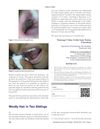
 Two siblings have a rare genetic condition causing curly, coarse hair.
 3 citations
,
October 2020 in “Dermatology Practical & Conceptual”
3 citations
,
October 2020 in “Dermatology Practical & Conceptual” Bubble hair damage is caused by high heat from styling tools, and trichoscopy helps diagnose it.
September 2025 in “Cosmetics” Lipid content and structure affect water absorption in different hair types.
22 citations
,
May 2019 in “Animals” High hair cortisol levels indicate stress in cows due to poor shelter conditions and health issues.
 March 2005 in “International Journal of Cosmetic Science”
 A new method helps understand hair shine and various products improve hair care.
48 citations
,
August 1998 in “Developmental Biology” Deleting part of a gene in mice causes wavy hair and high pup loss.
 January 2009 in “Nihon Keshouhin Gijutsushakaishi/Journal of S C C./Nihon Keshouhin Gijutsushakai kaishi”
 Curved human hair has different structures on each side, which might cause its shape and is similar to wool.
18 citations
,
August 2009 in “Skin Research and Technology” OCT can identify hair structures, but chemical treatments can damage them.
2 citations
,
July 2013 in “Acervo Digital da Universidade Estadual Paulista (Universidade Estadual Paulista)” The shampoo effectively defines and models curls while reducing frizz and volume.
February 2013 in “Journal of the American Academy of Dermatology” Uncombable hair syndrome causes dry, frizzy hair that can't be combed flat, seen in a young child.
29 citations
,
January 2003 in “Genomics” A new mouse mutation causes skin and hair issues, influenced by another gene.
16 citations
,
January 1977 13 citations
,
October 2008 in “PubMed” Japanese women's curved hair has an uneven internal structure and varying amino acid composition.
15 citations
,
August 2020 in “Analytical chemistry” Hair lipids do not protect against humidity.
3 citations
,
December 2021 in “Skin research and technology” Higher hair luminosity and shine mean higher perceived transparency.
254 citations
,
January 2007 in “Chemical Society Reviews” Hair is a complex protein fiber with unique properties useful for developing hair products.

The conclusion cannot be provided because the document is not accessible.
Hair cortisol content can indicate cortisol exposure and varies with age, puberty, and BMI in youth.
November 2024 in “Journal of Microscopy” Human hair varies in structure based on curl type, with high curl hair showing the most differences.
 3 citations
,
August 1980 in “Acs Symposium Series”
3 citations
,
August 1980 in “Acs Symposium Series” Hair increases in size when it absorbs water, and treatments like bleaching affect how much water it can take in.
 52 citations
,
August 1978 in “Journal of Applied Polymer Science”
52 citations
,
August 1978 in “Journal of Applied Polymer Science” Human hair's ability to get wet is complex and can change with treatments, damage, and environment.