 January 2009 in “Nihon Keshouhin Gijutsushakaishi/Journal of S C C./Nihon Keshouhin Gijutsushakai kaishi”
 Curved human hair has different structures on each side, which might cause its shape and is similar to wool.
July 2026 in “Open Minds International Journal” HIVEN Curl Code® may improve curly hair by reducing frizz and maintaining moisture.
 19 citations
,
October 1985 in “British Journal of Dermatology”
19 citations
,
October 1985 in “British Journal of Dermatology” The document concludes that unruly hair can be congenital or acquired, often lacks specific treatments, and can be managed with oils and short hairstyles.

Curly hair may be caused by a muscle contraction, and muscle relaxants might help treat it.
 May 2023 in “Accounts of chemical research”
 New methods can better classify curly hair types and lead to improved hair care products.
28 citations
,
March 2014 in “Biological reviews/Biological reviews of the Cambridge Philosophical Society” The document concludes that hair curvature can be explained by the growth patterns caused by the shape and separation of cells in the hair follicle and is affected by specific molecular pathways.
8 citations
,
July 2019 in “The journal of investigative dermatology/Journal of investigative dermatology” Curly hair is mechanically different from straight hair and may need new testing methods.
2 citations
,
July 2013 in “Acervo Digital da Universidade Estadual Paulista (Universidade Estadual Paulista)” The shampoo effectively defines and models curls while reducing frizz and volume.
 January 2024 in “Indian Journal of Pharmaceutical Sciences”
 Relaxing certain muscles might straighten curly hair.
10 citations
,
June 2019 in “Cosmetics” Mixed-race individuals have hair with varied shapes and more root damage.
 1 citations
,
April 2022 in “International Journal of Women's Dermatology”
1 citations
,
April 2022 in “International Journal of Women's Dermatology” Classifying curl patterns might help doctors assess and treat hair loss better.
Frizzy hair is fragile and can lead to hair loss and damage if not properly cared for.
November 2024 in “Journal of Microscopy” Human hair varies in structure based on curl type, with high curl hair showing the most differences.
 December 2023 in “Data in Brief”
 Curly hair's strength and flexibility vary with moisture and temperature.
4 citations
,
July 2010 in “International Journal of Cosmetic Science” Curved human hair has different structures on its convex and concave sides.
 January 2024 in “Indian Journal of Pharmaceutical Sciences”
 Relaxing the Arrector Pili Muscle might make curly hair straighter.
Black hair's diversity in patterns and textures is influenced by follicle shape and keratin, and it holds cultural, artistic, and mathematical significance.
78 citations
,
June 2003 in “Journal of the American Academy of Dermatology” Curly hair shape is determined by the hair bulb.
The curly mutation in SELH/Bc mice affects hair and may help study human genetic disorders.
 September 2015 in “The European physical journal. E, Soft matter and biological physics/The European physical journal. E, Soft matter”
 Longer time setting curls overnight leads to better curl retention.
 January 2012 in “International Journal of Trichology”
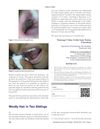
 Two siblings have a rare genetic condition causing curly, coarse hair.
1 citations
,
January 2025 in “International Journal of Cosmetic Science” Age-related hair curvature increases due to internal structural changes from grooming.
April 2026 in “Journal of Cosmetic Dermatology” More research is needed to create personalized treatments for seborrheic dermatitis in people with curly hair.
October 2012 in “한국미용학회지” For best curls and hair health, use keratin and ceramide after rinsing, or skip rinsing for stable curls.
 9 citations
,
September 2016 in “Plastic and reconstructive surgery. Global open”
9 citations
,
September 2016 in “Plastic and reconstructive surgery. Global open” The curved nonrotary punch is better for hair extraction in people with tightly curled hair.
April 2017 in “Journal of Dermatological Science” Asymmetric hair follicle differentiation causes the unique shape of kinky hair.
 21 citations
,
July 2010 in “International Journal of Cosmetic Science”
21 citations
,
July 2010 in “International Journal of Cosmetic Science” Older people's hair becomes less shiny because it gets more uneven and curved.
2 citations
,
July 2019 in “Cosmetics” Beautiful hair is flexible and elastic due to its unique double-layered structure and can be enhanced with succinic acid treatment.
 February 2024 in “Journal of Dermatological Science”
 Curved hair can develop when hair cells merge abnormally during growth.
1 citations
,
July 1935 in “Nature” Animal hair can curl tightly on its own, especially in foxes, due to changes in keratin.