 December 2025 in “Italian Journal of Anatomy and Embryology”
 Understanding embryologic layers improves skin disorder diagnosis and supports developing targeted therapies.

Correcting EDA fibronectin organization and YAP translocation can improve wound healing in fibrotic conditions.

Human hair keratins can self-assemble and support cell growth, useful for biomedical applications.
 July 2011 in “British Journal of Dermatology”
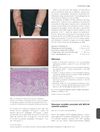
 Dermatologists give better information on pathology forms, hypersensitivity vasculitis is a common skin issue, misdiagnoses can occur, and various skin conditions are linked to loss of elastin or genetic factors.
4 citations
,
February 2023 in “Stem Cell Research & Therapy” Mouse skin cells can become sperm-like cells in the lab.
 July 2024 in “Journal of Nanobiotechnology”
 Mouse cell exosomes help hair regrowth and wound healing by activating a specific signaling pathway.
 February 2026 in “Cosmetics”
 These supernatants may help reduce hair loss by protecting hair cells.
 28 citations
,
February 2010 in “British journal of dermatology/British journal of dermatology, Supplement”
28 citations
,
February 2010 in “British journal of dermatology/British journal of dermatology, Supplement” WNT10A mutations cause varied symptoms in patients with odonto-onycho-dermal dysplasia.
 12 citations
,
September 2020 in “Stem cell research & therapy”
12 citations
,
September 2020 in “Stem cell research & therapy” Adult skin cell-based early-stage skin substitutes improve wound healing and hair growth in mice.
11 citations
,
January 2025 in “Regenerative Therapy” Tissue-engineered scaffolds help heal difficult wounds by supporting cell growth and repair.
 4 citations
,
October 2017 in “Advances in tissue engineering & regenerative medicine”
4 citations
,
October 2017 in “Advances in tissue engineering & regenerative medicine” Researchers created a potential skin substitute using a biodegradable mat that supports skin cell growth and layer formation.
 June 2026 in “International Journal of Molecular Sciences”
 Black Ginseng Concentrate may help treat hair loss by improving cell function and reducing stress.
January 2026 in “Materialia” Porcine ADM scaffold helps hair growth in mice.
July 2024 in “Journal of Investigative Dermatology” April 2024 in “UNESP Institutional Repository (São Paulo State University)” Alpaca skin has glands, hair follicles, and different collagen types.
 3 citations
,
September 2022 in “Journal of Drug Delivery Science and Technology”
3 citations
,
September 2022 in “Journal of Drug Delivery Science and Technology” Minoxidil, a hair loss treatment, works better and has fewer side effects when put into tiny particles called transethosomes, especially those containing oleic acid.

Platelet-rich plasma improves skin flap survival by reducing tissue death.
May 2019 in “Faculty Opinions – Post-Publication Peer Review of the Biomedical Literature” 418 citations
,
January 2018 in “Journal of Investigative Dermatology” Researchers found four distinct fibroblast types in human skin, which could help in treating wounds and fibrotic diseases.
 68 citations
,
March 2018 in “Biomaterials”
68 citations
,
March 2018 in “Biomaterials” Large-scale fibronectin nanofibers help heal wounds and repair tissue in a skin model of a mouse.
Different types of sun exposure damage skin cells and immune cells, with chronic exposure leading to more severe and lasting damage.
1 citations
,
January 2016 in “Journal of Clinical & Experimental Dermatology Research” 110 citations
,
August 2011 in “Journal of Visualized Experiments” 3D skin models better mimic human skin and melanoma progression than older methods.
December 2025 in “Advanced Healthcare Materials” The Spherical Skin Model improves drug and cosmetic testing by accurately mimicking human skin for efficient compound screening.
5 citations
,
October 2020 in “Bioengineering & translational medicine” Researchers used a laser to create advanced skin models with hair-like structures.
 February 2022 in “Journal of Investigative Dermatology”
 Newborn skin cells can change into wound-healing cells more easily than adult ones, which might explain why baby skin heals without scars. Understanding this could help treat chronic wounds and prevent scarring.
January 2022 in “Springer eBooks” Fibroblast growth factors are crucial for hair follicle development and regeneration.
3 citations
,
May 2011 in “Facial plastic surgery clinics of North America” Laser treatments can effectively reduce fine wrinkles and improve skin texture.
11 citations
,
April 1993 in “PubMed” Human hair cells can change based on their environment, especially interactions with certain skin cells.
 June 2026 in “HAL (Le Centre pour la Communication Scientifique Directe)”
 SH‑1 is safer for cosmetic use than PP405.