 27 citations
,
May 2006 in “Biochemical and Biophysical Research Communications”
27 citations
,
May 2006 in “Biochemical and Biophysical Research Communications” Wnt-10b is important for starting hair growth and developing hair follicles.
11 citations
,
June 2010 in “Medical Molecular Morphology” 14 citations
,
September 2001 in “Archives of Dermatological Research” Blocking hair follicle development stops key gene signals needed for hair growth in mice.
 June 2022 in “Research Square (Research Square)”
 Nestin-expressing cells turn into a specific type of skin cell in hair follicles during development and in adults.
 10 citations
,
September 2018 in “Regenerative Medicine”
10 citations
,
September 2018 in “Regenerative Medicine” New hair can grow from large wounds in mice, but less so as they age, involving reprogramming of skin cells and specific molecular pathways.
71 citations
,
November 2005 in “The journal of investigative dermatology. Symposium proceedings/The Journal of investigative dermatology symposium proceedings” Edar signaling is crucial for proper hair follicle development and function.
April 2016 in “The journal of investigative dermatology/Journal of investigative dermatology” Activating Sonic Hedgehog signaling in cancer stroma may help treat basal cell carcinoma.
 12 citations
,
December 2020 in “Archives animal breeding/Archiv für Tierzucht”
12 citations
,
December 2020 in “Archives animal breeding/Archiv für Tierzucht” EDA and EDAR are important for hair follicle development in cashmere goats and affect other related genes.
January 2010 in “Chinese journal of clinical anatomy” Hair follicles in C57BL/6 mice develop rapidly from late embryonic stages to shortly after birth, with key growth and regeneration phases identified.
193 citations
,
May 2008 in “Development” Activating β-catenin can turn skin cells into hair follicles.
Tan sheep's unique fur traits are determined during the embryonic stage by specific genes.
81 citations
,
September 2009 in “Birth defects research” Different body areas in mice produce different hair types due to interactions between skin layers.
173 citations
,
August 2015 in “Developmental cell” The study identified unique genes in hair follicle cells and their environment, suggesting these genes help organize cells for hair growth.
 3 citations
,
November 2018 in “Curēus”
3 citations
,
November 2018 in “Curēus” The cause and importance of misplaced oil glands in the hair follicle are not well understood.
 73 citations
,
July 1956 in “Journal of Investigative Dermatology”
73 citations
,
July 1956 in “Journal of Investigative Dermatology” Adult human skin can grow new fine hair follicles after a deep exfoliation treatment.
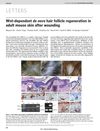 829 citations
,
May 2007 in “Nature”
829 citations
,
May 2007 in “Nature” Hair follicles can regrow in wounded adult mouse skin using a process like embryo development.
 May 2007 in “Science's STKE”
 Healing skin wounds in mice can create new hair follicles, and adjusting Wnt signaling could potentially reduce scarring and treat hair loss.
54 citations
,
January 2009 in “Development” β-catenin, Shh, and Bmp signaling control hair follicle development.
77 citations
,
April 1968 in “Development” Excess vitamin A can cause hair follicles to change into gland-like structures.
12 citations
,
August 2007 in “Human Molecular Genetics” Lymphotoxin-β is crucial for proper skin development in embryos.
 5 citations
,
January 2022 in “PloS one”
5 citations
,
January 2022 in “PloS one” Deleting the p63 gene in certain cells causes problems in thymus development and severe hair loss in mice.
 43 citations
,
January 2012 in “Biological Research”
43 citations
,
January 2012 in “Biological Research” The origins of many adult skin stem cells are still mostly unknown.

ARHGEF3 is essential for proper hair follicle development.
Hedgehog signaling can create new hair follicles in adult skin but may increase cancer risk.
 July 2022 in “Journal of Investigative Dermatology”
 Lef1 is essential for normal skin, hair growth, and healing wounds in mice.
 25 citations
,
May 2013 in “Journal of mammary gland biology and neoplasia”
25 citations
,
May 2013 in “Journal of mammary gland biology and neoplasia” Hedgehog signaling is crucial for mammary gland development over hair follicles.
8 citations
,
January 2025 in “Journal of Investigative Dermatology” Fetal skin has diverse fibroblast types that change as it develops.
 17 citations
,
December 2006 in “Gene Expression Patterns”
17 citations
,
December 2006 in “Gene Expression Patterns” Scube3 gene affects mouse embryo growth in multiple areas, but needs more research.
July 2008 in “VTechWorks (Virginia Tech)” PrPC is important for neural differentiation in cattle and mouse embryonic stem cells.
 April 2017 in “Journal of Investigative Dermatology”
 Deleting the CRIF1 gene in mice disrupts skin and hair formation, certain proteins affect hair growth, a new compound may improve skin and hair health, blood cell-derived stem cells can create skin-like structures, and hair follicle stem cells come from embryonic cells needing specific signals for development.