 12 citations
,
December 2020 in “Archives animal breeding/Archiv für Tierzucht”
12 citations
,
December 2020 in “Archives animal breeding/Archiv für Tierzucht” EDA and EDAR are important for hair follicle development in cashmere goats and affect other related genes.
11 citations
,
March 2004 in “Journal of Comparative Pathology” Norfolk Terriers have a genetic skin defect causing scaling and blisters due to a keratin issue.
4 citations
,
January 2006 in “International Journal of Cosmetic Science” The method shows how hair lipids form specific patterns and their roles in hair structure.
 4 citations
,
July 2014 in “International Journal of Dermatology”
4 citations
,
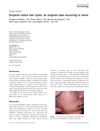
July 2014 in “International Journal of Dermatology” Twins had rare skin cysts likely due to genetics.
June 2023 in “bioRxiv (Cold Spring Harbor Laboratory)” Scientists created cell lines to study a genetic skin disorder using CRISPR technology.
19 citations
,
February 2013 in “Archives of Dermatological Research” 56 citations
,
November 1958 in “The Journal of Cell Biology” A unique skin cell similar to hair bulb melanocytes was identified, with better preservation using permanganate fixation.
2 citations
,
June 2010 in “Medicina de Familia SEMERGEN” The girl's "dandruff" was actually harmless hair casts, not a hygiene issue.
 May 2024 in “Journal of drug delivery science and technology”
 Exosomes show promise for treating skin diseases and improving skin regeneration.
1 citations
,
May 2024 in “Journal of Dermatological Science” Injecting specific cells into the skin can help improve skin structure and reduce blisters in a genetic skin disorder.
January 2007 in “UKnowledge (University of Kentucky)” Steers with winter hair coats and reduced sweating struggled with heat, leading to less grazing and poor performance.
11 citations
,
January 1988 in “PubMed” Epidermal cell extracts improve skin healing and reduce scarring.
 June 2026 in “Institutional Repositories DataBase (IRDB)”
 Crickets have genetically controlled hair plates that help them sense and move their antennae.
January 2005 in “Australian viticulture” Different tissues in cows have different types of cytokeratins.
 September 2019 in “Journal of Investigative Dermatology”
 Scientists used stem cells to create a model of the skin disease Epidermolysis Bullosa simplex, which helped them understand its molecular mechanisms and could aid in finding treatments.
56 citations
,
February 2012 in “Developmental biology” Sostdc1 controls the size and number of hair and mammary gland structures.
7 citations
,
May 1995 in “The journal of investigative dermatology/Journal of investigative dermatology”  33 citations
,
December 2004 in “Differentiation”
33 citations
,
December 2004 in “Differentiation” Mouse amnion can turn into skin and hair follicles with help from certain cells and factors.
January 1981 in “Purdue e-Pubs (Purdue University)” Pig skin is similar to human skin, with no major changes as they age.
15 citations
,
December 2020 in “International journal of molecular sciences” Epidermal stem cells create and maintain skin structures like hair and nails through specific signaling pathways and vary by location and function.
1 citations
,
February 2024 in “Journal of Microscopy and Ultrastructure” Exosomes from stem cells speed up wound healing.
July 2025 in “Journal of Investigative Dermatology” Tissue-engineered skin substitutes can model junctional epidermolysis bullosa and may help develop gene therapy.
14 citations
,
February 2011 in “Experimental dermatology” A protein called COMP is part of the connective tissue in normal human hair follicles and may be important for hair health.
 May 2025 in “Journal of Developmental Biology”
 Jawless vertebrates have teeth proteins similar to those in mammalian hair and nails.
126 citations
,
January 1987 in “Current topics in developmental biology/Current Topics in Developmental Biology” Different keratin proteins are expressed in various epithelial cells at different stages, affecting cell structure and function.
17 citations
,
November 1967 in “American Journal of Anatomy” Hairless mice have longer hair follicles and abnormal structures during the catagen phase.
 3 citations
,
January 2023 in “Regenerative Medicine”
3 citations
,
January 2023 in “Regenerative Medicine” Exosomes show promise for skin and hair rejuvenation, but more research and regulation are needed before they can be widely used.
15 citations
,
November 2009 in “Journal of Comparative Pathology” Epidermolysis bullosa in calves was not caused by mutations in the keratin genes bKRT5 and bKRT14.
2 citations
,
June 2025 in “Chemical Engineering Journal” The hydrogel helps heal seawater-immersed wounds by reducing infection and inflammation.
35 citations
,
September 2009 in “Development” Necl2 affects skin cell behavior and slows wound healing.