 April 2017 in “Journal of Investigative Dermatology”
 Scientists created a tiny, 3D model of a hair follicle that grows and acts like a real one.
30 citations
,
October 1994 in “Journal of Cutaneous Pathology” Multiple perifollicular fibromas may actually be unrecognized cases of Birt-Hogg-Dubé syndrome.
8 citations
,
October 2024 in “Developmental Cell” 28 citations
,
October 1985 in “The Journal of Cell Biology” Researchers isolated and identified structural components of human hair follicles, providing a model for studying hair formation.
57 citations
,
August 1999 in “Archives of dermatology” Hair follicles grow hair and release it through the skin.
4 citations
,
August 1991 in “The Journal of Dermatology” The tumor on the man's nose was a rare type called pedunculated follicular hamartoma.
 24 citations
,
November 1978 in “Biochemistry”
24 citations
,
November 1978 in “Biochemistry” α-type filaments in guinea pig hair follicles have unique structural features.
18 citations
,
March 2009 in “Experimental Dermatology” Pilomatricoma can develop into various hair-related structures.
 December 2025 in “Russian Journal of Skin and Venereal Diseases”
 Hair follicles are thinner in alopecia patients, especially in alopecia areata.
36 citations
,
September 1996 in “PubMed” DP and DS cells are different from DF cells in structure and function.
1 citations
,
January 2007 in “The Internet Journal of Dermatology” A rare, harmless skin tumor was found on a man's nose.
38 citations
,
November 2005 in “The journal of investigative dermatology. Symposium proceedings/The Journal of investigative dermatology symposium proceedings” Understanding normal hair follicle development helps analyze abnormalities in mutant mice.
15 citations
,
December 1972 in “Journal of Investigative Dermatology” 3 citations
,
July 1990 in “PubMed” Human hair follicles can grow and form structures in a collagen gel, useful for studying hair cell growth.
5 citations
,
March 1943 in “Archives of Dermatology and Syphilology” A rare case of severe scalp hair loss and nail issues in keratosis follicularis was observed.
50 citations
,
March 2001 in “Clinics in dermatology” Human hair is complex and grows in cycles starting from embryonic life.
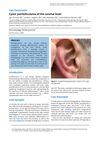 March 2026 in “Dermatology Online Journal”
 Cystic panfolliculoma is a rare, harmless tumor that can be confused with other skin tumors.
 149 citations
,
July 2017 in “PLoS Biology”
149 citations
,
July 2017 in “PLoS Biology” Hair follicle patterns form through a mix of self-organization and signaling interactions.
18 citations
,
January 1994 in “Skin Pharmacology and Physiology” Human dermal fibroblasts and hair papilla cells help outer root sheath cells grow and develop properly.
Hair bulb cells can create skin-like tissues for potential skin repair.
19 citations
,
August 1996 in “British Journal of Dermatology” Alopecia areata affects hair follicle structure, even in non-balding areas.
6 citations
,
July 2017 in “Clinical and Experimental Dermatology” Four new cases confirmed the unique features of follicular porokeratosis.
67 citations
,
February 1994 in “Developmental dynamics” Specific proteins and molecules play key roles in the development of human hair follicles.
 4 citations
,
July 2022 in “Annals of translational medicine”
4 citations
,
July 2022 in “Annals of translational medicine” Scientists created complete hair-like structures by growing mouse skin cells together in a special gel.
 September 2017 in “Journal of Investigative Dermatology”
 The research concluded that hyaluronic acid affects the formation and growth of hair follicle-like structures in a lab setting.
55 citations
,
February 2014 in “Journal of Structural Biology” Human hair has a complex, variable structure with a consistent matrix and double-twist pattern.
28 citations
,
July 2000 in “PubMed” Hair structure forms the same way inside and outside the body.
December 2001 in “中華皮膚科醫學雜誌” An 18-year-old boy had a harmless skin nodule near his nose with hair and oil glands inside.
January 2022 in “Clinical Cases in Dermatology” A woman's scalp nodule was a common, harmless pilar cyst, treated by surgical removal.
19 citations
,
July 1964 in “PubMed” Hair follicle cells become four types: medulla, cortex, cuticle, and inner root sheath.