 3 citations
,
January 2015 in “Mathematical problems in engineering”
3 citations
,
January 2015 in “Mathematical problems in engineering” Hair damage increases significantly with higher temperatures and longer heating times.
5 citations
,
July 2009 in “Clinical and experimental dermatology” January 2016 in “Case reports in clinical medicine” A 6-year-old girl was diagnosed with a rare hair disorder called monilethrix.
5 citations
,
January 2009 in “International Journal of Trichology” Two siblings had a rare hair condition with banded hair, which doesn't need treatment.
December 2018 in “International journal of women’s dermatology” FFA in young women is often missed, and no single treatment works best.
July 2025 in “International Journal of Trichology” A 6-year-old boy's leg hair loss was due to friction from sitting cross-legged, and it usually resolves on its own.
88 citations
,
March 2004 in “Journal of Investigative Dermatology” December 2021 in “Cosmetics”  2 citations
,
July 2020 in “Giornale italiano di dermatologia e venereologia”
2 citations
,
July 2020 in “Giornale italiano di dermatologia e venereologia” A woman with frontal fibrosing alopecia experienced unusual hair growth after using a specific topical lotion.
 April 2023 in “World Journal Of Advanced Research and Reviews”
 Cosmetic products or emotional factors might contribute to Frontal Fibrosing Alopecia, and trichoscopy is useful for diagnosis.
 13 citations
,
January 2012 in “International journal of trichology”
13 citations
,
January 2012 in “International journal of trichology” The study found that hair fragility in Pili annulati may be caused by cavities and damage within the hair shafts.
 155 citations
,
September 2008 in “British journal of dermatology/British journal of dermatology, Supplement”
155 citations
,
September 2008 in “British journal of dermatology/British journal of dermatology, Supplement” FFA is more common in postmenopausal women, can affect younger women, and may stabilize over time.
2 citations
,
October 2018 in “Skin appendage disorders” A boy's hair that was frizzy and hard to comb returned to normal after 9 months, possibly due to genetic factors.
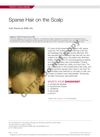
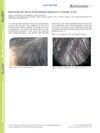
A 5-year-old girl has sparse, dry, and brittle hair but is otherwise healthy.
 1 citations
,
January 2018 in “Acta dermato-venereologica”
1 citations
,
January 2018 in “Acta dermato-venereologica” A teenager's hair with alternating white and dark bands, known as Pili annulati, is a genetic condition that is usually harmless and often considered attractive.
65 citations
,
May 2006 in “Journal of Structural Biology” Hair curliness is due to uneven distribution of different cortices within the hair fiber.
 34 citations
,
October 1982 in “Journal of applied polymer science”
34 citations
,
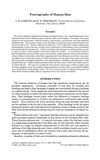
October 1982 in “Journal of applied polymer science” Moisture content significantly affects how human hair breaks.
September 2023 in “Journal of the American Academy of Dermatology” The hair care routine effectively improved scalp health and reduced fungus in children with kinky hair.
 63 citations
,
October 2011 in “Archives of Dermatology”
63 citations
,
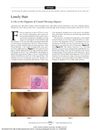
October 2011 in “Archives of Dermatology” Isolated long hairs at the original hairline can help diagnose Frontal Fibrosing Alopecia.
15 citations
,
January 2011 in “International journal of trichology” Using a hot iron on wet hair can cause dry, brittle hair with air bubbles inside.
 November 2022 in “The journal of investigative dermatology/Journal of investigative dermatology”
 Linalool in personal care products may contribute to hair loss by damaging hair follicle stem cells and triggering harmful immune responses.
 November 2008 in “Medical & surgical dermatology”
 A device was made in 2008 to measure hair loss severity. Other findings include: frizzy mutation in mice isn't related to Fgfr2, C/EBPx marks preadipocytes, Cyclosporin A speeds up hair growth in mice, blocking plasmin and metalloproteinases hinders healing, hyperbaric oxygen helps ischemic wound healing, amniotic membranes heal wounds better than polyurethane foam, rhVEGF165 from a fibrin matrix improves tissue flap viability and induces VEGF-R2 expression, and bFGF enhances wound healing and reduces scarring in rabbits.
13 citations
,
January 2001 in “Pediatric dermatology” A dark-haired Chinese girl had hair that looked banded under certain light but was normal under a microscope.
 4 citations
,
August 2023 in “Nature Communications”
4 citations
,
August 2023 in “Nature Communications” Mouse zigzag hair bends form due to a 3-day cycle of changes in hair progenitors and their environment.
 28 citations
,
November 2019 in “Gene”
28 citations
,
November 2019 in “Gene” The ITGB6 gene is important for tissue repair and hair growth, and mutations can lead to enamel defects and other health issues.
The curly mutation in SELH/Bc mice affects hair and may help study human genetic disorders.
7 citations
,
April 2000 in “Mammalian Genome” A new mutation in mice causes crooked whiskers and messy hair.
 16 citations
,
April 2017 in “ACM Transactions on Graphics”
16 citations
,
April 2017 in “ACM Transactions on Graphics” Light scatters differently from elliptical hair fibers than from circular ones, and a new model better predicts this behavior, especially for shiny highlights.
 November 2023 in “The journal of investigative dermatology/Journal of investigative dermatology”
 Early treatment and multidisciplinary care are key to managing Frontal Fibrosing Alopecia and preventing further hair loss.