 1 citations
,
June 2012 in “Revista Brasileira de Cirurgia Plástica”
1 citations
,
June 2012 in “Revista Brasileira de Cirurgia Plástica” The procedure is effective for reducing the forehead despite potential for visible scars.
 18 citations
,
February 2014 in “PubMed”
18 citations
,
February 2014 in “PubMed” Androgenetic alopecia is a common hair loss condition caused by testosterone effects on hair follicles, leading to thinner, shorter, and less pigmented hair, diagnosed using scalp dermoscopy and treated with topical minoxidil, antiandrogen agents, and 5-alpha reductase inhibitors.
May 2025 in “Actas Dermo-Sifiliográficas” Botulinum toxin is not effective for treating androgenetic alopecia.
 July 2026 in “Innovations in Pharmaceutical Sciences & Care”
 Combining mesotherapy injections with minoxidil improved hair growth and appearance.
July 2022 in “Journal of Investigative Dermatology” TRPS1 loss in balding scalp areas contributes to hair loss in androgenic alopecia.
June 2012 in “International journal of scientific research” Hair follicles in androgenetic alopecia show no chemical changes, only size reduction.
July 2025 in “Actas Dermo-Sifiliográficas” Botulinum toxin A does not significantly improve hair density or thickness in androgenetic alopecia.
10 citations
,
March 1997 in “Pediatric Dermatology” A rare case of trichothiodystrophy was found with autism, seizures, and mental retardation.

Millet extract, wheat germ oil, L-cystine, and calcium pantothenate reduced hair loss and improved hair growth in women with diffuse alopecia.
December 2025 in “Journal of Pharmacy And Bioallied Sciences” Personalized Ayurvedic treatment can effectively regrow hair in androgenetic alopecia.
 August 2025 in “Arabixiv (OSF Preprints)”
 Male pattern baldness is mainly caused by brain heat stress, not DHT.
 1 citations
,
December 2017 in “Anais Brasileiros de Dermatologia”
1 citations
,
December 2017 in “Anais Brasileiros de Dermatologia” Frontal fibrosing alopecia can mimic traction alopecia but has distinct features like facial papules and eyebrow thinning.
 26 citations
,
June 2018 in “Australasian Journal of Dermatology”
26 citations
,
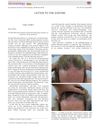
June 2018 in “Australasian Journal of Dermatology” Stopping sunscreen use on the forehead led to hair regrowth in a woman with frontal fibrosing alopecia.
 16 citations
,
January 2017 in “Anais brasileiros de dermatologia/Anais Brasileiros de Dermatologia”
16 citations
,
January 2017 in “Anais brasileiros de dermatologia/Anais Brasileiros de Dermatologia” Managing frontal fibrosing alopecia and lichen planus pigmentosus is challenging due to resistant hair loss and skin discoloration.
 October 1987 in “Clinics in Dermatology”
 Scalp reduction can improve hair distribution in certain baldness cases but requires careful patient selection and understanding of facial structure.
 49 citations
,
January 2003 in “Clinical and Experimental Dermatology”
49 citations
,
January 2003 in “Clinical and Experimental Dermatology” The document concludes that post-menopausal frontal fibrosing alopecia is a poorly understood condition that does not respond well to common treatments.
 3 citations
,
March 1998 in “Aesthetic Surgery Journal”
3 citations
,
March 1998 in “Aesthetic Surgery Journal” Experts suggest various surgical methods for hair restoration, including scalp reduction, transplantation using minigrafts, and establishing a permanent frontal hairline with follicular units. The drug finasteride may also be used alongside these procedures.
 8 citations
,
April 2001 in “Dermatologic Surgery”
8 citations
,
April 2001 in “Dermatologic Surgery” Michael L. Beehner proposed a standardized way to describe balding areas on the scalp to help hair restoration experts communicate better.
 April 2001 in “Dermatologic Surgery”
 Michael L. Beehner proposed a standardized naming system for balding scalp areas to help hair restoration surgery.
 7 citations
,
January 2018 in “International Journal of Trichology”
7 citations
,
January 2018 in “International Journal of Trichology” Wearing a wig caused a skin condition to develop in a woman with hair loss.
 3 citations
,
July 1997 in “Current problems in dermatology”
3 citations
,
July 1997 in “Current problems in dermatology” Hair restoration surgery has evolved over time, with a focus on natural-looking results and managing patient expectations, while also considering potential complications and the lifelong progression of male pattern baldness.
Orthognathic surgeons play a key role in modifying masculine facial features to be more feminine, often improving transgender women's quality of life.
 April 2012 in “Informa Healthcare eBooks”
 Lichen planopilaris is a rare, chronic condition causing hair loss, mainly in middle-aged women, and early treatment is important to prevent permanent baldness.
 November 2002 in “Dermatologic Surgery”
 Scalp reduction gives the most natural result for significant crown baldness, despite potential complications, and a systematic approach to surgical hair restoration results in few complications and high graft survival.
January 2024 in “Medicina” Proper planning and technique in upper-face feminization surgery are crucial to avoid complications and revisions.
3 citations
,
November 2021 in “Clinical, Cosmetic and Investigational Dermatology” Autologous cellular micrografts improve hair density and thickness in the short term for androgenetic alopecia.
 March 2025 in “Cosmetics”
 Combining treatments works best for early hair loss, while transplants are best for severe cases.
 April 2016 in “Journal of Clinical Research in Dermatology”
 A woman had skin and hair issues after a botulinum toxin injection.
 2 citations
,
January 2023 in “Curēus”
2 citations
,
January 2023 in “Curēus” Low-dose naltrexone may help reduce redness in certain scalp conditions.
 1 citations
,
July 2020 in “Benha Journal of Applied Sciences”
1 citations
,
July 2020 in “Benha Journal of Applied Sciences” Trichoscopy is useful for diagnosing Frontal Fibrosing Alopecia.