July 2023 in “Journal of personalized medicine” Injecting a person's own fat stem cells into their skin can make it look younger and improve double eyelids for over a year.
April 2020 in “Journal of the Endocrine Society” Taking thyroid medication reduced the patient's pituitary gland swelling and improved her symptoms.
 September 2023 in “Clinical anatomy”
 Forehead creases are formed by a tight connection between the skin and muscle through dense fibers, with changes in skin thickness and fewer skin appendages near the creases.
2 citations
,
January 1990 in “PubMed” Perforating folliculitis is a skin condition with small bumps that may be linked to other diseases and is hard to treat.
2 citations
,
March 2024 in “Dermatologic Surgery” The chemical peel improved the appearance of hand spots safely and effectively.
 2 citations
,
August 2008 in “Journal of Liaquat University of Medical & Health Sciences”
2 citations
,
August 2008 in “Journal of Liaquat University of Medical & Health Sciences” A painless cheek lump was misdiagnosed but found to be a rare, benign skin lesion called pilomatrixoma, treatable by surgery.
 12 citations
,
September 2021 in “The International Journal of Developmental Biology”
12 citations
,
September 2021 in “The International Journal of Developmental Biology” Liposomal carriers can improve tissue regeneration by stabilizing and retaining growth factors.
March 2022 in “International Journal of Trichology” Erlotinib can cause unusual hair growth, like long eyelashes and facial hair.
75 citations
,
September 1985 in “Archives of dermatology” Two boys had a rare skin condition needing to be differentiated from similar disorders, with unclear inheritance due to few cases.
13 citations
,
August 2005 in “Journal of Investigative Dermatology Symposium Proceedings” Mutations in the DSG4 gene cause fragile, sparse hair in humans, mice, and rats.
2 citations
,
March 2016 in “Serbian Journal of Dermatology and Venerology” A six-year-old boy with excessive hair growth and other symptoms may have a genetic link on chromosome 17q, requiring regular medical follow-ups.
7 citations
,
May 1988 in “International Journal of Dermatology” The patient's hair has unique structural differences with alternating bright and dark bands.
Acitretin improved monilethrix symptoms temporarily, but they returned after stopping treatment.
 66 citations
,
August 1999 in “The Journal of Clinical Endocrinology & Metabolism”
66 citations
,
August 1999 in “The Journal of Clinical Endocrinology & Metabolism” Women with acromegaly often have irregular periods due to hormone imbalances and growth hormone effects.
 1 citations
,
May 2006 in “Thyroid Research and Practice”
1 citations
,
May 2006 in “Thyroid Research and Practice” Skin can become dry and thick in hypothyroidism.
April 2021 in “Authorea (Authorea)” A 20-year-old woman had stable Progressive Hemifacial Atrophy and Vitiligo after treatment, suggesting a possible link between the conditions.
2 citations
,
May 1979 in “PubMed” Monilethrix is not caused by a metabolic defect.
November 2020 in “Acta Medica Bulgarica/Acta medica Bulgarica” The document concludes that treatment improved skin lesions but not scalp hair loss in two patients with Graham-Little-Piccardi-Lassueur syndrome.
97 citations
,
March 2006 in “Journal of Investigative Dermatology” Mutations in the DSG4 gene cause a severe form of brittle hair and skin issues.
 April 2017 in “Journal of Investigative Dermatology”
 A boy with Oculodentodigital syndrome had a unique GJA1 gene mutation causing his symptoms.
2 citations
,
November 2023 in “Skin Research and Technology” RCM and dermoscopy help identify different types of hair loss in children.
10 citations
,
January 1987 in “PubMed” Thyroid hormone and epidermal growth factor affect hair angle, tooth eruption, and ear development in rats.
 April 2024 in “Indian dermatology online journal”
 A rare hair follicle disorder can cause itchy, bluish-black bumps on the body.
July 2019 in “Dermatologic Surgery” 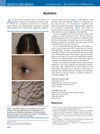 6 citations
,
August 2012 in “The Journal of Pediatrics”
6 citations
,
August 2012 in “The Journal of Pediatrics” A 12-year-old girl was diagnosed with monilethrix, a genetic condition causing fragile, beaded hair that breaks easily, with no effective treatment available.
September 2012 in “Annals of saudi medicine/Annals of Saudi medicine” The twins' condition is unique and doesn't match any known syndromes.
January 2012 in “Case reports in pediatrics” A 16-year-old boy's arm hair grew more after wearing a splint, but it returned to normal in 8 months.
1 citations
,
December 2022 in “Skin Appendage Disorders” Recognizing trichofolliculomas is important to avoid unnecessary surgery.
11 citations
,
April 2021 in “Journal of Clinical Medicine” The LED device safely improves neck skin appearance without affecting thyroid function.
 December 2025 in “TURKDERM”
 Facial trichostasis spinulosa is a chronic condition with significant cosmetic impact, especially in young women.