October 2022 in “Journal of Drugs in Dermatology” Combining PRP and laser treatments improves hair density best for androgenetic alopecia.
March 2022 in “Al-Azhar International Medical Journal (Print)” SVF treatment is more effective than Nanofat for hair growth.
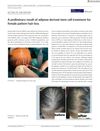 April 2021 in “Journal of Cosmetic Dermatology”
 Stem cell treatment improved hair density in female hair loss patient.
99 citations
,
July 2005 in “Ultramicroscopy” The research improved understanding of hair and skin properties across different ethnicities and conditions.
 2 citations
,
January 2008 in “Journal of Society of Cosmetic Chemists of Japan”
2 citations
,
January 2008 in “Journal of Society of Cosmetic Chemists of Japan” PMS nanoparticles improve damaged hair by protecting and restoring its surface and color.

The 1550 nm fractional Er:Glass laser improved hair regrowth in patients with androgenic alopecia, but didn't significantly change collagen type I, skin fibroblasts, or macrophages. More research is needed for optimal results.
 22 citations
,
November 2013 in “Clinical and experimental dermatology (Print)”
22 citations
,
November 2013 in “Clinical and experimental dermatology (Print)” Ecklonia cava, a type of seaweed, may help hair grow.
 15 citations
,
July 2019 in “Lasers in surgery and medicine”
15 citations
,
July 2019 in “Lasers in surgery and medicine” The erbium-glass laser effectively promotes hair regrowth in alopecia areata.
 10 citations
,
August 2018 in “Dermatologic Surgery”
10 citations
,
August 2018 in “Dermatologic Surgery” Laser treatment improves hair density and increases growth factors in androgenetic alopecia.
January 2026 in “Minia Journal of Medical Research” SVF cell therapy may help regenerate hair in androgenic alopecia.
 April 2024 in “Skin research and technology”
 Adding stromal vascular fraction to platelet-rich plasma injections did not significantly improve hair growth in androgenetic alopecia treatment.
 January 2024 in “Journal of Cosmetic Dermatology”
 The 1565 nm non-ablative fractional laser is more effective and satisfying than 5% minoxidil for treating hair loss.
 December 2022 in “Research Square (Research Square)”
 The ethyl acetate fraction of Ophioglossum vulgatum Linn. may promote hair growth and could be a new herbal treatment for hair loss.
 June 2021 in “Research Square (Research Square)”
 Using fat-derived cells to treat hair loss increased hair density and thickness without side effects.
January 2021 in “Faculty of 1000 Research Ltd” The treatment showed promising hair growth results but needs more research.
January 2021 in “Faculty of 1000 Research Ltd” Combining SVF cells with PRP may boost hair growth in androgenic alopecia.
May 2021 in “F1000Research” The treatment led to denser, thicker hair growth and less hair loss.
October 2022 in “Dermatologic Therapy” Both treatments for resistant alopecia areata were equally effective.
39 citations
,
January 2013 in “Skin pharmacology and physiology” Nanoparticles show promise for drug delivery through hair follicles but not through healthy skin.
 2 citations
,
March 2020 in “PubMed”
2 citations
,
March 2020 in “PubMed” Biotin deficiency is not a major cause of Telogen Effluvium hair loss.
 1 citations
,
January 2022 in “Faculty reviews”
1 citations
,
January 2022 in “Faculty reviews” The best long-lasting results in treating hair loss may be achieved through combination therapy, including treatments like finasteride, minoxidil, and platelet-rich plasma injections.
1 citations
,
September 2019 Laser and light therapies can help regrow hair but need more research for best results.
April 2026 in “Journal of Exercise Rehabilitation” Stem cell therapy can help reduce hair loss from COVID-19 vaccination.
Platelet-rich plasma is a promising and cost-effective treatment for hair and skin issues in older adults in India.
March 1986 in “Fed. Proc., Fed. Am. Soc. Exp. Biol.; (United States)” Marginal dietary zinc intake in rats led to weight loss and hair issues, but no significant changes in blood fractions.

Laser treatments effectively increase hair growth in hair loss conditions.
 October 2025 in “Cell Transplantation”
 New hair loss treatments like stem cells and gene therapy show promise but need more research for safety and effectiveness.
January 2025 in “Journal of the Egyptian Womenʼs Dermatologic Society” Both cryotherapy and FCO2 laser are effective and safe for treating patchy alopecia areata.

Using a specific laser and platelet-rich plasma together can effectively improve hair thickness and density in men with hair loss, without serious side effects.
January 2020 in “Journal of Genetics and Gene Therapy” The combination of hair follicle stem cells and PRP shows promise for treating hair loss in Asian men and women.