 January 1997 in “Elsevier eBooks”
 Hair and nails are skin parts that develop early and serve protective and functional roles.
 June 2026 in “Journal of Pakistan Association of Dermatologists”
 Nanoemulsion-based serums for hair growth are gaining research interest, with potential for more global collaboration and clinical use.
 June 2026 in “Scientific Reports”
 Hypericin and berberine may help hair growth by activating oxytocin signals.
 May 2026 in “Frontiers in Pharmacology”
 Dendrobium officinale polysaccharide helps hair regrowth in hair loss mice by affecting local steroid metabolism and hair follicle responses.
 April 2026 in “Frontiers in Cell and Developmental Biology”
 CD200- cells in hair follicles have a higher ability to regenerate hair.

Hair follicle-derived sheets can effectively treat vitiligo by repigmenting skin.
 February 2026 in “International Journal of Web of Multidisciplinary Studies”
 Restoring microbial balance and using exosome therapies may help treat hair disorders like alopecia and acne.

The study found that different genes are active in cashmere goats' hair growth stages, which can help improve cashmere production.
 January 2026 in “Nature Communications”
 A wearable device using NIR light may help treat hair loss non-invasively.
 January 2026 in “Communications Biology”
 Yak hair follicles adapt to cold through specific gene regulation, enhancing cell growth.
 December 2025 in “Applied and Computational Engineering”
 Hair dyes can be harmful, but risks vary by person and can be reduced.
 December 2025 in “The American Journal of Medical Sciences and Pharmaceutical Research”
 Ultrasonic and infrared treatments can improve hair strength and appearance with minimal damage.
 May 2025 in “Animal Bioscience”
 Inhibiting prolactin reduces hair follicle activation in cashmere goats.

Exosome therapy could help hair growth but needs more research for safety and effectiveness.
 January 2025 in “Indian Journal of Unani Medicine”
 Unani medicine effectively reduced hair loss in a 24-year-old woman without side effects.
 December 2024 in “Frontiers in Veterinary Science”
 Dorper sheep's wool shedding is linked to specific genes and pathways, which may help understand human hair growth.
 November 2024 in “Research Square (Research Square)”
 Lipids may help treat hair loss by promoting hair growth through the HIF-1 pathway.
 October 2024 in “SPIRE - Sciences Po Institutional REpository”
 Glypicans help hair follicle stem cells differentiate by interacting with specific receptors, influencing hair growth.
 August 2024 in “Journal of Animal Science and Technology”
 Angora goat hair growth is influenced by gene expression, sex hormones, and breed differences.
 August 2024 in “Biomolecules & Therapeutics”
 A new compound, HTPI, promotes hair growth by protecting cells from damage and regulating energy use.

Good nutrition may help prevent premature hair graying.
 July 2024 in “Frontiers in Pharmacology”
 Pilose antler extracts help hair growth by activating hair follicle stem cells.
 July 2024 in “Dermatology and Therapy”
 Darker hair colors may increase the risk of alopecia areata, while lighter hair colors may decrease it.
 June 2024 in “Al- Anbar Medical Journal”
 Acute telogen effluvium can be resolved by addressing causes, but chronic telogen effluvium is harder to treat.
 June 2024 in “Frontiers in pharmacology”
 2-deoxy-D-ribose gel may help regrow hair in cases of hair loss.
 June 2024 in “International journal of nanomedicine”
 Azelaic acid micro/nanocrystals, especially with ultrasound and salicylic acid, greatly improve acne treatment.
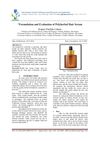 June 2024 in “International Journal of Pharmaceutical Research and Applications”
 Polyherbal hair serum can hydrate the scalp and promote hair growth safely.
 May 2024 in “International Journal For Multidisciplinary Research”
 The herbal hair cream helps protect and improve hair health.
 April 2024 in “bioRxiv (Cold Spring Harbor Laboratory)”
 GRK2 is essential for healthy hair follicle function, and its absence can lead to hair loss and cysts.
 March 2024 in “Bioimpacts”
 400 nm particles penetrate hair follicles best, but mouse models aren't fully reliable for human studies.