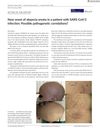
 32 citations
,
March 2021 in “Journal of cosmetic dermatology (Print)”
32 citations
,
March 2021 in “Journal of cosmetic dermatology (Print)” COVID-19 infection may trigger alopecia areata in some patients.
 10 citations
,
August 2016 in “Oxford Medical Case Reports”
10 citations
,
August 2016 in “Oxford Medical Case Reports” Tocilizumab therapy may cause skin and hair conditions like halo naevi, vitiligo, and alopecia areata.
 8 citations
,
January 2022 in “Infectious diseases News Opinions Training”
8 citations
,
January 2022 in “Infectious diseases News Opinions Training” Genetic differences affect COVID-19 severity and treatment effectiveness.
 3 citations
,
July 2015 in “European Journal of Dermatology”
3 citations
,
July 2015 in “European Journal of Dermatology” AGEs may cause hair loss by increasing inflammation in hair follicles.
 1 citations
,
September 2010 in “The journal of investigative dermatology/Journal of investigative dermatology”
1 citations
,
September 2010 in “The journal of investigative dermatology/Journal of investigative dermatology” The meeting highlighted major advances in skin research, including new findings on skin microbes, genetic links to skin diseases, and improved treatments for various conditions.
 June 2026 in “Journal of Obstetrics Gynecology and Cancer Research”
 Salivary cytokines and the Free Androgen Index are promising non-invasive markers for diagnosing PCOS.
September 2025 in “Diseases” Higher levels of certain proteins in the blood are linked to more severe patchy alopecia areata.
 August 2025 in “International Journal of Scientific Research in Biological Sciences”
 Higher levels of DHEA and TNF-α are linked to PCOS symptoms.
 August 2024 in “Frontiers in Pharmacology”
 Antibody treatments show promise for hair loss but need more research.
 March 2024 in “World Academy of Sciences Journal”
 Exercise helps maintain healthy skin by promoting regeneration and reducing inflammation.
 185 citations
,
August 2020 in “Mayo Clinic Proceedings”
185 citations
,
August 2020 in “Mayo Clinic Proceedings” Men are more likely to have severe COVID-19 cases and fatalities than women due to factors like lifestyle, aging, and biological differences.
 17 citations
,
September 2003 in “Journal of Investigative Dermatology Symposium Proceedings”
17 citations
,
September 2003 in “Journal of Investigative Dermatology Symposium Proceedings” Old treatments for other skin conditions showed promise for hair regrowth in mice with a hair loss condition.

Plakophilin 1 helps control skin cell immune responses to prevent excessive inflammation.
 16 citations
,
January 2018 in “International Journal of Trichology”
16 citations
,
January 2018 in “International Journal of Trichology” Minoxidil may help treat hair loss by reducing inflammation-related gene activity in skin cells.
 1 citations
,
January 2017 in “Springer eBooks”
1 citations
,
January 2017 in “Springer eBooks” Understanding the immune-related causes of Alopecia Areata has led to potential treatments like JAK inhibitors.
 1 citations
,
October 2012 in “Medical Hypotheses”
1 citations
,
October 2012 in “Medical Hypotheses” The conclusion suggests that treatments targeting root causes of chronic diseases may be developed by focusing on gene expression and lifestyle factors.
1 citations
,
January 2004 in “Linchuang pifuke zazhi” Substance P helps hair growth by extending the growth phase and affecting certain growth factors.
 February 2024 in “Frontiers in physiology”
 Modifying certain signals in the body can help wounds heal without scars and regrow hair.
 April 2018 in “Journal of Investigative Dermatology”
 Both Th1 and Th2 immune responses are increased in alopecia areata, with Th2 response more strongly linked to how severe the disease is.
 April 2015 in “Plastic and Reconstructive Surgery”
 TLR3 activation helps improve skin and hair follicle healing in mice.
February 2023 in “Materials today bio” The treatment effectively promotes hair regrowth in androgenetic alopecia without causing skin irritation.
 7 citations
,
July 2019 in “The Journal of Dermatology”
7 citations
,
July 2019 in “The Journal of Dermatology” Terbinafine effectively treated kerion celsi despite disrupted immune responses.
 April 2022 in “International journal of respiratory and pulmonary medicine”
 People with lower levels of free testosterone tend to have worse COVID-19 outcomes.
56 citations
,
July 2014 in “PloS one” SARMs may be an effective treatment for a certain type of breast cancer by blocking cancer growth and spread.
52 citations
,
May 2015 in “Cytotherapy” DS-MSCs from hair follicles may improve diabetic wound healing.
19 citations
,
December 2021 in “Stem Cell Research & Therapy” Muse cells from human bone marrow help reduce symptoms of atopic dermatitis in mice.
13 citations
,
September 2022 in “Biomolecules” The research confirms that Hidradenitis Suppurativa is characterized by increased inflammation, disrupted skin cell organization, and abnormal metabolic processes.
3 citations
,
January 2025 in “Discovery Medicine” Fruit acids can help prevent skin aging from UV exposure.
December 2025 in “Journal of 108 - Clinical Medicine and Phamarcy” B blood type has the highest growth factors and cytokines in umbilical cord blood-derived PRP.
 July 2022 in “The journal of investigative dermatology/Journal of investigative dermatology”
 Particulate matter causes inflammation in hair cells, potentially harming hair growth.