10 citations
,
May 2025 in “Cell Biomaterials” New technologies help us understand how the body reacts to medical implants, which can improve implant performance.
April 2016 in “The journal of investigative dermatology/Journal of investigative dermatology” Neoplasms hide in hair follicles to avoid the immune system.
April 2026 in “bioRxiv (Cold Spring Harbor Laboratory)” Different expansin genes affect root hair growth in plants due to their diverse functions and evolutionary changes.
32 citations
,
May 2023 in “Frontiers in Immunology” Understanding cellular interactions in VCA may lead to better treatments and reduce rejection.
July 2022 in “British Journal of Dermatology”  63 citations
,
November 2009 in “British journal of dermatology/British journal of dermatology, Supplement”
63 citations
,
November 2009 in “British journal of dermatology/British journal of dermatology, Supplement” Sub3 is essential for fungus adherence but not for skin invasion.
July 2025 in “Journal of Investigative Dermatology” Candida auris uses the immune response to colonize hair follicles.
72 citations
,
July 1984 in “Journal of Investigative Dermatology”  15 citations
,
February 2013 in “Pharmaceutical nanotechnology”
15 citations
,
February 2013 in “Pharmaceutical nanotechnology” Finasteride delivery through skin improved using invasomes and iontophoresis.
 July 2026 in “European Journal of Plastic Surgery”
 Needle-free minoxidil delivery improves hair growth more than topical minoxidil alone in women.
 August 2025 in “Photodermatology Photoimmunology & Photomedicine”
 LED therapy is a promising, non-invasive skin treatment, but needs standardization and personalization.

Plucked hair follicles grow faster than conventional ones, making them a potentially better option for hair transplants.
 1 citations
,
January 2020 in “E3S web of conferences”
1 citations
,
January 2020 in “E3S web of conferences” The study found that injecting spores directly into rabbit skin effectively caused fungal skin infections, with symptoms worsening over time.
 April 2018 in “Journal of Investigative Dermatology”
 High amphiregulin in the skin is a bad sign for acute graft-versus-host disease.
4 citations
,
February 2016 in “Experimental Dermatology” Blocking α1-integrin makes adult fibroblasts more like foetal ones, improving their movement and aiding wound healing.
58 citations
,
December 2000 in “Experimental Dermatology” Involucrin is a useful marker for keratinocyte differentiation in mice.
 10 citations
,
September 1997 in “Molecular carcinogenesis”
10 citations
,
September 1997 in “Molecular carcinogenesis” Mirex seems to promote a unique group of skin cells different from those affected by another tumor promoter, TPA.
1 citations
,
January 2022 in “bioRxiv (Cold Spring Harbor Laboratory)” Injury boosts normal skin cell growth, reducing cancer cell advantage.
 September 2009 in “Hair transplant forum international”
 Changing the direction of cuts can make it easier to put in implants.
 October 2004 in “European Neuropsychopharmacology”
 Impulsiveness is common across various psychiatric disorders and linked to many psychological symptoms.
135 citations
,
October 1999 in “Journal of Cell Science” Overexpressing PKCα in mice skin increases inflammation but doesn't affect tumor growth.
 September 2011 in “Urology”
 The IPP index is linked to storage symptoms and leftover urine, and may help manage urinary tract symptoms.
2 citations
,
December 2007 in “Microbial pathogenesis” Anthrax bacteria can infect and destroy hair follicles in mice, but the immune system eventually clears the infection.
 10 citations
,
April 2007 in “Aesthetic Plastic Surgery”
10 citations
,
April 2007 in “Aesthetic Plastic Surgery” The new patient-controlled expansion technique for breast reconstruction is safe, efficient, and cost-effective.
30 citations
,
July 1993 in “Journal of Investigative Dermatology” 2 citations
,
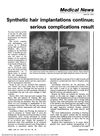
June 1979 in “JAMA” Synthetic hair implants are dangerous and can cause severe infections.
 8 citations
,
June 1979 in “JAMA”
8 citations
,
June 1979 in “JAMA” Synthetic hair implants can cause severe infections and are risky.
2 citations
,
December 2015 in “Journal of dermatology” β-interferon injections for melanoma can cause excessive hair growth at the injection sites.
20 citations
,
August 2005 in “The Journal of laboratory and clinical medicine” Mice with damaged skin or hair follicles are more susceptible to anthrax infection.
 5 citations
,
July 1988 in “Facial Plastic Surgery”
5 citations
,
July 1988 in “Facial Plastic Surgery” Tissue expansion is a useful method for reconstructive surgery with good results and room for further enhancement.