4 citations
,
June 2022 in “Journal of cleaner production” New eco-friendly method strengthens and sets hair using light and causes less damage.
 September 2025 in “The health sciences AUS.”
 Intralesional triamcinolone acetonide effectively treats acne keloidalis nuchae with minimal side effects.
 61 citations
,
May 2016 in “Scientific reports”
61 citations
,
May 2016 in “Scientific reports” The peptide IMT-P8 can effectively deliver proteins into the skin and cells for potential skin treatments.
 6 citations
,
November 2004 in “Bioorganic & Medicinal Chemistry Letters”
6 citations
,
November 2004 in “Bioorganic & Medicinal Chemistry Letters” Scientists created iodinated arylhydantoins and arylthiohydantoins that could potentially be used for imaging prostate cancer. Some versions with specific side-chains showed high potential for this use.
69 citations
,
January 2002 in “Journal of biomedical optics” Dyes can penetrate human skin and hair follicles up to 1.2 mm deep and the sebaceous gland can store dye; Indocyanine Green lotion was made for safe dyeing and monitoring.
36 citations
,
December 2009 in “Skin pharmacology and physiology” Helium-neon laser treatment can stimulate hair growth in mice.
 November 2011 in “Australasian Journal of Dermatology”
 Cellulite may be linked to low adiponectin, isotretinoin with UVB can treat psoriasis effectively, permanent alopecia post-chemotherapy resembles a unique hair loss, deodorants may cause fragrance allergies, desmoplastic melanoma is becoming more common, and intensive UVB treatment can give long-term psoriasis remission.
 4 citations
,
January 2020 in “Lasers in Surgery and Medicine”
4 citations
,
January 2020 in “Lasers in Surgery and Medicine” Using a 308-nm excimer lamp with minoxidil promotes hair growth in Alopecia Areata patients, especially younger ones or those with smaller bald spots.
 February 2009 in “Journal of The American Academy of Dermatology”
 Fractional infrared technology is effective and safe for treating cervical laxity.
January 2019 in “Dermatologic Surgery”  59 citations
,
January 2013 in “Annals of Dermatology”
59 citations
,
January 2013 in “Annals of Dermatology” Asian hair is more resistant to UV damage due to higher lipid content.
 September 2024 in “Cureus”
 Removing breast implants resolved the patient's symptoms.
November 2025 in “Photochemistry and Photobiology” Standardizing light therapy methods could improve spinal cord injury treatment.
 December 2024 in “Medical alphabet”
 Combining erbium laser, laser blood irradiation, and minoxidil is most effective for treating diffuse alopecia.
2 citations
,
November 2024 in “JAAD Case Reports” Anti-PD-L1 immunotherapy can cause hair loss and unexpected hair color change, but treatment can restore hair growth and color.
 36 citations
,
October 2014 in “Langmuir”
36 citations
,
October 2014 in “Langmuir” Bleaching hair removes its protective top layer and exposes more hydrophilic groups, changing its chemical surface and affecting how it interacts with products.
 22 citations
,
July 2004 in “International Journal of Cosmetic Science”
22 citations
,
July 2004 in “International Journal of Cosmetic Science” UV radiation and visible light can damage hair, but there are ways to protect it.
 3 citations
,
October 1979 in “Laboratory animals”
3 citations
,
October 1979 in “Laboratory animals” Hairless rats are good for testing anti-inflammatory drugs, similar to haired rats, without needing to remove fur.
 December 2023 in “Forensic science international. Genetics”
 The RapidHIT ID system can effectively get DNA profiles from hair roots with enough cells.
April 2026 in “UNC Libraries” Pulsed electric field treatment may help shrink untreated liver tumors.
July 2022 in “Journal of Investigative Dermatology”  6 citations
,
November 2018 in “Photodiagnosis and Photodynamic Therapy”
6 citations
,
November 2018 in “Photodiagnosis and Photodynamic Therapy” A wearable cap-like device using light therapy reduced scalp skin lesions by 71% and was painless.
 1 citations
,
July 2015 in “British Journal of Dermatology”
1 citations
,
July 2015 in “British Journal of Dermatology” Imiquimod improved skin pigmentation in most patients with xeroderma pigmentosum and may prevent further skin cancer, but some treatments can have side effects.
June 2026 in “Chemical Engineering Journal” 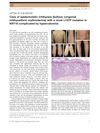 October 2011 in “Journal of dermatology”
 A man with a rare skin condition and a new gene mutation developed high calcium levels due to his treatment.
January 2012 in “Journal of Cosmetics Dermatological Sciences and Applications” Iontophoresis greatly improves skin absorption of certain substances, especially in hairy mice.
March 2026 in “Dyes and Pigments” Riboflavin and blue light speed up genipin hair dye, making it fast, glossy, stable, and eco-friendly.
November 2025 in “Advanced Science” The treatment using a special hydrogel shows promise for promoting hair growth.
5 citations
,
October 2020 in “Veterinary record case reports” Fluorescent light energy may help treat skin infections in dogs with calcinosis cutis.
 September 2022 in “Research Square (Research Square)”
 Hydrocolloid wound dressings emit energy that can affect human hair follicle metabolism.