1 citations
,
November 2012 in “European Journal of Cell Biology” The authors clarified data overlap and corrected a figure error, apologizing for any confusion.
Loose anagen hair syndrome in children may improve with age, but treatment results vary.
The FGF5 gene variant causes long hair in Akitas, and genetic testing is advised to manage coat length and welfare.
 May 2024 in “Frontiers in medicine”
 A genetic mutation in the LIPH gene causes tightly curled hair that stops growing in some Japanese individuals.
 November 2023 in “Advanced Science”
 A specific hair protein variant increases the spread of breast cancer and is linked to worse survival rates.
 October 2022 in “Gadua Journal of Pure and Allied Science”
 Terbinafine is the most effective treatment for tinea capitis, a scalp infection often confused with other conditions.
 June 2022 in “Research Square (Research Square)”
 Nestin-expressing cells turn into a specific type of skin cell in hair follicles during development and in adults.
 May 2022 in “bioRxiv (Cold Spring Harbor Laboratory)”
 Primary cilia affect the size and oil production of eye glands but not the oil's makeup.
 May 2022 in “Research Square (Research Square)”
 Nestin marks cells that can become a specific type of skin cell in hair follicles of both developing and adult mice.
 December 2021 in “Molecular genetics and genomics”
 Cats with abnormal hair had DSG4 gene changes causing hair problems.
The document describes a rare case of IFAP syndrome, a genetic condition with symptoms of hair loss, light sensitivity, and scaly skin.
 August 2020 in “Pakistan Journal of Zoology”
 A new mutation in the Hairless gene causes hair loss in two Pakistani families.
 August 2019 in “Journal of Investigative Dermatology”
 The study found that tight junctions reach the top layer of the skin's stratum granulosum, not just the second top layer as previously thought.
 April 2017 in “Journal of Investigative Dermatology”
 Deep phenotyping helps distinguish between xeroderma pigmentosum and trichothiodystrophy, aiding in diagnosis and treatment.
April 2016 in “The journal of investigative dermatology/Journal of investigative dermatology” The ALADIN score can predict how well patients with alopecia areata will respond to JAK inhibitor treatments.
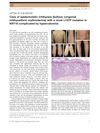 October 2011 in “Journal of dermatology”
 A man with a rare skin condition and a new gene mutation developed high calcium levels due to his treatment.
 November 2005 in “Journal of Investigative Dermatology Symposium Proceedings”
 The 2004 hair research meeting presented new findings on hair cell differentiation, genetic factors in hair loss, hair pigmentation, and potential targeted therapies.
 June 2003 in “Journal of Investigative Dermatology Symposium Proceedings”
 Advancements in hair biology include new treatments and tools for hair growth and alopecia.
 May 2003 in “Journal of Investigative Dermatology”
 The meeting covered advances in understanding hair growth, causes of hair loss, and potential treatments.
 27 citations
,
August 2006 in “Laboratory Investigation”
27 citations
,
August 2006 in “Laboratory Investigation” SCF and ET-1 together significantly increase skin pigmentation and melanin production.
 3 citations
,
April 1990 in “Archives of dermatology”
3 citations
,
April 1990 in “Archives of dermatology” The book reveals diverse patterns of hair growth in different species and advancements in hair and alopecia research.
 January 2000 in “BioScience”
 The document concludes that understanding hair biology is key to treating hair disorders, with gene therapy showing potential as a future treatment.
 555 citations
,
July 2001 in “Genes & Development”
555 citations
,
July 2001 in “Genes & Development” Tcf3 and Lef1 are key in deciding skin stem cell roles.
 417 citations
,
September 2005 in “PLoS biology”
417 citations
,
September 2005 in “PLoS biology” Understanding gene expression in hair follicles can reveal insights into hair growth and disorders.
235 citations
,
July 1999 in “Journal of biological chemistry/The Journal of biological chemistry” Human hair is made up of different keratins, some strong and some weak, with specific types appearing at various stages of hair growth.
186 citations
,
December 2012 in “Current opinion in cell biology” Keratin proteins are increasingly recognized as important for cell health and are linked to many diseases.
 176 citations
,
August 2015 in “The journal of allergy and clinical immunology/Journal of allergy and clinical immunology/The journal of allergy and clinical immunology”
176 citations
,
August 2015 in “The journal of allergy and clinical immunology/Journal of allergy and clinical immunology/The journal of allergy and clinical immunology” Alopecia areata involves immune activation in the scalp, suggesting treatments targeting TH1, TH2, and IL-23 pathways.
 115 citations
,
August 2008 in “The Journal of Clinical Endocrinology & Metabolism”
115 citations
,
August 2008 in “The Journal of Clinical Endocrinology & Metabolism” Thyroid hormones help hair grow, reduce hair loss, and increase hair pigment.
98 citations
,
December 2015 in “The Journal of Cell Biology” Keratin is crucial for skin barrier formation and affects mitochondrial function.
88 citations
,
June 2000 in “Journal of Investigative Dermatology” Keratin 17 is important for hair and nail structure and affects pachyonychia congenita symptoms.