 43 citations
,
August 2018 in “Cell Stem Cell”
43 citations
,
August 2018 in “Cell Stem Cell” Hoxc genes control hair growth through Wnt signaling.
30 citations
,
December 2014 in “BMC Genetics” Certain genes and proteins may influence wool growth in Aohan fine wool sheep.
25 citations
,
November 2020 in “Proceedings of the National Academy of Sciences” HoxC genes are crucial for normal hair and nail development.
 21 citations
,
November 2010 in “Journal of molecular medicine”
21 citations
,
November 2010 in “Journal of molecular medicine” FoxN1 gene is essential for proper thymus structure and preventing hair loss.
19 citations
,
July 2020 in “EBioMedicine” A gene variant increases the risk of a type of hair loss by affecting hair protein production.
17 citations
,
July 2022 in “BMC Genomics” The FA2H gene improves cashmere fineness by enhancing hair growth in goats.
 9 citations
,
May 2012 in “PLOS ONE”
9 citations
,
May 2012 in “PLOS ONE” ILK is essential for skin development, pigmentation, and healing.
7 citations
,
August 2020 in “Genes” Different genes are active in dogs' hair growth and skin, similar to humans, which helps understand dog skin and hair diseases and can relate to human conditions.
 6 citations
,
September 2015 in “Journal of Investigative Dermatology”
6 citations
,
September 2015 in “Journal of Investigative Dermatology” Using special RNA to target a mutant gene fixed hair problems in mice.
5 citations
,
December 2011 in “Springer eBooks”  4 citations
,
January 2019 in “International journal of molecular sciences”
4 citations
,
January 2019 in “International journal of molecular sciences” Genetically modified sheep with more β-catenin grew more wool without changing the wool's length or thickness.
2 citations
,
October 2021 in “JID innovations” Uterine leiomyomas don't significantly change gene expression in the scalp of people with Central Centrifugal Cicatricial Alopecia.
 2 citations
,
March 2021 in “bioRxiv (Cold Spring Harbor Laboratory)”
2 citations
,
March 2021 in “bioRxiv (Cold Spring Harbor Laboratory)” Hairless mammals have genetic changes in both their protein-coding and regulatory sequences related to hair.
2 citations
,
September 2017 in “Biotechniques/BioTechniques” Researchers created a mouse cell line to study hair growth and test hair growth drugs.
 2 citations
,
December 2016 in “Experimental cell research”
2 citations
,
December 2016 in “Experimental cell research” The research found a way to identify and study skin cells with stem cell traits, revealing they behave differently in culture and questioning current stemness assessment methods.
1 citations
,
June 2025 in “Frontiers in Genetics” Key genes IRF2BP2 and EGFR are linked to Hetian sheep's double-coat fleece.
1 citations
,
October 2019 in “PubMed” Removing the p75 gene in mouse skin cells didn't affect their skin or hair growth.
1 citations
,
February 2016 in “Cell Transplantation” Hair follicles have a more inactive cell cycle than other skin cells, which may help develop targeted therapies for skin diseases and cancer.
 April 2026 in “Cellular and Molecular Immunology”
 SPT6 prevents excessive skin inflammation by blocking a feedback loop.
 January 2026 in “BMC Veterinary Research”
 A genetic variant in "Blonde d'Aquitaine" calves causes death at birth due to a missing protein.
 December 2025 in “Frontiers in Medicine”
 ARWH is a rare hair disorder with no cure, but potential treatments include minoxidil and other therapies.
January 2024 in “International journal of molecular sciences” Hoxc13 gene affects wool length in Gansu alpine fine-wool sheep.
 May 2022 in “bioRxiv (Cold Spring Harbor Laboratory)”
 Primary cilia affect the size and oil production of eye glands but not the oil's makeup.
 January 2022 in “bioRxiv (Cold Spring Harbor Laboratory)”
 Skin lesions in Carney complex are likely caused by a specific group of skin cells that promote pigment production due to a genetic mutation.
 January 2020 in “Medical journal of clinical trials & case studies”
 A 37-year-old male with severe skin and internal issues has a rare inherited skin condition called dystrophic epidermolysis bullosa.
 July 2019 in “Journal der Deutschen Dermatologischen Gesellschaft”
 A mother and daughter have a rare genetic hair loss disorder with no effective treatment.
 April 2018 in “bioRxiv (Cold Spring Harbor Laboratory)”
 A gene variant causes patched hair loss in mice, similar to alopecia areata in humans.
 April 2017 in “Journal of Investigative Dermatology”
 Researchers created a skin graft that senses blood glucose and could treat diabetes using CRISPR-edited stem cells.
 April 2017 in “Journal of Investigative Dermatology”
 Deleting the CRIF1 gene in mice disrupts skin and hair formation, certain proteins affect hair growth, a new compound may improve skin and hair health, blood cell-derived stem cells can create skin-like structures, and hair follicle stem cells come from embryonic cells needing specific signals for development.
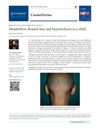 January 2026 in “Cosmoderma”
 A 9-year-old girl has a rare hair disorder causing beaded, sparse hair.