 September 2017 in “Journal of Dermatology & Cosmetology”
 Hepatitis C treatment may cause frontal fibrosing alopecia.
15 citations
,
May 2009 in “Chemical Physics Letters” A new method accurately measures molecular movement without complex modeling.
 1 citations
,
January 2024 in “Nature communications”
1 citations
,
January 2024 in “Nature communications” Activating TLR5 in the gut can extend lifespan and improve health in aged mice.
 6 citations
,
November 2012 in “Hair transplant forum international”
6 citations
,
November 2012 in “Hair transplant forum international” The Laxometer helps make hair transplants with many grafts safer.
21 citations
,
May 2024 in “American Journal of Medical Genetics Part A” Myhre syndrome symptoms worsen over time, with specific genetic variants affecting severity.
1 citations
,
January 2025 in “Dermatologic Therapy” Monopolar radiofrequency effectively reduces facial wrinkles with minimal side effects.
 64 citations
,
June 2010 in “Journal of The European Academy of Dermatology and Venereology”
64 citations
,
June 2010 in “Journal of The European Academy of Dermatology and Venereology” Finasteride improves hair density and thickness in women with hair loss.
1 citations
,
April 2025 in “American Journal of Medical Genetics Part C Seminars in Medical Genetics” Eflornithine improved symptoms in Bachmann–Bupp Syndrome patients.

EFBL offers hidden incisions, faster recovery, and fewer risks, but may raise hairline and cost more.
February 2025 in “Journal of the European Academy of Dermatology and Venereology” Mogamulizumab can cause hair loss, often linked to a better treatment response.
 December 2024 in “Brazilian Journal of Health Review”
 Early diagnosis of alopecia frontal fibrosante is crucial, but treatment remains controversial and varies.
11 citations
,
May 2023 in “Proceedings of the National Academy of Sciences” MicroRNA-205 helps hair regrow by making hair follicle stem cells less stiff.
 8 citations
,
July 2016 in “Hair transplant forum international”
8 citations
,
July 2016 in “Hair transplant forum international” FUT-MD hair transplants have higher follicle survival rates than FUE transplants.
December 2022 in “Clinical and experimental dermatology and therapies” Adding the topical gel improved hair growth more than using minoxidil or finasteride alone.
July 2025 in “Journal of Investigative Dermatology” M1 homeopathic complex may help slow melanoma cell growth.
1 citations
,
October 2025 in “Journal of Investigative Dermatology” Delgocitinib cream may help treat frontal fibrosing alopecia.
 53 citations
,
May 2010 in “Dermatologic Surgery”
53 citations
,
May 2010 in “Dermatologic Surgery” Hair transplantation may not work for Frontal Fibrosing Alopecia as transplanted hair was lost when the disease came back.
 3 citations
,
September 2024 in “BMC Oral Health”
3 citations
,
September 2024 in “BMC Oral Health” Low-level laser therapy reduces orthodontic relapse in rats, but fulvic acids do not.
 26 citations
,
June 2018 in “Australasian Journal of Dermatology”
26 citations
,
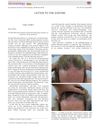
June 2018 in “Australasian Journal of Dermatology” Stopping sunscreen use on the forehead led to hair regrowth in a woman with frontal fibrosing alopecia.
6 citations
,
July 2005 in “Acta Ophthalmologica Scandinavica” Mitochondriopathy may cause eyelash loss.
January 2023 in “Dermatologic Therapy” Intralesional corticosteroids and 5-alpha-reductase inhibitors are the best treatments for frontal fibrosing alopecia.
 46 citations
,
January 2015 in “Journal of The American Academy of Dermatology”
46 citations
,
January 2015 in “Journal of The American Academy of Dermatology” Trichoscopy helps diagnose and assess the severity of Frontal Fibrosing Alopecia.
6 citations
,
August 2024 in “Biomacromolecules” The model helps test drugs for clubfoot fibrosis by mimicking cell environments and shows minoxidil reduces harmful collagen links.
1 citations
,
December 2012 in “Journal of dermatological science” Combining ficlatuzumab and gefitinib can cause severe scarring hair loss.
1 citations
,
September 2016 in “Plastic & Reconstructive Surgery Global Open” Facial Feminization Surgery is effective and safe, with minimal complications.
58 citations
,
April 1993 in “Developmental Biology” bFGF delays hair growth in mice.
 May 2024 in “Ultramicroscopy”
 Atomic Force Microscopy is a more accurate way to assess hair damage and the effect of cosmetic treatments.
January 2026 in “American Journal of Medical Genetics Part A” A new genetic variant causes trichothiodystrophy in two brothers, but their mother may carry it without showing symptoms.
 October 2025 in “Frontiers in Medicine”
 The minoxidil-finasteride combination is more effective for hair growth than minoxidil alone.
Fgf20 is crucial for hair follicle formation by influencing cell movement and growth.