February 2025 in “Brazilian Journal of Hair Health” Personalized multimodal treatment significantly improved hair growth and scalp coverage in androgenetic alopecia without side effects.
July 2021 in “Plastic and reconstructive surgery. Global open” Verteporfin treatment in mice led to complete skin healing without scarring.
June 2019 in “PRISM (University of Calgary)” DPCs and new biomaterials can greatly improve skin healing.
May 2013 in “DOAJ (DOAJ: Directory of Open Access Journals)” The multimodal microemulsion with minoxidil, diclofenac, and tea tree oil is more effective for hair growth than minoxidil alone.
 1 citations
,
August 2025 in “Journal of Ayurveda and Holistic medicine.”
1 citations
,
August 2025 in “Journal of Ayurveda and Holistic medicine.” Ayurvedic treatment effectively improved tinea capitis symptoms.
20 citations
,
November 2017 in “PubMed” A new supplement may treat hair loss by targeting multiple causes like inflammation and stress.
January 2026 in “International Journal of Cosmetic Science” Hair vibrancy involves how hair looks and feels, helping create better hair products.
 1 citations
,
January 2014 in “Rinsho Shinkeigaku”
1 citations
,
January 2014 in “Rinsho Shinkeigaku” Immunological treatment improved both neuropathy and alopecia.
January 2025 in “Veterinary Record Case Reports” The dog's skin condition improved quickly with treatment and did not return.
3 citations
,
March 2024 in “arXiv (Cornell University)” The new AI system improves remote skin condition diagnosis and access to care.
 3 citations
,
March 2014 in “Veterinary dermatology”
3 citations
,
March 2014 in “Veterinary dermatology” Norwegian puffin dogs have a unique type of hair loss that often doesn't get better on its own and responds well to ciclosporin treatment.
 May 2026 in “Nature Communications”
 The new treatment effectively heals drug-resistant bacteria-infected wounds.
January 2026 in “Clinical Dermatology Review” Platelet-rich plasma therapy improves hair growth and health in androgenetic alopecia better than some FDA-approved treatments.
 January 2025 in “Advances in Clinical Medicine”
 Fractional CO2 laser therapy effectively improves skin conditions and recovery when combined with other treatments.
March 2014 in “LA Referencia (Red Federada de Repositorios Institucionales de Publicaciones Científicas)” The reading activities used images effectively but didn't develop critical thinking about power and context.
October 2025 in “Journal of the Endocrine Society” The patient was satisfied with hormone therapy, and her epilepsy remained stable.
June 2025 in “Bioactive Materials”  November 2025 in “Bioscientia Medicina Journal of Biomedicine and Translational Research”
 A combined treatment with microneedling and vitamin D3 led to complete hair regrowth in a woman with stubborn patch alopecia areata.
 October 2025 in “Dermatology and Therapy”
 Nutrafol® nutraceuticals improve hair thickness and strength.
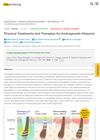
Low-level laser therapy is the most effective for hair loss, but other treatments also show promise.
Accurate diagnosis and new therapies are crucial for effectively treating certain types of hair loss.

Early combination therapy can effectively regrow hair in frontal fibrosing alopecia.
January 2026 in “Journal of Aesthetic Nursing” Combining PRP, light therapy, and microneedling can significantly regrow hair in severe alopecia cases.
July 2025 in “Carolina Digital Repository (University of North Carolina at Chapel Hill)” Low-level laser therapy is the most supported non-drug treatment for hair loss, but combining it with other methods may be promising.
 April 2026 in “Pharmaceutics”
 Cellulose-based skin dressings show promise for wound healing but need more research and clinical trials.
 53 citations
,
September 2007 in “Veterinary dermatology”
53 citations
,
September 2007 in “Veterinary dermatology” Allergic cats with yeast overgrowth improved with antifungal treatment.
50 citations
,
January 2016 in “Journal of the American Academy of Dermatology” Pulse steroid therapy for alopecia areata shows a 43% complete response rate but has a high relapse rate, especially in children.
44 citations
,
August 2014 in “Anais brasileiros de dermatologia/Anais Brasileiros de Dermatologia” Methotrexate is a promising and safe treatment for severe alopecia areata, with better results when combined with corticosteroids.
38 citations
,
January 2013 in “Dermatology” Careful patient selection is key for effective pulse corticosteroid treatment in children with alopecia areata.
33 citations
,
October 2014 in “Veterinary Dermatology” Epidermolysis bullosa is a genetic disease causing fragile skin and blisters in both animals and humans.