Search
for
Sort by
Research
450-480 / 1000+ resultsresearch Recurrent Priapism after Initiation of Oral Minoxidil
Oral minoxidil may cause priapism, especially in people with certain health conditions.
research Application of microneedle patches for drug delivery; doorstep to novel therapies
Microneedle patches could replace injections but need more development for better use in medicine.

research Microneedles self-implanting Astragalus polysaccharides-hybridized composite hydrogel combined with minoxidil to enhance in situ anti-androgenetic alopecia.
Microneedles with Astragalus and minoxidil improve hair growth.

research Analysis on the treatment compliance of patients with androgenetic alopecia and its influencing factors: based on the comparison between microneedle therapy and drug therapy
Microneedling therapy leads to better treatment adherence than drug therapy for hair loss.
research Combining rapid degrading microneedles with Slow-Released drug delivery system for the treatment of alopecia areata
A new microneedle patch treats hair loss effectively with fewer side effects and less frequent use.
research Naringin Promotes Hair Regeneration via Wnt/β-catenin Pathway: A Dose-Dependent Study in C57BL/6J Mice
Naringin from citrus fruits can significantly promote hair growth better than minoxidil.
research Characterization and management of hypertrichosis induced by low-dose oral minoxidil in the treatment of hair loss
Low-dose oral minoxidil for hair loss can cause mild excessive hair growth, usually appearing within the first 3 months, but it can be managed by adjusting the dose or removing the unwanted hair, with most people not needing to stop the treatment.
research [The effect of nizoral on the function of the hypothalamo-hypophyseal-ovarian system in virilism].
Nizoral improved menstrual cycles and reduced hair growth in patients with hyperandrogenism.
research Monthly versus quarterly dutasteride mesotherapy for male androgenetic alopecia: A randomized trial
research Nitroglycerin in Dermatology
Nitroglycerin ointment is now used to treat several skin conditions with fewer side effects.
research Effectiveness of Topical Minoxidil (5%) Plus Topical Finasteride (0.1%) Fixed-Dose Combination Versus Topical Minoxidil (5%) Plus Oral Finasteride (1 Mg/Day) in Grade II-IV Androgenetic Alopecia: A Randomized, Double Blind Clinical Trial

research Minoxidil nanoliposomes as a hair growth stimulator and a scalp disinfectant.
Minoxidil nanoliposomes boost hair growth and reduce scalp bacteria better than regular minoxidil.

research Microneedles as the technique of drug delivery enhancement in diverse organs and tissues
Microneedles improve drug delivery in various body parts, are safe and painless, and show promise in cosmetology, vaccination, insulin delivery, and other medical applications.
research A randomized controlled, single-observer blinded study to determine the efficacy of topical minoxidil plus microneedling versus topical minoxidil alone in the treatment of androgenetic alopecia
Combining microneedling with minoxidil is more effective for hair growth than using minoxidil alone.
research Formulation optimization, in vitro and in vivo evaluation of niosomal nanocarriers for enhanced topical delivery of cetirizine
Niosomes can effectively deliver cetirizine topically for treating alopecia.
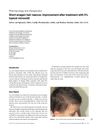
research Short anagen hair naevus: improvement after treatment with 5% topical minoxidil
Using 5% topical minoxidil improved and normalized the hair growth in a girl with short anagen hair naevus.
research ODP342 Panhypopituitarism Induced by CTLA-4 and PD-1/PD-L1 Inhibitor Immunotherapy
Immunotherapy for cancer caused a patient to develop a condition affecting hormone production, requiring ongoing hormone replacement therapy.
research α‐Difluoromethylornithine, a polyamine inhibitor: its potential role in controlling hair growth and in cancer treatment and chemo‐prevention
DFMO may help control hair growth and treat cancer.

research Microneedling kombinasi minoksidil 5% dengan steroid sistemik dan topikal pada pasien alopesia areata: laporan kasus
The combination therapy improved severe alopecia areata in a patient after 14 days.
research Acquired Generalized Hypertrichosis Due to Diazoxide
A 6-year-old boy developed excessive hair growth after taking diazoxide for low blood sugar.
research Film-trigger applicator (FTA) for improved skin penetration of microneedle using punching force of carboxymethyl cellulose film acting as a microneedle applicator
The film-trigger applicator improves microneedle skin delivery and drug efficiency using simple finger force.
research Alopecic and aseptic nodules of the scalp: A new case with a systematic review of the literature
Alopecic and aseptic nodules of the scalp are rare, treatable, and often resolve with doxycycline or on their own.

research Successful management of Netherton syndrome using IVIG and dupilumab: A case report
A young boy with Netherton syndrome improved significantly using IVIG, dupilumab, and dietary changes.
research 311 Novel Penile Ultrasound Technique to Explain Mechanism of Erectile Dysfunction (ED) in Young Patients using Finasteride for Androgenic Alopecia
Ultrasound shows 96% of young men with erectile dysfunction after using finasteride have abnormal penile tissue.
research Advances in clinical applications of microneedle
Microneedles improve drug delivery, patient compliance, and have potential in cancer treatment and skin care.
research Clinical Efficacy, Cosmetic Acceptability, and Local Tolerability of a New Formulation of Topical 5% Minoxidil without Propylene glycol: A 6-month, Multicentre, Real-life, Prospective, Assessor-Blinded Study in 196 Subjects with Hair Loss. The andldquo;NOMINALandrdquo; Trial
The new 5% minoxidil formulation without propylene glycol effectively promotes hair growth with fewer side effects and better user satisfaction.
research Dutasteride-loaded nanostructured lipid carrier for androgenic alopecia treatment - An in vivo study.
Nanostructured lipid carriers can improve androgenic alopecia treatment by reducing dutasteride dosage and maintaining its presence in hair follicles longer.

research Effects of Skin Environmental Changes by Steam Towel, Ethanol, l-Menthol and Carpronium on the Drug Behavior in the Minoxidil Nanoparticles-applied Mice
Using a steam towel, l-menthol, and carpronium before applying minoxidil nanoparticles can increase its absorption and potentially improve hair growth.
research Restoration of hair growth with topical diphencyprone in mouse and rat models of alopecia areata
Topical diphencyprone helped regrow hair in mice and rats with a condition similar to human hair loss.