1 citations
,
January 2019 in “PubMed” cgVEGF164 boosts hair follicle growth in mice.
8 citations
,
March 2023 in “British Journal of Dermatology” Next-generation sequencing greatly improves understanding and treatment of genetic hair disorders.
231 citations
,
December 1999 in “Journal of Investigative Dermatology” Hair follicle size is mainly influenced by the number of cells and extracellular matrix volume, with cell number having a larger impact.
 May 2014 in “JAMA Dermatology”
 Mother and son diagnosed with a rare genetic hair loss condition with no effective treatment.
 July 2014 in “Faculty Opinions – Post-Publication Peer Review of the Biomedical Literature”
 Applying valproic acid on the scalp increased hair growth in men with hair loss.
 19 citations
,
February 2013 in “The American Journal of Dermatopathology”
19 citations
,
February 2013 in “The American Journal of Dermatopathology” Nonscarring alopecia has higher hair density than scarring alopecia, and hair density can help diagnose the type of alopecia.
 13 citations
,
April 2020 in “Experimental Cell Research”
13 citations
,
April 2020 in “Experimental Cell Research” PCAT1 helps hair growth by controlling miR-329/Wnt10b.

The natural compound VB-1, found in a Chinese herb, can promote hair growth by boosting cell activity in human skin cells.
 4 citations
,
January 2017 in “Annals of Dermatology”
4 citations
,
January 2017 in “Annals of Dermatology” Frequent hairdryer use may worsen hair fragility in people with Pili Annulati.
 96 citations
,
October 2000 in “The FASEB Journal”
96 citations
,
October 2000 in “The FASEB Journal” The p75 neurotrophin receptor is important for hair follicle regression by controlling cell death.
September 2025 in “British Journal of Dermatology”  February 2022 in “Chinese Journal of Dermatology”
 A 36-year-old woman with worsening hair loss over 10 years was treated with various medications, and after six months, her hair loss did not worsen significantly.
 3 citations
,
May 2008 in “Hair transplant forum international”
3 citations
,
May 2008 in “Hair transplant forum international” Common hair loss disorders may not need stem cell therapy, but could benefit from other treatments like hair cycle control and immune restoration therapy.
 234 citations
,
December 1996 in “Journal of The American Academy of Dermatology”
234 citations
,
December 1996 in “Journal of The American Academy of Dermatology” Middle-aged women with chronic telogen effluvium experience increased hair shedding but usually don't get significantly thinner hair.
 April 2024 in “Clinical dermatology review (Print)”
 Trichoscopy is an effective, noninvasive method for early diagnosis of Female Pattern Hair Loss.
46 citations
,
April 1971 in “American Journal of Clinical Nutrition” Lack of protein causes hair root damage, but it can be reversed by eating protein again.
4 citations
,
April 2018 in “The journal of pediatrics/The Journal of pediatrics” A 6-year-old girl's inability to grow her hair long was due to Loose Anagen Hair Syndrome, which causes hair to shed easily and may improve with age.
61 citations
,
March 1966 in “Archives of Dermatology” Nevoid basal cell carcinomas start in the skin and hair follicles.
 October 2021 in “Research Square (Research Square)”
 Hair follicle stem cells in hairpoor mice are disrupted, causing hair loss.
 13 citations
,
May 2022 in “Cell discovery”
13 citations
,
May 2022 in “Cell discovery” The study found new details about human hair growth and suggests that preventing a specific biological pathway could potentially treat hair graying.
 January 2025 in “Dermatology Practical & Conceptual”
 Perinevoid alopecia can be effectively treated with non-invasive corticosteroids.
 19 citations
,
August 2013 in “Facial Plastic Surgery Clinics of North America”
19 citations
,
August 2013 in “Facial Plastic Surgery Clinics of North America” Children's hairlines change shape as they grow, with women often developing a widow's peak and men's hairlines becoming more convex and possibly balding at the temples, influenced by genetics and hormones.
April 2012 in “Journal of evolution of medical and dental sciences” No effective treatment exists to stimulate hair growth in atrichia with papular lesions.
 1 citations
,
July 2018 in “Elsevier eBooks”
1 citations
,
July 2018 in “Elsevier eBooks” Triple horizontal scalp biopsies are 98% accurate in diagnosing hair loss, better than single biopsies.
37 citations
,
August 1999 in “Journal of Investigative Dermatology” A specific gene mutation causes complete hair loss without other health issues.
 58 citations
,
September 2012 in “Dermatologic Clinics”
58 citations
,
September 2012 in “Dermatologic Clinics” Male pattern hair loss caused by follicular miniaturization; early diagnosis and treatment can reduce psychological burden.
 8 citations
,
January 2020 in “International Journal of Trichology”
8 citations
,
January 2020 in “International Journal of Trichology” Different patterns on the scalp help diagnose types of hair loss without needing a biopsy.
1 citations
,
August 2020 The Shaven mutation in mice affects hair growth and causes a greasy coat due to abnormal lipid content.
July 2024 in “Journal of Investigative Dermatology” Versican in dermal papilla cells is crucial for healthy hair growth.
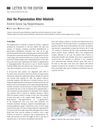 April 2025 in “Turkish Journal of Hematology”
 Nilotinib may cause gray hair to return to its original color.